

Understanding satiation is crucial for behavior analysts working to maintain effective reinforcement systems. This motivating operation directly impacts how we design interventions and interpret client behavior. When a reinforcer loses its effectiveness due to recent consumption, we’re observing satiation in action.
Table of Contents
- Satiation in ABA: What is Satiation in Applied Behavior Analysis?
- Satiation in Practice: Worked ABA Examples
- Satiation on the BCBA Exam: Relevance and Common Traps
- Clinical and Ethical Considerations for BCBAs
- Quick Reference Checklist for Satiation
- Final Summary
Satiation in ABA: What is Satiation in Applied Behavior Analysis?
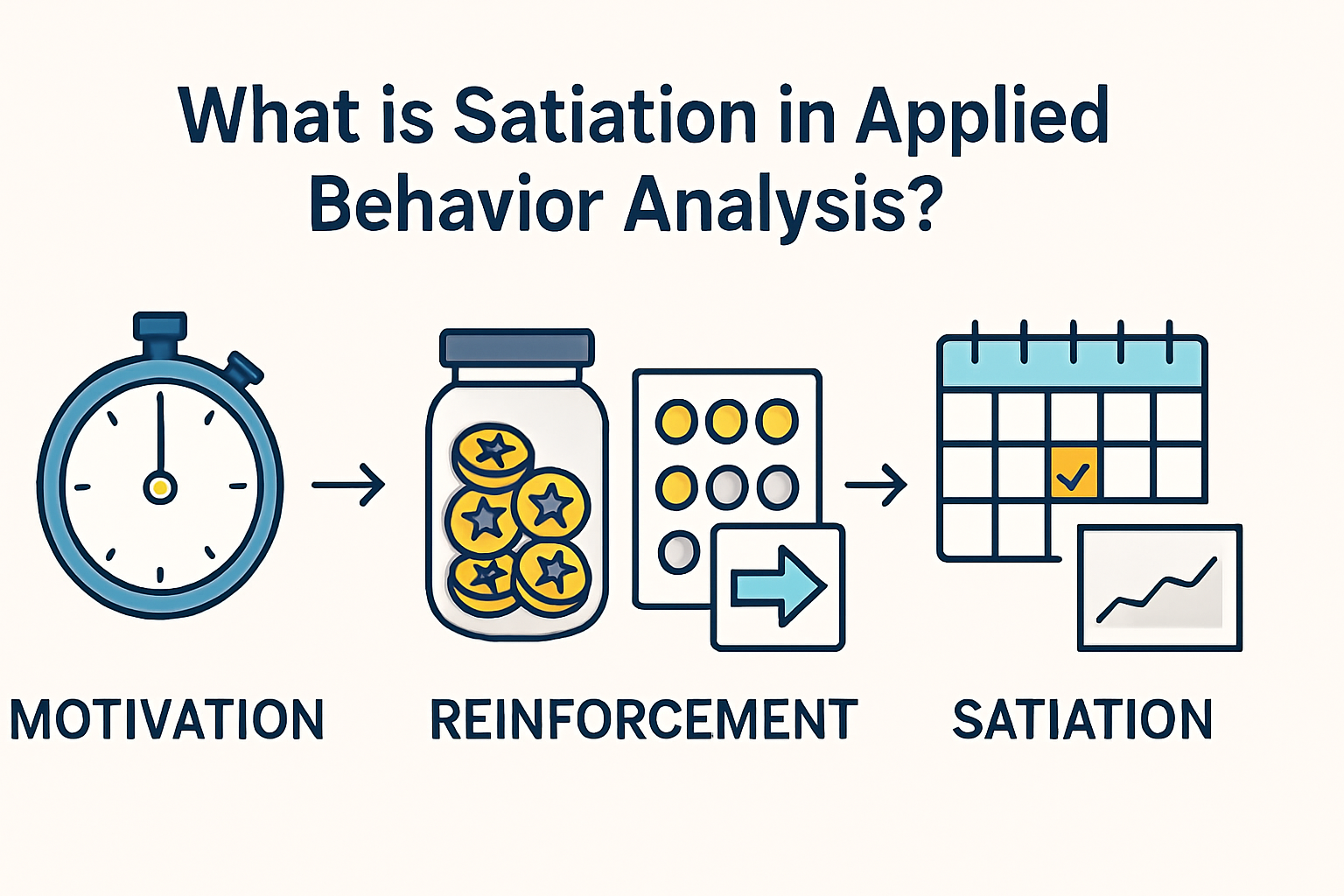
In Applied Behavior Analysis, satiation refers to a specific type of motivating operation that decreases the reinforcing effectiveness of a stimulus. This occurs when an individual has recently consumed or experienced that stimulus to the point where its value diminishes.
The Formal Definition and Key Characteristics
Satiation is formally defined as an abolishing operation that temporarily reduces the reinforcing value of a stimulus. The key mechanism involves recent consumption or presentation making the stimulus less desirable. Think about food after a large meal – even your favorite dessert might not seem appealing when you’re already full.
This differs fundamentally from deprivation, which increases a stimulus’s reinforcing value. Satiation operates on a continuum, with effects that can vary based on individual history and context.
Satiation vs. Deprivation: The Critical Pairing
These two motivating operations represent opposite ends of the same continuum. Understanding their differences is essential for effective behavior analysis.
- Satiation decreases reinforcer effectiveness while deprivation increases it
- Satiation follows recent consumption; deprivation follows absence
- Both are temporary states that influence current behavior
- Effective programming requires managing both conditions
Satiation in Practice: Worked ABA Examples
Real-world examples help clarify how satiation operates in clinical settings. Each scenario demonstrates the practical implications of this concept.
Example 1: The Snack Break and Work Refusal
A client receives their preferred snack immediately before a work session. When demands are presented, the client engages in elopement behavior rather than completing tasks.
- Antecedent: Recent consumption of preferred food items
- Behavior: Elopement from work area
- Consequence: Escape from demands
- Analysis: Satiation on food decreased its value as a reinforcer for compliance
Example 2: Praise Overload During Social Skills
During a social skills drill, a therapist provides enthusiastic praise for every correct response. Over time, the client’s correct responding decreases despite continued praise delivery.
- Antecedent: Continuous, high-intensity social praise
- Behavior: Decreasing correct responses
- Consequence: Continued praise delivery
- Analysis: Social reinforcement lost effectiveness due to satiation
Example 3: Managing Satiation in a Token Economy
A client immediately exchanges all earned tokens for extended tablet access. For the remainder of the session, they show no interest in earning additional tokens.
- Antecedent: Recent extended access to high-preference activity
- Behavior: Lack of engagement with token system
- Consequence: No additional token earning
- Analysis: Satiation on the backup reinforcer reduced token value
Satiation on the BCBA Exam: Relevance and Common Traps
Exam questions frequently test your ability to identify satiation and distinguish it from similar concepts. Understanding these distinctions is crucial for success.
How Exam Items Frame Satiation Questions
Typical question stems ask you to identify which motivating operation is in effect or explain why a previously effective reinforcer lost its power. These questions often present brief scenarios similar to our worked examples.
You might encounter questions about reinforcer sampling procedures or need to differentiate satiation from other variables affecting behavior. Always look for evidence of recent consumption or presentation.
Frequent Misconceptions and Wrong Answer Choices
Several common traps can lead to incorrect answers on satiation questions. Being aware of these helps you avoid mistakes.
- Confusing satiation with extinction – extinction involves no reinforcement delivery
- Mistaking habituation – sensory adaptation rather than motivational change
- Overlooking deprivation – the opposite motivating operation
- Misidentifying punishment – which decreases future behavior, not reinforcer value
Clinical and Ethical Considerations for BCBAs
Managing satiation effectively is both a clinical skill and an ethical responsibility. Proper handling ensures interventions remain effective and clients experience success.
Preventing and Managing Satiation in Treatment Plans
Effective behavior analysts implement strategies to prevent satiation from undermining intervention effectiveness. These practical approaches maintain reinforcement value over time.
- Use varied reinforcers within and across sessions
- Monitor consumption of preferred items and activities
- Implement stimulus pairing procedures to establish new reinforcers
- Schedule reinforcement appropriately based on client satiation patterns
- Conduct regular preference assessments to identify current motivators
The Ethical Imperative of Effective Reinforcement
The BACB Ethics Code emphasizes using effective procedures (Code 2.09) and maximizing reinforcement (Code 4.10). Managing satiation directly supports these ethical obligations by ensuring interventions produce meaningful behavior change.
When reinforcers lose effectiveness due to satiation, behavior analysts must adapt their approach. This might involve identifying new reinforcers through systematic assessment or adjusting reinforcement schedules. For more on ethical practice, see our guide on ethics in ABA practice.
Quick Reference Checklist for Satiation
Use this checklist to identify and address satiation in clinical practice and exam scenarios.
- Look for evidence of recent consumption or presentation
- Check if previously effective reinforcers are losing power
- Differentiate from extinction (no reinforcement delivered)
- Consider deprivation as the opposite condition
- Implement reinforcement variety strategies
- Monitor and adjust based on ongoing assessment
Final Summary
Satiation represents a critical motivating operation that behavior analysts must understand and manage. By decreasing reinforcer effectiveness through recent consumption, it directly impacts intervention success. Recognizing satiation in practice, distinguishing it from similar concepts on exams, and implementing prevention strategies are essential skills for effective practice.
For further study on related concepts, explore our resources on motivating operations and preference assessments. The official BACB Ethics Code provides additional guidance on ethical reinforcement practices.


