
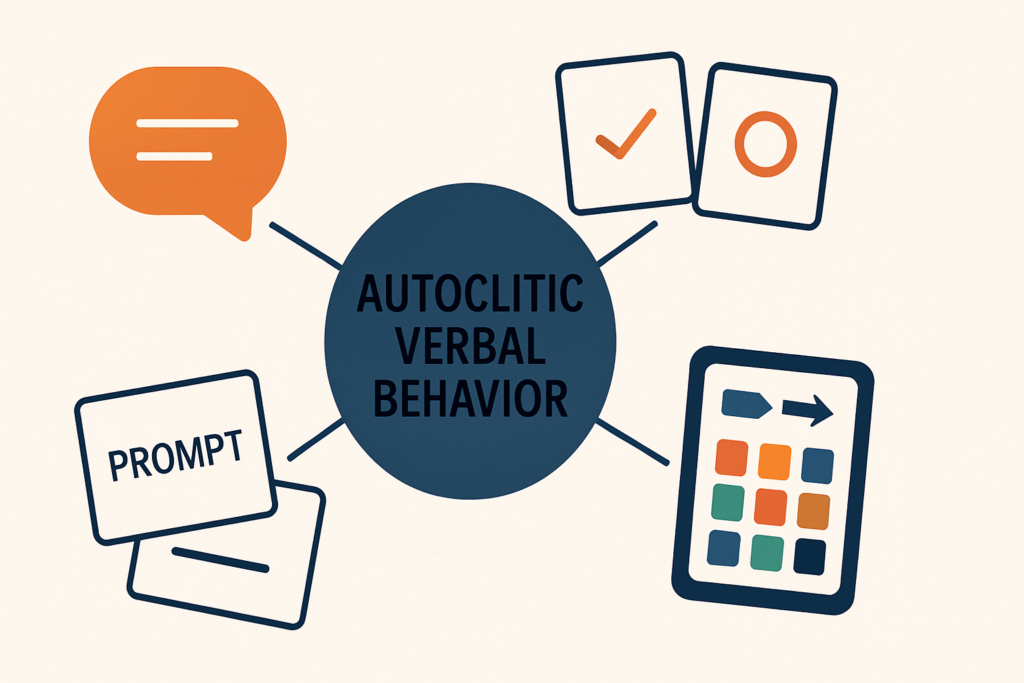
What is Autoclitic Verbal Behavior?
In verbal behavior analysis, autoclitic verbal behavior represents a sophisticated form of communication that modifies how listeners interpret other verbal responses. B.F. Skinner introduced this concept to explain how speakers add layers of meaning to their primary statements.
Table of Contents
- What is Autoclitic Verbal Behavior?
- Autoclitic ABA in Practice: Analysis and Examples
- Autoclitics and the BCBA Exam: What You Must Know
- Quick-Reference Checklist and Summary
An autoclitic functions as verbal behavior about verbal behavior, providing context, qualification, or emphasis to the main message being conveyed.
Skinner’s Definition and Key Characteristics
Skinner defined autoclitics as verbal responses that modify the effect of other verbal behavior on the listener. These responses are dependent on a primary verbal operant and serve to clarify, strengthen, or qualify the speaker’s message.
Key characteristics include:
- Dependency on primary responses: Autoclitics cannot stand alone; they require a primary verbal operant to modify
- Listener effect alteration: They change how the listener responds to the primary statement
- Multiple types: Include descriptive, qualifying, quantifying, and relational autoclitics
- Response to own behavior: The speaker responds to their own verbal behavior with additional verbal behavior

Autoclitics vs. Other Verbal Operants: A Quick Comparison
Understanding how autoclitics differ from other verbal operants is crucial for accurate analysis. While mands, tacts, and intraverbals serve primary functions, autoclitics frame or comment on these responses.
- Mands: Request or demand reinforcers (“I want cookie”)
- Tacts: Label or describe environmental features (“That’s red”)
- Intraverbals: Respond to others’ verbal behavior (Answering questions)
- Autoclitics: Modify primary operants (“I think I want the cookie”)
The critical distinction lies in whether the verbal behavior modifies other verbal behavior from the same speaker versus serving as a primary response itself.
Autoclitic ABA in Practice: Analysis and Examples
Applying autoclitic analysis in ABA practice requires careful observation of how verbal responses influence listener behavior. These examples demonstrate practical applications with ABC analysis and hypothesized functions.
Example 1: The Qualifying Autoclitic in a Social Context
Consider a child presented with two toy choices. The child says, “Maybe I want the blue one.” Here, “maybe” functions as a qualifying autoclitic that modifies the primary mand.
- Antecedent: Choice between two toys offered
- Behavior: “Maybe I want the blue one”
- Consequence: Reduced social commitment if choice is incorrect
The hypothesized function involves mitigating social risk or avoiding definitive statements that could lead to correction or disapproval. This autoclitic allows the child to maintain flexibility in their response.
Example 2: Descriptive Autoclitics and Listener Action
A therapist observes a client successfully completing a difficult task and says, “Honestly, you did great on that trial.” The word “honestly” serves as a descriptive autoclitic modifying the primary tact.
- Antecedent: Client’s successful task completion
- Behavior: “Honestly, you did great on that trial”
- Consequence: Increased credibility of praise and potential reinforcement effect
The function involves strengthening the effect of the praise on the listener by emphasizing sincerity. This autoclitic enhances the reinforcing value of the therapist’s statement.
Example 3: Quantifying Autoclitics in Mand Frames
A client approaches the snack table and says, “I need two cookies, please.” The word “two” functions as a quantifying autoclitic within the mand frame.
- Antecedent: Desire for cookies and presence of multiple cookies
- Behavior: “I need two cookies, please”
- Consequence: Receives exactly two cookies
The function is to specify the magnitude of the mand, providing precise information about the desired quantity. This autoclitic helps ensure the listener delivers the correct amount.
Autoclitics and the BCBA Exam: What You Must Know
Mastering autoclitic concepts is essential for success on the BCBA examination, particularly in the verbal behavior domain. Questions often test your ability to identify, analyze, and distinguish these complex verbal responses.
Task List Alignment and Common Question Formats
Autoclitics align with Section B-14 of the BACB Task List, which covers verbal behavior concepts. Exam questions typically follow several formats that require specific analytical skills.
- Identification questions: “Which word in the following statement functions as an autoclitic?”
- Distinction questions: “How does this autoclitic differ from an intraverbal response?”
- Function analysis: “What is the hypothesized function of the autoclitic in this scenario?”
- Multiple choice applications: Selecting the correct autoclitic type from given examples
For comprehensive exam preparation, review our verbal operants guide to strengthen your understanding of related concepts.
Top 3 Exam Traps to Avoid
Many candidates lose points on autoclitic questions due to common misunderstandings. Recognizing these traps can significantly improve your exam performance.
- Confusing autoclitics with intraverbals: Remember that autoclitics modify the speaker’s own verbal behavior, while intraverbals respond to others’ verbal behavior
- Overlooking subtle autoclitics: Common examples like “I think,” “probably,” “certainly,” “honestly,” and “maybe” are easily missed in analysis
- Misidentifying the primary operant: Failing to correctly identify which verbal operant the autoclitic is modifying leads to incorrect classifications
Understanding radical behaviorism principles provides essential context for analyzing verbal behavior concepts.
Quick-Reference Checklist and Summary
Use this practical checklist to quickly identify autoclitic verbal behavior in clinical observations and exam scenarios. This tool helps streamline your analysis process.
Autoclitic Identification Checklist
- Is it verbal behavior? Confirm the response involves language or symbolic communication
- Does it comment on other verbal behavior? Determine if it modifies another verbal response from the same speaker
- Does it change listener response? Assess whether it alters how the listener interprets the primary statement
- Is it dependent on primary response? Verify it cannot function independently of the main verbal operant
- Does it fit autoclitic types? Check if it serves descriptive, qualifying, quantifying, or relational functions
Key Takeaways for Your Study Notes
Autoclitic verbal behavior represents a sophisticated layer of communication that requires careful analysis. These key points summarize essential concepts for your BCBA preparation.
- Autoclitics are modifiers that frame or qualify primary verbal responses
- They are dependent on primary operants and cannot function independently
- Understanding autoclitics is crucial for analyzing nuanced communication in clinical settings
- Mastery of these concepts is required for the verbal behavior section of the BCBA exam
- Practice identifying subtle examples like “I believe,” “possibly,” and “definitely” in various contexts
For additional study resources, explore our BCBA exam prep guide to develop a comprehensive study strategy. The official BACB Task List provides the authoritative framework for all exam content.


