Negative punishment in ABA is one of the most important—and most misunderstood—concepts in applied behavior analysis (ABA) practices. Many people hear “punishment” and picture scolding, yelling, or harsh consequences. In ABA, punishment has a specific meaning. It refers to a behavior that decreases because of what happens right after it.
Specifically, it means that taking away something valuable after a behavior occurs makes that behavior less likely. This idea appears on the BCBA® exam. It comes up in questions about punishment, time-out, response cost, ethics, and treatment planning. You can see this in daily life. Learners often lose access to tokens, games, privileges, or screen time after behaving badly.
For a broader overview of how punishment fits into treatment, you can also read “Punishment in ABA: Ethical Use, Side Effects, and How It’s Tested on the BCBA® Exam” here:
https://bcbamockexam.com/punishment-in-aba-ethics-side-effects-bcba-exam/
This guide explains it in ABA using simple language and everyday examples. You will learn how it is different from negative reinforcement and positive punishment. You will also see how ABA methods like time-out and response cost work.
Finally, you will understand how exam questions present positive and negative reinforcement, as well as positive and negative punishment. This will help you choose the best answer. For official task-list and exam information, you can always check the BACB website:
https://www.bacb.com/
What Is Negative Punishment in ABA?
Definition (task-list style)
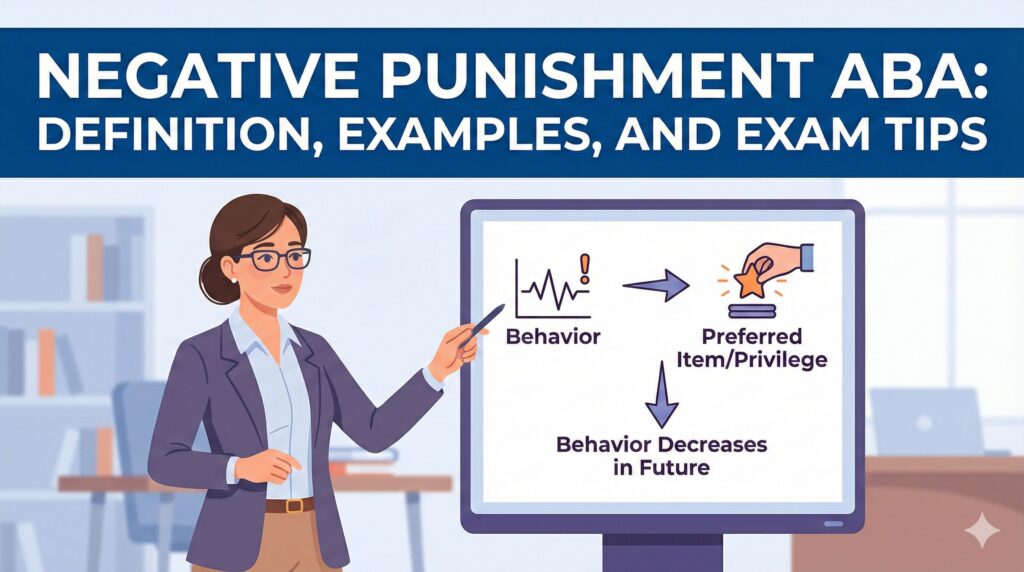
Negative punishment happens when a behavior goes down in the future. This occurs because someone takes away something liked or valuable right after the behavior.
-
Negative = something is taken away
-
Punishment = the behavior occurs less often in the future
In practical terms, it decreases the likelihood that the behavior will happen again. If the behavior does not happen less over time, it is not negative punishment. This is true even if you take away a token, privilege, activity, or access to a reward. In ABA, we define procedures by their effect on the likelihood of that behavior, not by how “strict” they seem.
Basic pattern in operant conditioning
In operant conditioning, it follows this pattern:
-
A behavior occurs (the behavior occurring is the target response).
-
Someone removes a preferred item (token, game, privilege, attention, activity).
-
In similar situations, the behavior is less likely to occur again.
ABA cares less about how “harsh” the consequence looks and more about what happens to behavior. If removing something makes the behavior decrease, you are dealing with a type of punishment: negative punishment.
What the terms “positive” and “negative” actually mean
A common exam trap is misunderstanding the terms positive and negative. In ABA:
-
“Positive” means something is added.
-
“Negative” means something is removed.
-
Then you decide whether it’s reinforcement or punishment by what happens to behavior.
For a general psychology overview of punishment, you can also see an introductory article such as:
https://www.verywellmind.com/what-is-punishment-2795413
Negative Punishment vs Negative Reinforcement
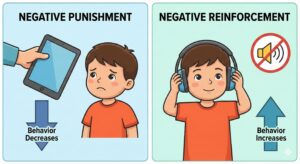
“Negative reinforcement vs negative punishment” is a classic BCBA® exam trap. Both include the word “negative” (something is removed), but they create opposite effects on behavior.
Negative reinforcement
Negative reinforcement occurs when a behavior increases because it removes or reduces an aversive stimulus.
Example: A student wears noise-cancelling headphones. The loud classroom noise (an unpleasant sound) goes down. The student then uses the headphones more often.
The behavior increases, so this is reinforcement.
Negative punishment
It occurs when a behavior decreases because it produces the loss of a preferred stimulus.
Example: A student hits a peer → loses 5 minutes of recess → hitting decreases over time.
The behavior decreases, so this is punishment.
BCBA® exam shortcut:
-
If behavior goes up → reinforcement (positive or negative).
-
If behavior goes down → punishment (positive or negative).
-
“Negative” only tells you something was removed.
If you want more practice with reinforcement concepts, you can also read about positive reinforcement here:
https://bcbamockexam.com/positive-reinforcement-aba-definition-examples/
Negative Punishment vs Positive Punishment
Both negative and positive punishment decrease behavior, but they do it differently.
Positive punishment
A behavior decreases when something is added after it. This is often an unpleasant consequence, like a reprimand, extra chores, or brief physical guidance.
Example: A learner shouts in class → teacher gives a firm reprimand → shouting decreases.
Negative punishment
A behavior decreases because something preferred is removed after it (e.g., token, screen time, privilege, access to a game).
Example: A teen slams a door → parent removes car privileges for the weekend → door slamming decreases.
Exam cue:
-
Positive punishment → add something unpleasant; behavior decreases.
-
Negative punishment → remove something pleasant; behavior decreases.
For a focused comparison of positive vs negative punishment, see:
https://bcbamockexam.com/positive-vs-negative-punishment-aba/
Everyday Examples of Negative Punishment
Here are simple examples you can use for sessions, parent coaching, or BCBA® exam practice.
Token loss for aggression
-
Behavior: A student hits a peer during group work.
-
Consequence: The teacher removes one token from the student’s behavior chart.
-
Future effect: Hitting decreases across the next several weeks.
→ Token loss functions as negative punishment if it reduces the behavior (i.e., decreases undesired behaviors).
Loss of screen time for swearing
-
Behavior: A learner swears at a sibling during an argument.
-
Consequence: The caregiver removes 10 minutes of evening screen time.
-
Future effect: Swearing occurs less often.
→ Removal of screen time is negative punishment if it reduces swearing.
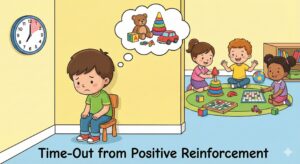
Time-out from positive reinforcement
-
Behavior: During a preferred group game, a learner repeatedly grabs toys from peers.
-
Consequence: The therapist removes the learner from the game for 2 minutes (time-out from reinforcement), then allows return.
-
Future effect: Toy grabbing decreases during the game across sessions.
They briefly remove access to the reinforcing game. If this reduces grabbing, it functions as negative punishment.
BCBA® exam-style example (response cost)
A BCBA designs a level system. Following rules earns points toward weekend outings. Property destruction results in removal of points. Over several weeks, property destruction decreases.
→ This is response cost, a form of negative punishment.
Types of Negative Punishment in ABA
Two common negative punishment procedures in ABA are response cost and time-out from positive reinforcement.
Response cost
Response cost removes a specific amount of a reinforcer contingent on a behavior.
Examples:
-
Losing tokens after breaking a rule
-
Losing points for aggression or noncompliance
-
Losing part of an allowance for repeated violations
To be response cost, the removal must be linked to the behavior and reduce that behavior over time.
Time-out from positive reinforcement
Time-out removes access to reinforcement for a brief period following a behavior. Time-out is negative punishment when:
-
The original environment is actually reinforcing, and
-
Removal leads to a behavior decrease
If the time-out area contains equal or more reinforcement (attention, preferred items), it may not function as punishment.
Using Negative Punishment in ABA Treatment Planning
It can be part of evidence-based plans, but it should be used carefully and ethically. Punishment can help reduce behavior in some cases. However, it should not be the only method used. Strong reinforcement strategies are typically the foundation—because they increase desired behaviors and build lasting skills.
If you are building a broader study plan around reinforcement and punishment procedures, you can explore additional BCBA® exam materials here:
https://bcbamockexam.com/exam-study-materials/
Start with assessment and function
Before any punishment procedure, conduct an FBA. If escape (negative reinforcement) maintains behavior, removing tokens may have limited impact. Match the plan to function.
Pair with strong reinforcement for alternatives
Use differential reinforcement (DRA/DRI/DRO) alongside it. Reinforce replacement behaviors heavily so the learner contacts more reinforcement for good behaviors than for problem behavior.
Make rules clear and predictable
Caregivers and learners should know exactly what leads to loss of tokens, points, privileges, or screen time. Vague or inconsistent procedures can create confusion and frustration.
Monitor side effects and social validity
Punishment procedures can produce side effects such as emotional responding, avoidance, or aggression. Monitor both target behavior and collateral behavior, and check acceptability with families/teams.
Fade punishment over time
As good behavior increases and problem behavior decreases, slowly reduce response cost and time-out. Focus more on reinforcement, teaching skills, and natural consequences.
How Negative Punishment Appears on the BCBA® Exam
Look for these patterns:
-
The stem describes a behavior that decreases after a consequence.
-
The consequence involves removing tokens, points, privileges, screen time, or access to preferred activities.
-
The question asks you to label the procedure. You need to choose between negative reinforcement and negative punishment. You can also select an ethical alternative.
If the behavior is happening less often and something preferred is taken away, negative punishment is usually the best label.
If you want to practice these distinctions in full-length exam format, you can try a free mock exam here:
https://bcbamockexam.com/free-bcba-mock-exam/
Common BCBA® Exam Traps with Negative Punishment
Trap 1 — Confusing with extinction
Extinction means the behavior no longer produces the reinforcer that previously maintained it. Negative punishment removes a separate reinforcer after the behavior.
Trap 2 — Confusing with negative reinforcement
In both cases something is removed—so look at behavior change:
-
Behavior increases → negative reinforcement
-
Behavior decreases → negative punishment
Trap 3 — Assuming all time-out is negative punishment
Time-out only functions as punishment if it removes reinforcement and leads to behavior decrease.
Trap 4 — Ignoring ethics and teaching
Test-wise answers usually prioritize reinforcement, teaching replacement skills, and least-restrictive procedures. A punishment-heavy plan without teaching is rarely the best option.
Quick Study Checklist
Before the exam, make sure you can:
-
Define in your own words
-
Distinguish negative reinforcement vs punishment
-
Distinguish negative vs positive punishment and extinction
-
Identify response cost and time-out examples
-
Explain how to pair punishment with strong reinforcement strategies
-
Recognize ethical considerations and monitor side effects
Final Thoughts
Negative punishment in ABA is not “being harsh.” It is a technical process of operant conditioning. In this process, behavior decreases when the learner loses access to something valuable after acting.
When used carefully, negative punishment methods like response cost and time-out can reduce unwanted behaviors. At the same time, a plan full of rewards can boost desired behaviors and strengthen positive actions.
When you can clearly separate reinforcement from punishment, you will be ready for BCBA® exam questions. Understanding what “positive” and “negative” mean will help you create ethical and effective treatment plans.
If you’re preparing for the BCBA® exam and want more structured practice, you can explore BCBA Mock Exam resources and study materials here:
https://bcbamockexam.com/