Negative reinforcement is one of the most misunderstood ideas in ABA.
If you ever googled “negative reinforcement ABA” for the BCBA® exam, you’re not alone.
Many people hear “negative” and think punishment. In ABA, negative reinforcement increases behavior, just like positive reinforcement. However, it does this by removing something unpleasant instead of adding something nice.
This guide explains positive and negative reinforcement with clear definitions, everyday negative reinforcement examples, and BCBA® exam tips. The goal is to help you turn a confusing term into an effective tool you can use with real clients and on test day.
What Is Negative Reinforcement in ABA?
Definition (task-list style)
Negative reinforcement in ABA happens when a behavior increases because it removes, reduces, or postpones an aversive stimulus. In other words, the consequence increases the likelihood of that behavior occurring again.
-
Negative = someone takes something away.
-
Reinforcement = the behavior goes up in the future.
If the behavior does not become more likely, it is not negative reinforcement.
Basic pattern (escape/avoidance style)
In negative reinforcement ABA examples, the pattern usually looks like this:
-
An unpleasant or aversive event is present or signaled.
-
The person engages in a behavior.
-
The aversive event stops, delays, or weakens.
-
Next time, the person is more likely to repeat that behavior in similar situations.
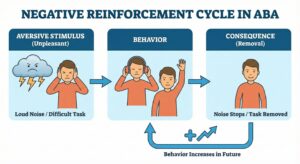
In evidence-based ABA, negative reinforcement is one of many reinforcement strategies. It isn’t “bad” by itself; it depends on how you use it and what behaviors you’re strengthening.
Negative Reinforcement vs Positive Reinforcement in ABA
Both negative reinforcement and positive reinforcement are types of reinforcement. Both increase a desired behavior and can lead to positive outcomes in the long term when used well.
Positive reinforcement in ABA
-
You add something pleasant after the behavior.
-
Example: Child completes a task → gets access to a preferred activity → task completion increases.
This usually builds positive behavior through rewards, praise, or access to preferred items.
Negative reinforcement in ABA
-
You remove something unpleasant when the behavior happens.
-
Example: Child completes a hard worksheet → teacher removes half the remaining problems → worksheet completion increases.
Here, both procedures are types of reinforcement, but they work differently.
For BCBA® exam questions about positive and negative reinforcement, always ask:
-
“What happens to the behavior over time?”
If it increases, you are looking at reinforcement (positive or negative).
If it decreases, you are looking at punishment (positive or negative).
Negative Reinforcement vs Punishment
This “negative reinforcement vs punishment” contrast is a classic BCBA® exam trap.
You can summarize them this way:
-
Negative reinforcement: behavior increases because something aversive is removed.
-
Positive punishment: behavior decreases because something aversive is added.
-
Negative punishment: behavior decreases because something pleasant is removed.
If the stem says that the behavior happens more often to escape or avoid something, think about negative reinforcement first. Don’t automatically assume punishment just because the situation sounds “negative.”
Everyday Negative Reinforcement Examples
Here are simple negative reinforcement examples you can adapt for sessions, supervision, or exam questions.
Seatbelt beeping: a classic negative reinforcement ABA example
-
Aversive stimulus: Car makes a loud beeping sound.
-
Behavior: Driver puts on seatbelt.
-
Consequence: Beeping stops.
-
Future effect: Driver is more likely to put the seatbelt on quickly.
The beeping stopping negatively reinforces seatbelt use. The behavior is escaping an aversive sound.

Homework escape: negative reinforcement in the classroom
-
Aversive stimulus: Long worksheet.
-
Behavior: Student asks for help using a complete sentence.
-
Consequence: Teacher removes half the problems after the request.
-
Future effect: Student is more likely to ask for help appropriately instead of tearing the paper.
Removal of part of the task functions as negative reinforcement for appropriate requesting. If a child often tears up work, teaching a new “ask for help” response can turn escape behavior into something more acceptable.
Noise-cancelling headphones and escape from problem behaviors
-
Aversive stimulus: Loud classroom noise and nearby problem behavior.
-
Behavior: Child independently gets noise-cancelling headphones and puts them on.
-
Consequence: The noise level decreases.
-
Future effect: Child is more likely to use headphones instead of screaming or running away.
Here, the decrease in noise negatively reinforces the replacement behavior and supports more positive behavior in the classroom.
BCBA®-style negative reinforcement exam example
A client often shouts when given a non-preferred chore. When he shouts, staff usually take over and finish the chore for him. Over time, he shouts more often and more quickly when chores appear.
-
Aversive stimulus: Non-preferred chore.
-
Behavior: Shouting.
-
Consequence: Someone removes the chore.
-
Future effect: Shouting increases.
This is negative reinforcement of shouting (escape-maintained behavior), not punishment. On the exam, focus on the behavior occurring more often because the chore goes away.
Types of Negative Reinforcement in ABA: Escape vs Avoidance
For the BCBA® exam, you should be able to distinguish escape and avoidance. Both involve removing or preventing an aversive stimulus.
Escape
-
The behavior stops an ongoing aversive stimulus.
-
Example: Child hands over a “break” card during a hard task → staff pause the task → child increases the use of the break card.
Avoidance
-
The behavior prevents the aversive stimulus from starting.
-
Example: Teen checks assignment list and starts homework early → avoids teacher’s reprimand the next day → early homework starts increase.
Many negative reinforcement ABA questions use warning signals to show avoidance. For example:
“When the teacher walks to his desk with a worksheet, he quickly goes to the small-group table. This way, he rarely gets the worksheet.”
Here, the student is avoiding the task before it begins.
Using Negative Reinforcement in ABA Treatment Planning
In real ABA programs, understanding negative reinforcement in ABA is an effective tool for functional assessment and intervention.
Identify function
Many severe problem behaviors (aggression, self-injury, elopement) happen because individuals escape from tasks, noise, or social demands. Recognizing this escape-maintained function is part of evidence-based practice and functional behavior assessment.
Teach safer alternative behaviors
You can keep negative reinforcement but attach it to a safer replacement behavior, such as:
-
Mands for a break
-
Asking for help
-
Using a schedule, timer, or choice board
Here, reinforcement strategies shift from dangerous responses to safer ones. The client still escapes or avoids the aversive event, but now by using functional communication instead of unwanted behavior.

Use shaping and task adjustments
Break tasks into smaller steps, add prompts, and reinforce approximations. As the child completes easier steps successfully, you can gradually increase difficulty while still providing positive outcomes (like breaks, praise, or reduced demands).
Balance reinforcement and punishment ethically
ABA prioritizes reinforcement-based methods. Knowing the difference between positive reinforcement, negative reinforcement, and punishment helps you create plans that use more reinforcement and less punishment, while still reducing unwanted behavior.
If you’d like structured practice applying these concepts, you can try a free full-length BCBA® mock exam here:
https://bcbamockexam.com/free-bcba-mock-exam/
You can also browse more ABA terms and exam guides in the ABA terms blog section:
https://bcbamockexam.com/category/aba-terms/
How Negative Reinforcement in ABA Appears on the BCBA® Exam
Common patterns in negative reinforcement ABA questions:
“To escape / avoid…” language
-
“The client runs away to avoid…”
-
“The behavior occurs most often right after a demand is presented…”
Increasing behavior plus removal of an aversive event
If the stem says the behavior happens more often after removing a task, noise, or reprimand, think negative reinforcement.
Trick answers that say “punishment”
If behavior increases, it is not punishment. This is true even if the outcome looks negative, such as when nagging stops or a headache goes away.
Treatment questions about escape-maintained behavior
You might see stems like:
“Which intervention would most directly address this escape-maintained behavior?”
Correct options usually:
-
Change the task or task difficulty
-
Teach a functional communication response for breaks or help
-
Adjust schedules of reinforcement so appropriate behavior contacts more reinforcement than problem behavior
When you review ABA terms, it can also help to compare negative reinforcement with positive reinforcement. You can pair this article with your positive reinforcement notes or post on your site to see the full picture of types of reinforcement.
Quick Study Checklist for Negative Reinforcement ABA Questions
Before the exam, make sure you can:
-
Give the definition of negative reinforcement in your own words.
-
Tell the difference between positive and negative reinforcement and not confuse them with punishment.
-
Label escape vs avoidance examples as different types of reinforcement.
-
Explain at least three everyday examples of negative reinforcement.
-
Describe how negative reinforcement can reduce problem behaviors while still supporting positive outcomes in the long term.
One powerful intervention for escape-maintained behavior is functional communication training (FCT):
-
First, teach the person to ask for a break or help when they feel overwhelmed.
-
Next, modify tasks so the person can finish them more easily.
When a child learns to ask for help, they can complete more work. Good behavior links to negative reinforcement instead of shouting or aggression.
Final Thoughts on Negative Reinforcement in ABA
Negative reinforcement in ABA is not about “being negative” or “being mean.”
It is an evidence-based learning process where behaviors grow stronger because they turn off or prevent something unpleasant. When you understand how negative reinforcement works, you can use it in ethical programs that focus on reinforcement and lead to lasting, positive results.
Master this concept and:
-
BCBA® exam questions on negative reinforcement will feel much easier.
-
You’ll be quicker at spotting escape-maintained behavior and choosing the right reinforcement strategies in everyday practice.
For official information about the BCBA® exam and task list, you can also visit the BACB:
https://www.bacb.com