Respondent Behavior vs Operant Behavior: How to Tell Them Apart in Real Life and on the Exam
By BCBA Mock Exam
Introduction
Respondent and operant behavior show up all over the BCBA® exam—often in the same question.
You’re expected to:
-
Know the definition of each
-
Recognize them in real-life style scenarios
-
Understand how consequences relate to operant behavior but not to respondent behavior
-
Identify when a situation involves both respondent and operant components
In this article, we’ll walk through:
-
Clear, exam-ready definitions of respondent and operant behavior
-
Everyday examples you’ll actually see in practice
-
How the two types of behavior interact
-
Common exam traps and mini practice questions with explanations.
1. Big Picture: Two Ways Behavior Is Controlled
In behavior analysis, we usually talk about behavior in two big categories:
Respondent behavior
-
Elicited by antecedent stimuli
-
Often involves reflexes, physiological responses, and emotions
-
Think: “automatic” or “reflexive” reactions
Operant behavior
-
Emitted and then shaped by its consequences
-
Affected by reinforcement and punishment
-
Think: “what we do” to get or avoid things
On the BCBA® exam, many stems quietly ask: “Is this behavior controlled by what happens before (respondent) or by what happens after (operant)?”
2. What Is Respondent Behavior?
Respondent behavior is behavior that is elicited by antecedent stimuli.
Key features:
-
Triggered automatically by certain stimuli
-
Does not require a history of consequences for that specific response to occur
-
Involves reflexes and physiological reactions
Examples of respondent behavior:
-
Pupil constriction in response to bright light
-
Salivation when food is placed in the mouth
-
Startle response to a sudden loud noise
-
Increased heart rate and sweaty palms when entering a dentist’s office (after conditioning)
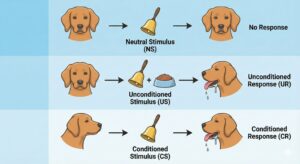
Respondent behavior is influenced by respondent conditioning (classical conditioning):
-
Neutral stimuli become conditioned stimuli (CS) that elicit conditioned responses (CR) after pairing with unconditioned stimuli (US).
Exam hint:
-
If the stem focuses on automatic body reactions (heart rate, sweating, startle, salivation, muscle tension), you’re probably looking at respondent behavior.
3. What Is Operant Behavior?
Operant behavior is behavior that is emitted and then affected by its consequences.
Key features:
-
The probability of the behavior changes based on its history of reinforcement or punishment
-
Controlled by antecedent conditions and consequences (three-term contingency)
-
Often voluntary, flexible, and under stimulus control
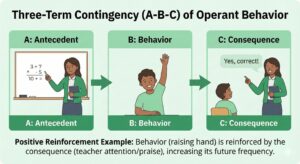
Examples of operant behavior:
-
Asking for a break to escape a hard task
-
Completing homework to earn tokens
-
Pressing a button to turn on music
-
Screaming in the dentist’s chair to escape the procedure
Operant behavior is shaped by:
-
Reinforcement (positive and negative)
-
Punishment (positive and negative)
-
Extinction, schedules of reinforcement, stimulus control, MOs, etc.
Exam hint:
-
If the stem focuses on what happens after the behavior (what the person gets or avoids) and how that changes future responding, you’re in operant territory.
4. Comparing Respondent vs Operant: Key Dimensions
Here’s a simple side-by-side comparison you can keep in mind for the exam:
-
Type of relation
-
Respondent: Stimulus → Response (S–R)
-
Operant: Antecedent → Behavior → Consequence (A–B–C)
-
-
Control
-
Respondent: Controlled primarily by antecedent stimuli (US/CS)
-
Operant: Controlled by consequences (history of reinforcement/punishment), in the context of antecedents and MOs
-
-
Examples
-
Respondent: Heart racing, startle, salivation, sweating
-
Operant: Asking, hitting, working, compliance, problem behavior to escape or gain things
-
-
Learning processes
-
Respondent: Classical conditioning (pairing of stimuli)
-
Operant: Consequence-based learning (reinforcement, punishment, extinction)
-
Exam tip:
-
When a question asks about which process is operating, look at whether the change is due to pairing of stimuli (respondent) or contingencies of reinforcement/punishment (operant).
5. Mixed Real-Life Examples: Both Respondent and Operant
Most real-world situations include both respondent and operant components.
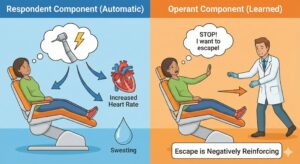
Example 1 – Dentist anxiety
-
Respondent: Heart rate increases (CR) when hearing the drill sound (CS) due to pairing with past painful procedures (US).
-
Operant: The client screams or refuses to sit, and if this behavior repeatedly leads to escape from the procedure, escape is negatively reinforcing the operant behavior.
Example 2 – Fear of dogs
-
Respondent: Automatic fear response (CR) when seeing a dog (CS) after being bitten (US) in the past.
-
Operant: Avoiding parks with dogs, crossing the street, or holding on to a caregiver more tightly; if these behaviors consistently reduce contact with dogs, they’re maintained by negative reinforcement.
Exam tip:
-
Sometimes the stem wants you to identify the respondent piece (e.g., CS/CR).
-
Other times it wants you to analyze the operant piece (what’s maintaining avoidance behavior). Read carefully.
6. How the Exam Asks About Respondent vs Operant Behavior
Common question formats include:
-
“Which of the following is an example of respondent behavior?”
-
“Which of the following involves operant conditioning rather than respondent conditioning?”
-
“This scenario contains both respondent and operant components. Which part is operant?”
-
“Which statement BEST differentiates respondent and operant conditioning in this example?”
Key skills the exam tests:
-
Correctly labeling respondent vs operant processes
-
Identifying whether a response is elicited (respondent) or emitted and selected by consequences (operant)
-
Distinguishing respondent versus operant extinction
-
Recognizing when fear/anxiety is respondent but avoidance behavior is operant.
7. Respondent vs Operant Extinction (Important Discrimination)
Don’t let extinction questions trick you.
Respondent extinction
-
Repeatedly present the CS without the US.
-
The CR becomes weaker or stops.
-
Example: Riding an elevator many times without it getting stuck; fear response decreases.
Operant extinction
-
Stop providing reinforcement for a previously reinforced operant behavior.
-
The behavior decreases over time.
-
Example: Tantrums no longer produce escape from tasks; tantrums decrease.
Exam tip:
-
If the stem is about a stimulus no longer being paired with another stimulus → respondent extinction.
-
If the stem is about a behavior no longer contacting reinforcement → operant extinction.
8. Common BCBA® Exam Traps
Watch for these respondent vs operant pitfalls:
Trap 1 – Calling consequences “respondent”
-
If the question describes a behavior followed by a consequence that changes future behavior, it’s operant, not respondent.
Trap 2 – Treating all emotional behavior as respondent only
-
Feelings like fear may be respondent, but what the client does because of that feeling (escape, avoidance) is often operant.
Trap 3 – Ignoring the word “elicited” vs “emitted”
-
“Elicited” → respondent; “emitted” → operant in exam language.
Trap 4 – Confusing physiological changes with operant behavior
-
Heart racing, sweating, blushing, stomach fluttering – usually respondent.
-
Saying “I’m anxious,” leaving the room, asking for help – usually operant.
Trap 5 – Misreading the focus of the question
-
Some questions ask about the fear response itself (respondent).
-
Others ask about avoidance behavior maintained by escape (operant).
-
Always ask: “Which behavior is the question talking about?”
9. Mini BCBA® Exam–Style Questions (With Explanations)
Question 1 – Respondent or Operant? A child’s heart rate increases and palms become sweaty when they hear the sound of the school fire alarm, due to past experiences with loud drills. Which type of behavior BEST describes the increased heart rate and sweating?
A. Operant behavior maintained by escape B. Respondent behavior elicited by a conditioned stimulus C. Operant behavior maintained by attention D. Respondent behavior maintained by reinforcement
Correct Answer: B Explanation: The physiological reactions (heart rate, sweating) are respondent responses (CR) elicited by a conditioned stimulus (the alarm), based on past pairings with aversive events.
Question 2 – Identifying Operant Behavior A teenager hears the sound of the dental drill (which elicits an automatic fear response) and immediately asks to reschedule the appointment. The dentist agrees, and the teenager’s anxiety decreases.
Which part of this scenario is MOST clearly an example of operant behavior? A. The sound of the dental drill B. The teenager’s increased heart rate C. Asking to reschedule the appointment D. The memory of past dental visits
Correct Answer: C Explanation: Asking to reschedule is an operant behavior that is negatively reinforced by escape from the aversive situation.
Question 3 – Respondent vs Operant Extinction A client developed a fear response to a specific elevator after it once got stuck (US). The therapist has the client ride the same elevator many times without any problems, and the fear response decreases. Later, the client stops pressing the “alarm” button repeatedly when riding the elevator because it no longer results in staff attention.
Which statement is MOST accurate? A. Both the decreased fear and decreased alarm-button pressing are examples of respondent extinction B. The decreased fear is respondent extinction; the decreased alarm-button pressing is operant extinction C. The decreased fear is operant extinction; the decreased alarm-button pressing is respondent extinction D. Both changes are examples of operant extinction
Correct Answer: B Explanation: Fear reduction from repeated CS without US is respondent extinction. Decreased alarm-button pressing because it no longer contacts attention is operant extinction.
Question 4 – Mixed Scenario A child was bitten by a dog in the past. Now, when they see a dog, their heart rate increases and they cling tightly to their parent’s leg. Over time, this clinging behavior is reinforced because the parent immediately removes the child from the area whenever it occurs.
Which is the BEST description of the behaviors in this scenario? A. Both the heart rate increase and clinging are respondent behaviors B. Both the heart rate increase and clinging are operant behaviors C. Heart rate increase is respondent; clinging is operant behavior maintained by negative reinforcement D. Heart rate increase is operant; clinging is respondent
Correct Answer: C Explanation: Heart rate increase is a respondent response to a conditioned stimulus (seeing the dog). Clinging is an operant response that is negatively reinforced by escape from the dog.
10. Key Takeaways
-
Respondent behavior is elicited by antecedent stimuli (US/CS) and includes reflexive and physiological responses.
-
Operant behavior is emitted and selected by its consequences (reinforcement, punishment, extinction).
-
Many real-life situations contain both: a respondent component (automatic reaction) and an operant component (what the person does in response).
-
Respondent extinction involves presenting the CS without the US; operant extinction involves withholding reinforcement for a previously reinforced behavior.
-
On the BCBA® exam, always ask:
-
Is this behavior being controlled by a paired stimulus (respondent) or by its consequences (operant)?
-
Which specific behavior is the question about—the automatic reaction or the escape/avoidance/approach behavior?
-
Clear respondent–operant discriminations will help you avoid traps and confidently answer design, conditioning, and extinction questions on test day.