
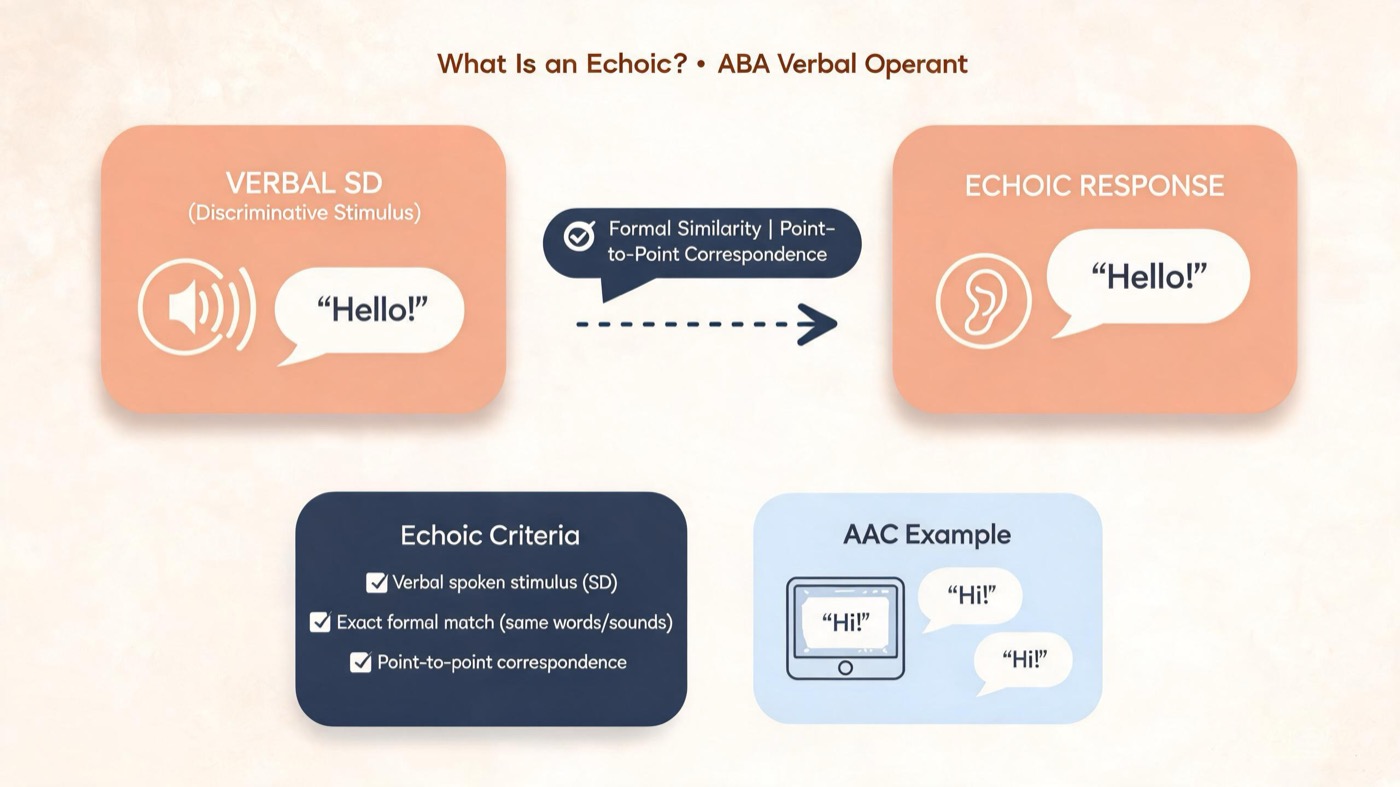
What Is an Echoic? Defining the Verbal Operant
In behavior analysis, an echoic is a verbal operant controlled by a verbal discriminative stimulus (SD) that has point-to-point correspondence and formal similarity with the response. In simpler terms, when someone says something and the learner repeats it (or attempts to), that is an echoic. The antecedent is a spoken word, and the response is a vocal imitation of that word. For example, a therapist says ‘ball’ and the child says ‘ball’.
Table of Contents
- What Is an Echoic? Defining the Verbal Operant
- Echoics in Action: Three Worked ABA Examples
- Common Exam Traps and How to Avoid Them
- Quick Checklist for Identifying Echoics
- Summary: Putting It All Together
- References
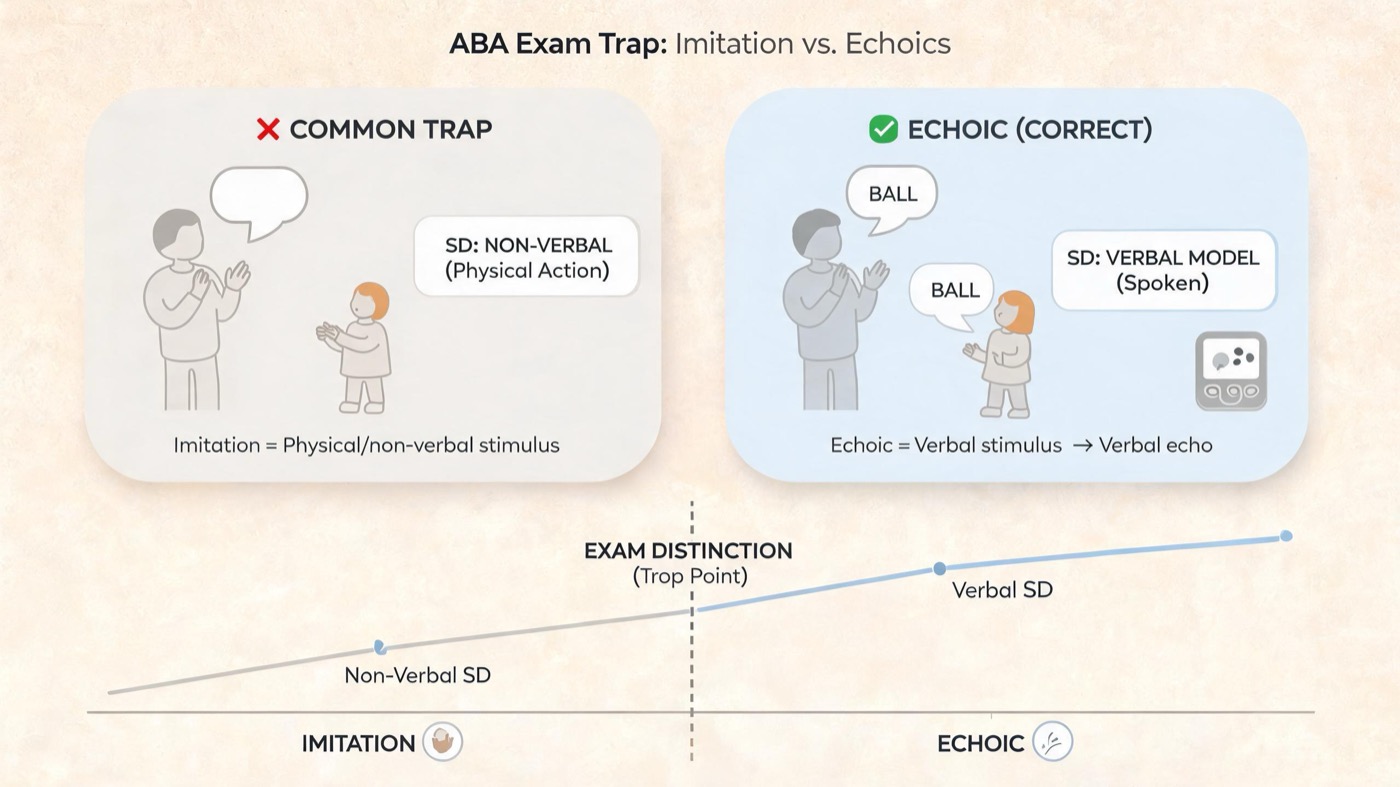
Echoics are distinct from imitation. Imitation involves a non-verbal SD (e.g., a model clapping hands) and a motor response. Echoics require a verbal model. This distinction is tested frequently on the BCBA exam, especially when differentiating among verbal operants.
Echoic vs. Other Verbal Operants
To identify an echoic, compare it to other verbal operants:
- Mand: controlled by a motivating operation (MO); the response benefits the speaker (e.g., saying ‘water’ because thirsty).
- Tact: controlled by a non-verbal stimulus (e.g., seeing a dog and saying ‘dog’).
- Intraverbal: controlled by another verbal statement without point-to-point correspondence (e.g., answering ‘What color is the sky?’ with ‘blue’).
- Echoic: the verbal SD and response match in form (e.g., therapist says ‘cat’, learner says ‘cat’).
On the exam, read the scenario carefully: if the antecedent is a verbal model and the response is a vocal approximation, think echoic.
Why Echoics Matter on the BCBA Exam
Echoics are foundational for building a verbal behavior repertoire. They are often the first step in teaching language to learners with autism or developmental delays. Exam questions may ask you to identify the operant in a given ABC sequence or to distinguish echoics from imitation. Knowing the controlling variables is key: the verbal SD is the critical feature.
Echoics in Action: Three Worked ABA Examples
The best way to master echoics is to practice analyzing real scenarios. Below are three examples with full ABC analysis.
Example 1: Teaching Naming of Objects
A BCBA holds up a ball and says ‘ball’. The learner says ‘ball’. The BCBA says ‘Great!’ and gives a high-five.
- Antecedent (SD): Verbal model ‘ball’ (spoken by BCBA).
- Behavior: Learner says ‘ball’.
- Consequence: Praise and high-five (social positive reinforcement).
- Function: The behavior is controlled by the verbal SD, making this an echoic.
Example 2: Echoic During Play
During toy play, a parent says ‘vroom vroom’ while pushing a car. The child says ‘vroom’. Play continues.
- Antecedent: Parent’s verbal model ‘vroom vroom’.
- Behavior: Child says ‘vroom’.
- Consequence: Continued play (likely reinforcement).
- Note: The verbal SD is the discriminative stimulus; the response matches it partially. This is a natural echoic occurring outside formal teaching.
Example 3: Error Correction for an Incorrect Echoic
A learner says ‘ba’ when the clinician models ‘ball’. The clinician repeats ‘ball’ slowly and provides a partial prompt. The learner then says ‘ball’ and receives a small edible.
- Antecedent: Clinician says ‘ball’ (verbal model).
- Behavior (first): Learner says ‘ba’ (incorrect echoic).
- Consequence: Clinician provides error correction (re-model and prompt).
- Behavior (second): Learner says ‘ball’ (correct echoic).
- Consequence: Edible (reinforcement). This shows how differential reinforcement shapes accurate echoics.
Common Exam Traps and How to Avoid Them
Many candidates miss points because of subtle misunderstandings. Watch for these traps.
Trap 1: Confusing Echoics with Imitation
Imitation involves a non-verbal SD (e.g., adult claps hands, child claps hands). Echoics require a verbal model. If the SD is a spoken word, it is an echoic; if it is a physical action, it is imitation. On the exam, check the modality of the antecedent.
Trap 2: Thinking Echoics Only Occur in Teaching
Echoics happen naturally. A child hears a new word on TV and repeats it, or an adult copies an accent. The defining feature is the verbal model, not the context. Do not assume an echoic only happens during DTT.
Trap 3: Overlooking the Motivating Operation
Although echoics are primarily under antecedent control, motivating operations can influence their strength. For example, a child who wants a cookie may echo ‘cookie’ more readily than a neutral word. However, the echoic is still defined by the verbal SD; the MO modifies the likelihood but does not change the operant class.
Trap 4: Assuming All Vocal Responses Are Echoics
Not all vocalizations are echoics. If a child says ‘ball’ because they see a ball (tact) or want a ball (mand), those are different operants. The key is whether the response matches a verbal SD from another speaker.
Quick Checklist for Identifying Echoics
Use this checklist when analyzing exam scenarios. Ask yourself:
- Is the antecedent a spoken word/phrase from another person? (If yes, proceed.)
- Does the response closely resemble the antecedent (point-to-point correspondence)?
- Is there formal similarity? (The response sounds like the model.)
- Is the response under control of the verbal SD, not a non-verbal stimulus or MO?
- If the answer is yes to all, the behavior is an echoic.
For additional practice, check out our Verbal Operants BCBA Exam Guide for more examples and comparison charts.
Summary: Putting It All Together
Echoics are a core verbal operant defined by a verbal SD with point-to-point correspondence and formal similarity. They are essential for language acquisition and appear regularly on the BCBA exam. Remember to distinguish echoics from imitation (non-verbal SD), mands (MO control), tacts (non-verbal stimulus), and intraverbals (verbal SD without correspondence). By using the examples and checklist above, you can confidently identify echoics in any scenario.
For more exam prep resources, visit our BCBA Exam Prep Guide and take advantage of our free BCBA mock exam questions.



