
What Are Operational Definitions in ABA?
In Applied Behavior Analysis, an operational definition is a clear, concise, and measurable description of a behavior. It specifies exactly what the behavior looks like so that different observers can reliably identify and record it. On the BCBA exam, you will be asked to distinguish operational definitions from vague or subjective descriptions. A strong operational definition is observable, measurable, and repeatable across settings and observers.
Table of Contents
- What Are Operational Definitions in ABA?
- How to Write Operational Definitions for the BCBA Exam
- Operational Definition Examples: ABC Analysis and Hypothesized Function
- Common Exam Traps and How to Avoid Them
- Quick Checklist: Is Your Definition Operational?
- Summary and Next Steps for Your BCBA Exam Prep
Operational definitions exclude internal states like feelings or intentions. Instead, they focus on what a person does. For example, ‘hitting’ is defined as ‘any instance of forceful contact between an open or closed hand and another person’s body,’ not ‘showing aggression.’
Core Components of an Operational Definition
Every operational definition must include three key elements:
- Observable: The behavior can be seen and recorded. Avoid labeling inner experiences.
- Measurable: You can count or time the behavior. Use concrete terms like ‘number of times’ or ‘duration in seconds.’
- Repeatable: The definition yields consistent results across different observers (interobserver agreement).
For instance, ‘out of seat’ is defined as ‘any instance where the client’s buttocks lose contact with the chair seat for more than 2 seconds.’ This meets all three criteria.
How to Write Operational Definitions for the BCBA Exam
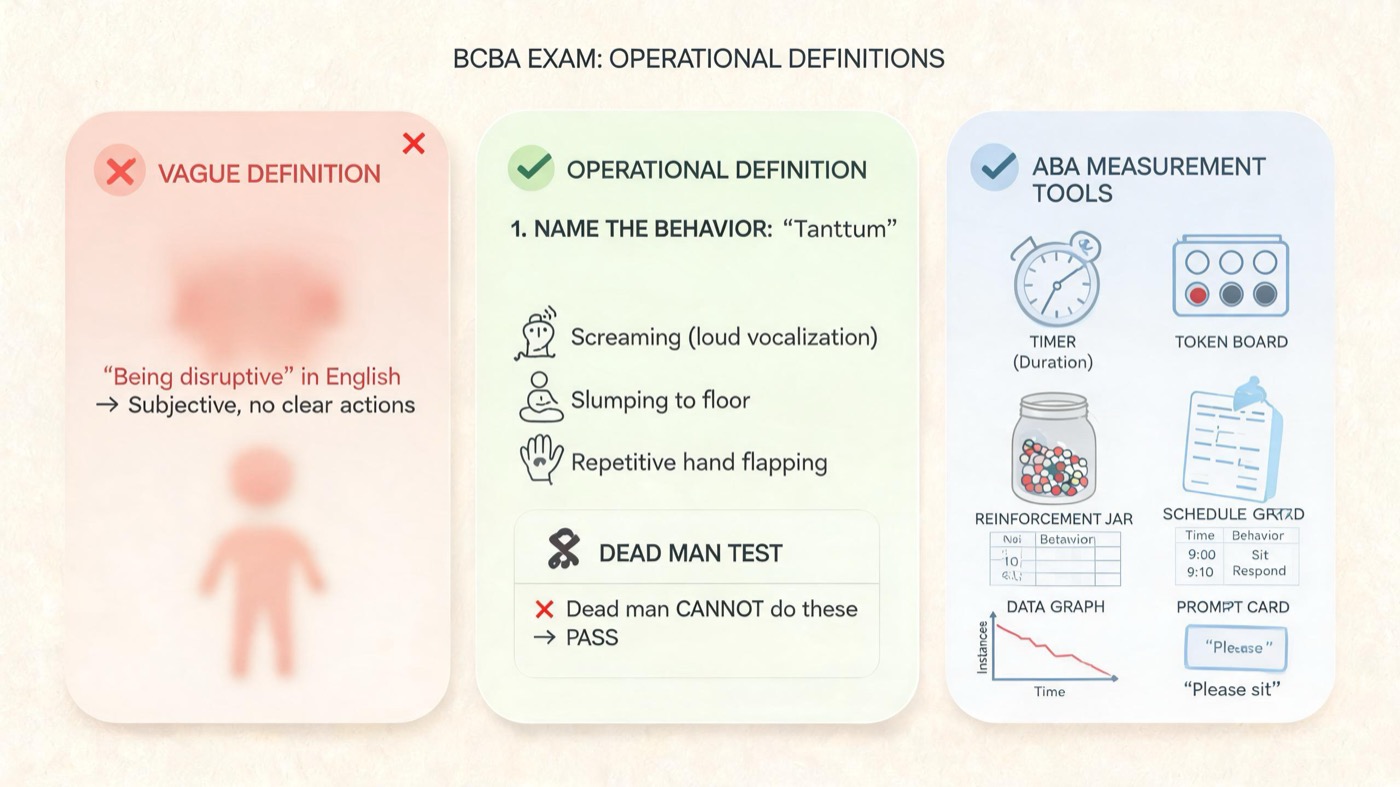
Writing operational definitions is a skill tested directly on the BCBA exam. The key is to be specific and objective. Start by naming the behavior, then list the exact topographical features that count as instances. Use action verbs and avoid labels like ‘aggressive’ or ‘disruptive.’
The Dead Man Test and Other Quality Checks
The Dead Man Test is a simple way to check if your definition is operational: If a dead man can do it, it is not a valid definition of behavior. For example, ‘stays seated’ fails because a dead man can also stay seated. Instead, define what the person does actively, like ‘walks to designated area within 30 seconds of instruction.’
Other quality checks include:
- Does it pass the ‘stranger test’? Would someone unfamiliar with the client identify the behavior exactly the same way?
- Is it free of subjective terms? Words like ‘angry,’ ‘frustrated,’ or ‘happy’ are not okay.
- Can you count it? Behavioral definitions should be designed for data collection (frequency, duration, etc.).
On the exam, you may be given a definition and asked if it is operational. Apply these tests quickly.
Operational Definition Examples: ABC Analysis and Hypothesized Function
Linking operational definitions to the ABC model (Antecedent-Behavior-Consequence) and the hypothesized function is a common exam task. Below are three examples that mirror the BCBA task list.
Example 1: Aggression (Hypothesized Function: Escape)
Operational Definition: Any instance of forceful contact between an open or closed hand, foot, or object and another person’s body, including hitting, kicking, pushing, or throwing objects that make contact.
ABC Analysis:
- Antecedent: A demand is presented (e.g., ‘Please complete your math worksheet’).
- Behavior: Client makes forceful contact with another person (e.g., hits peer with a closed fist).
- Consequence: The demand is removed, or the client is moved to a quiet area.
Hypothesized Function: Escape from demands.
Example 2: Off-Task Behavior (Hypothesized Function: Attention)
Operational Definition: Any instance where the client is not engaged in the assigned task for at least 5 consecutive seconds. Examples include looking away from materials, playing with non-task items, or engaging in unrelated conversation.
ABC Analysis:
- Antecedent: Teacher provides instruction to work independently.
- Behavior: Client looks away from worksheet and starts talking to peer about a video game.
- Consequence: Teacher walks over and says, ‘Please focus,’ providing attention.
Hypothesized Function: Attention (social positive reinforcement).
Example 3: Self-Stimulatory Behavior (Hypothesized Function: Automatic)
Operational Definition: Any instance of hand-flapping, defined as repetitive up-and-down or side-to-side movement of both hands at or above shoulder level, lasting at least 2 seconds.
ABC Analysis:
- Antecedent: Client is in a quiet room with no demands.
- Behavior: Both hands move rapidly up and down near the ears.
- Consequence: No immediate social consequence; behavior continues uninterrupted.
Hypothesized Function: Automatic reinforcement (sensory stimulation).
Common Exam Traps and How to Avoid Them
The BCBA exam often includes questions designed to trip you up with poorly written definitions. Recognizing these traps is essential.
Confusing Topography with Function
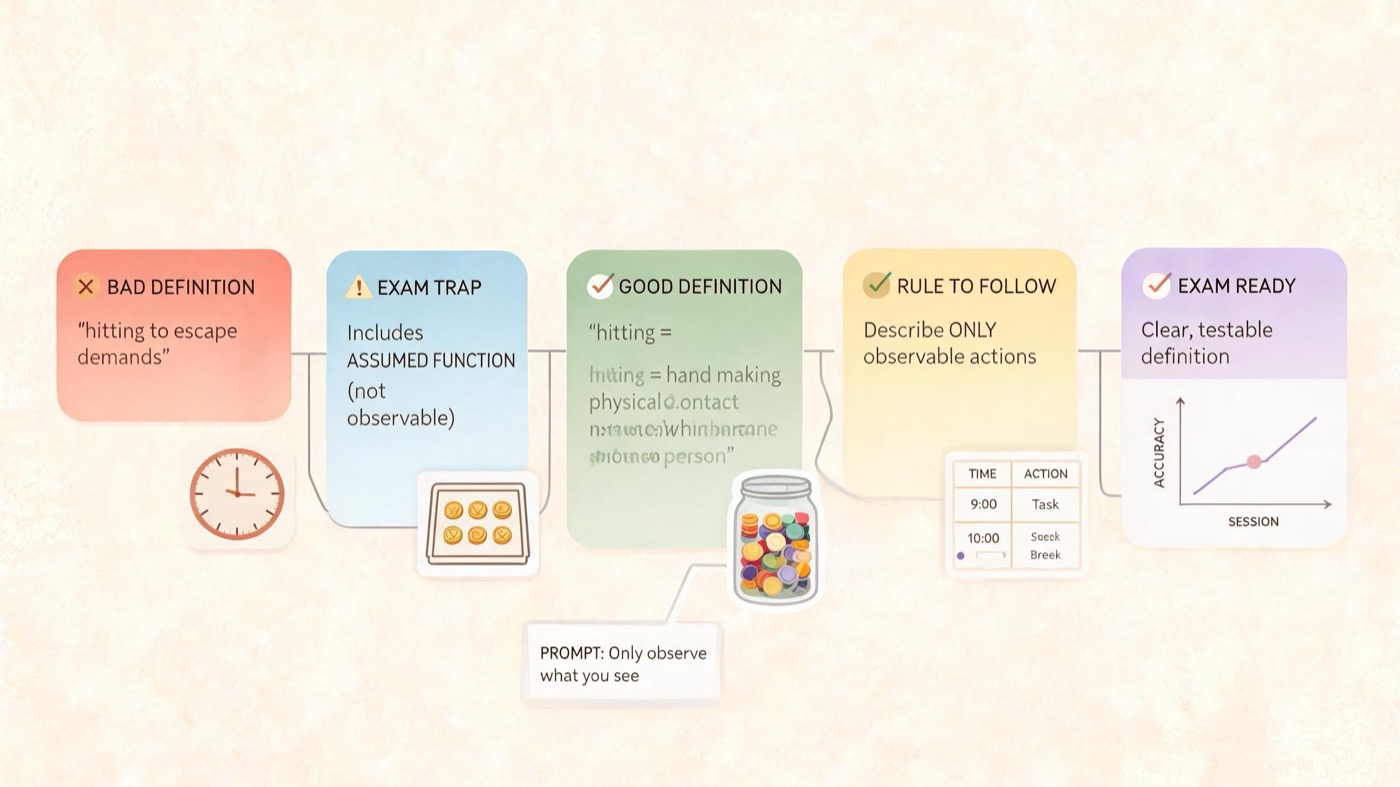
A common error is to include the function inside the definition. For example, ‘hitting to escape demands’ is not operational because it assumes the function. The definition should describe the topography (movement) only. Save the function for the ABC analysis.
Using Subjective Terms Like ‘Angry’
Words like ‘angry,’ ‘upset,’ or ‘frustrated’ are mentalistic and not observable. Instead, describe the visible actions: ‘clenching fists,’ ‘raising voice,’ or ‘kicking objects.’ Remember, operational definitions must be free of emotional labels.
Making Definitions Too Broad or Too Narrow
If you define aggression as ‘any harmful act,’ it is too vague. If you list every possible form of hitting, you may miss novel instances. Aim for a definition that captures the whole class of responses you want to address.
Quick Checklist: Is Your Definition Operational?
Use this checklist before submitting any definition on the exam or in practice:
- Is the behavior observable? Can you see it happening?
- Is it measurable? Can you count, time, or record it?
- Does it pass the Dead Man Test? (A dead man cannot do it.)
- Does it avoid subjective terms like ‘angry’ or ‘frustrated’?
- Does it describe topography only, not function?
- Would a stranger be able to identify the behavior reliably?
- Does it include examples and non-examples? (Optional but helpful.)
If you answer ‘No’ to any of these, revise the definition.
Summary and Next Steps for Your BCBA Exam Prep
Operational definitions are the foundation of reliable data collection and effective behavior intervention plans. On the BCBA exam, you will need to write, evaluate, and select operational definitions across multiple scenarios. Focus on keeping definitions observable, measurable, and free of subjective language. Use the Dead Man Test and the checklist above to catch errors.
To practice, look for operational definition questions in your study materials. You can also review the BCBA exam prep guide for additional strategies. Mastering this topic will help you avoid unnecessary points lost.
For more detail on how operational definitions tie into the scientific foundations of behavior analysis, see our article on radical behaviorism. Additionally, the BACB website provides the most current task list and ethical guidelines.



