
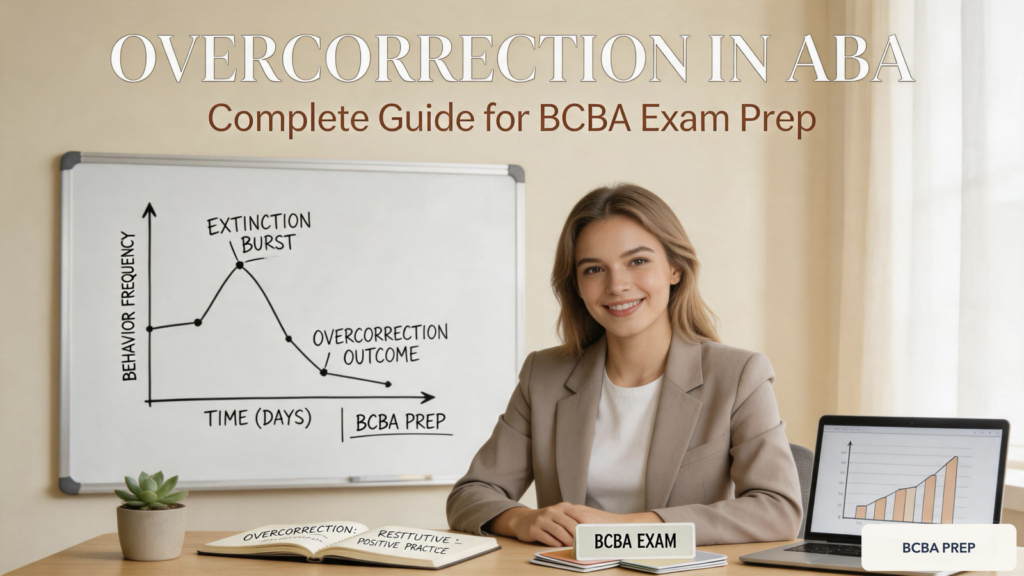
What Is Overcorrection in ABA?
In applied behavior analysis, overcorrection is a behavior reduction procedure that involves requiring the learner to engage in corrective actions after a problem behavior. It is categorized as a punishment-based intervention and is most effective when combined with reinforcement of alternative behaviors.
Table of Contents
- What Is Overcorrection in ABA?
- Types of Overcorrection: Positive Practice vs Restitutional
- Overcorrection on the BCBA Exam: What to Know
- ABA Overcorrection Examples with ABC Data
- Overcorrection Quick Review Checklist
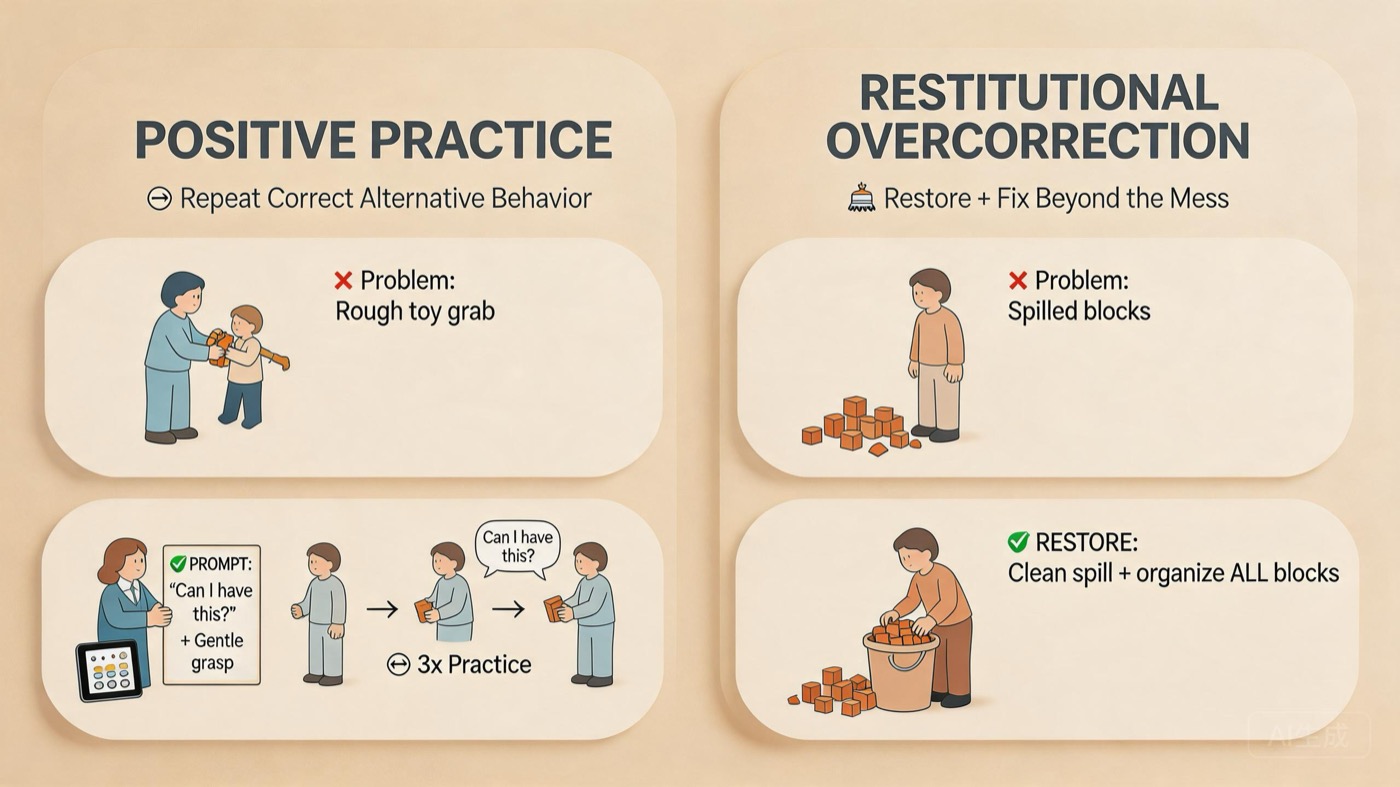
Overcorrection has two main forms: positive practice and restitutional overcorrection. Both are intended to reduce the future likelihood of the target behavior, but they differ in what the learner must do.
Key Components of Overcorrection
- Overcorrection: A punishment procedure where the learner must correct the effects of the behavior or practice an appropriate behavior repeatedly.
- Positive practice: Repeatedly performing the correct or alternative behavior after an error occurs.
- Restitutional overcorrection: Restoring the environment to a state that is better than before the behavior occurred.
When implementing overcorrection, always pair it with differential reinforcement to teach the learner what to do instead. For more on combining interventions, see our guide on differential reinforcement.
Overcorrection must be applied consistently and with a clear rationale tied to the function of the behavior. Documenting the specific behavior, its function, and the corrective procedure is essential for ethical and effective practice. For a deeper understanding of behavior functions, check our article on the four functions of behavior.
Types of Overcorrection: Positive Practice vs Restitutional
Positive Practice Overcorrection
Positive practice requires the learner to repeatedly engage in a correct or alternative behavior immediately after the problem behavior. This is not simply a reprimand; it is a structured teaching opportunity.
Example:
- Behavior: A child throws a tantrum to access a toy.
- Antecedent: The child is told the toy is unavailable.
- Consequence: The child must practice requesting the toy calmly 10 times.
- Hypothesized function: Access to tangible item (toy).
The repeated practice serves as a punisher (because it requires effort) while also teaching the skill. However, positive practice should be accompanied by reinforcement when the child requests appropriately in the future.
Restitutional Overcorrection
Restitutional overcorrection focuses on repairing the environmental damage caused by the behavior, often going beyond the original state. This type is particularly useful for behaviors that disrupt the physical environment.
Example:
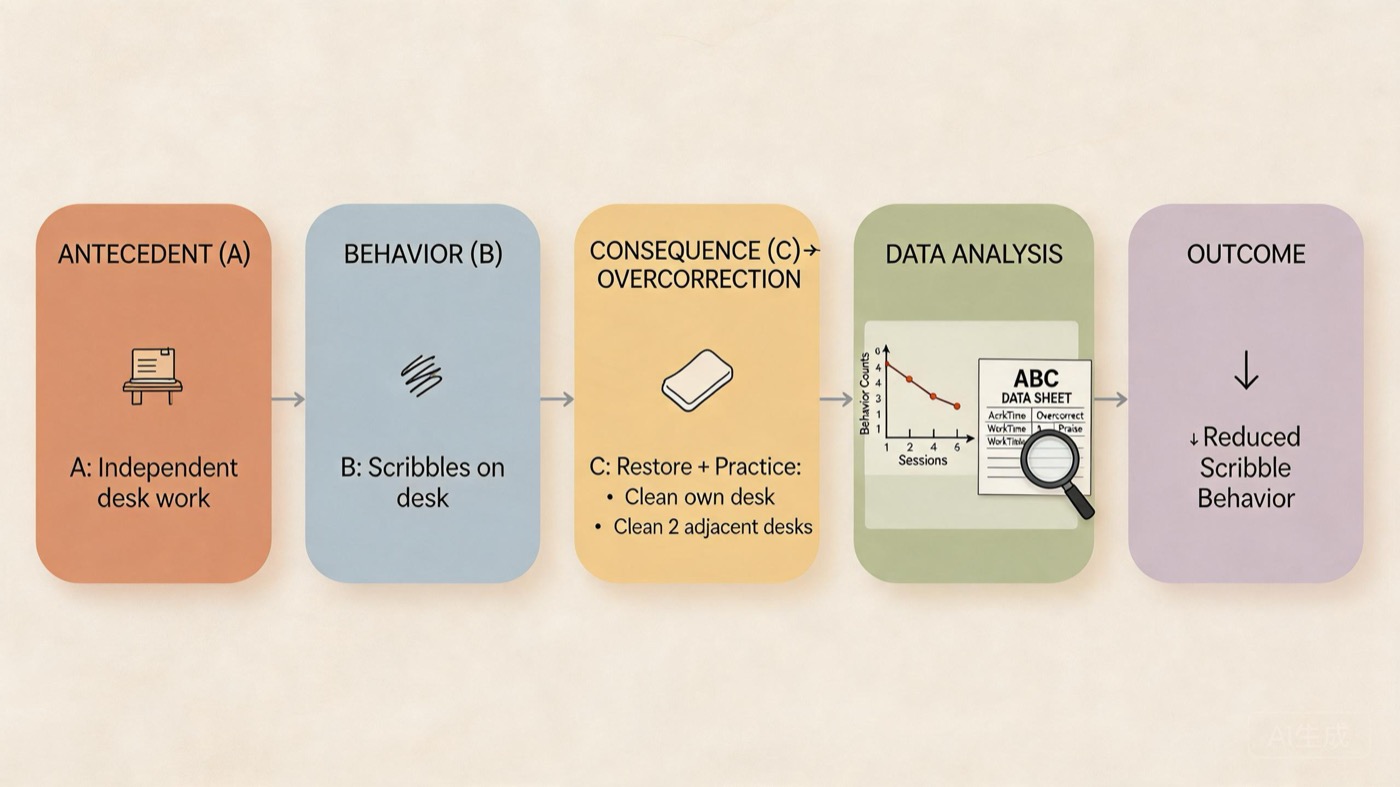
- Behavior: A student writes on a desk with a marker.
- Antecedent: The student is given a task they find difficult.
- Consequence: The student must clean all desks in the classroom, not just their own.
- Hypothesized function: Escape from the demanding task.
Both types of overcorrection require the learner to engage in the corrective behavior immediately after the problem behavior. Over time, the effort and inconvenience reduce the future probability of the behavior.
Overcorrection on the BCBA Exam: What to Know
The BCBA exam often tests overcorrection through scenario-based questions. You must be able to identify the type of overcorrection, its function, and how to implement it ethically.
Common Exam Traps
- Trap 1: Confusing overcorrection with punishment. Overcorrection is a punishment procedure, but remember that it must be paired with reinforcement of alternative behaviors to be effective and ethical.
- Trap 2: Forgetting to document function. Always identify the function of the behavior before selecting an intervention. Overcorrection may not be appropriate for all functions.
- Trap 3: Misidentifying the type. Practice distinguishing positive practice (practicing a behavior) from restitutional (fixing the environment).
- Trap 4: Ignoring reinforcement. Overcorrection alone may lead to side effects. Always combine with differential reinforcement of alternative behavior (DRA).
How to Approach Overcorrection Questions
When you see a question about overcorrection, follow these steps:
- Read the scenario and identify the target behavior and its function.
- Look for whether the consequence involves practicing a skill or restoring the environment.
- Check if the description mentions any reinforcement for appropriate behavior.
- Pinpoint any potential ethical concerns, such as effort or social validity.
For more exam strategies, see our BCBA test question strategies guide.
ABA Overcorrection Examples with ABC Data
Example 1: Positive Practice for Aggression
- Antecedent: Peer takes a toy from the child (A).
- Behavior: Child hits the peer (B).
- Consequence: Child must practice apologizing and sharing 5 times (C).
- Function: Access to toy (tangible).
Example 2: Restitutional for Property Destruction
- Antecedent: Teacher gives a non-preferred worksheet (A).
- Behavior: Student rips the worksheet (B).
- Consequence: Student must sweep the entire classroom and retrieve all paper scraps (C).
- Function: Escape from the task.
Example 3: Positive Practice for Social Errors
- Antecedent: A classmate says hello to a child with autism (A).
- Behavior: The child ignores the greeting (B).
- Consequence: The child must practice greeting back 10 times with the teacher (C).
- Function: Social avoidance (automatic or negative reinforcement).
Each example illustrates how the consequence is directly linked to the behavior and its function. The corrective effort serves as a punisher, reducing the likelihood of the behavior recurring.
Overcorrection Quick Review Checklist
Use this checklist for exam day review:
- Define overcorrection as a punishment procedure requiring corrective action.
- Differentiate between positive practice (repeated appropriate behavior) and restitutional (environmental repair beyond original state).
- Remember to pair overcorrection with differential reinforcement of alternative behavior.
- Identify the function of the target behavior before choosing an overcorrection strategy.
- Document the specific behavior, corrective procedure, and data on effectiveness.
- Consider ethical implications: effort, duration, and social validity.
- Practice with sample exam scenarios to improve accuracy.
Overcorrection is a valuable tool when used correctly. The BCBA exam will test your ability to apply it in a functional context. For comprehensive practice, check out our free BCBA mock exam questions.
For authoritative information on ethical implementation, refer to the BACB Ethics Code. Always ensure interventions are consistent with the principles of behavior analysis and prioritize the client’s dignity and well-being.



