

What Are Practice Effects in ABA?
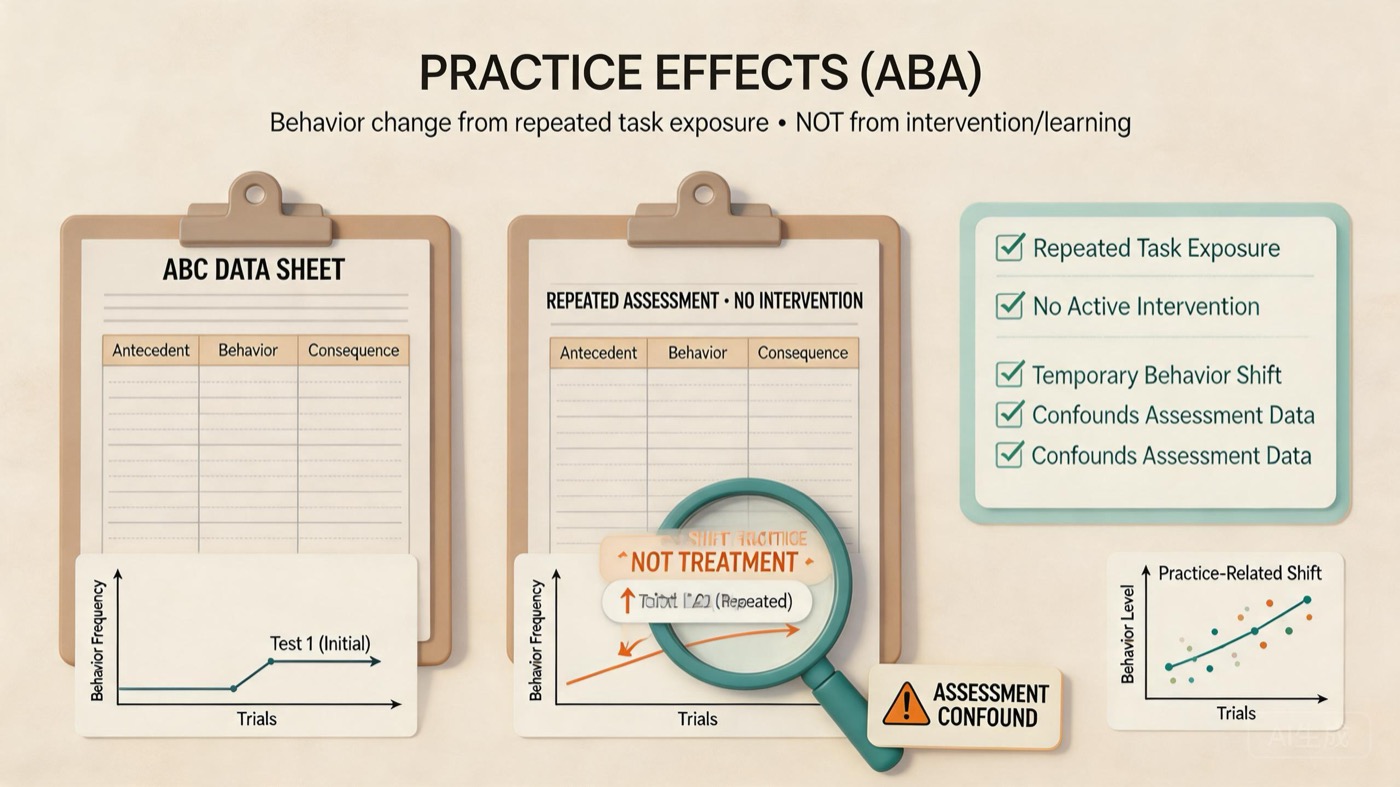
Practice effects refer to changes in a behavior that result from repeated exposure to a task or assessment, rather than from a true intervention or learning. In applied behavior analysis, these effects are often temporary and can confound data interpretation. For example, a BCBA candidate may score higher on a second mock exam simply because they are familiar with the question format, not because they have mastered the content.
Table of Contents
- What Are Practice Effects in ABA?
- How Practice Effects Impact BCBA Exam Performance
- ABA Examples of Practice Effects with ABC Analysis
- Common Exam Traps Related to Practice Effects
- Quick Checklist to Mitigate Practice Effects
- Summary: Mastering Practice Effects for the BCBA Exam
- References
It is critical to distinguish practice effects from actual learning. Learning involves durable, generalized changes in behavior, while practice effects are often transient and context-specific. ABA research frequently encounters this issue in multiple baseline designs, where repeated testing can lead to improvements even without intervention. This phenomenon is linked to reactivity and multiple treatment interference.
Practice Effects vs. Learning: Key Differences
- Duration: Practice effects are usually short-term; learning produces lasting change.
- Generalization: Practice effects often do not generalize to new contexts; learning does.
- Mechanism: Practice effects may be due to familiarity, while learning involves new response-reinforcer relations.
- Detection: In visual analysis, a sudden jump after repeated testing may indicate practice effects rather than treatment effects.
How Practice Effects Impact BCBA Exam Performance
Many BCBA candidates rely on mock exams to gauge readiness. However, practice effects can artificially inflate scores, leading to false confidence or, conversely, anxiety if scores plateau. Understanding how these effects manifest is key to accurate self-assessment.
Familiarity with Question Formats
Repeated exposure to scenario-based questions may improve response speed without genuine concept mastery. For instance, a candidate might recognize a pattern in the way answer choices are structured, allowing them to eliminate distractors faster. This does not necessarily mean they can apply the principle to a novel vignette.
Changes in Test-Taking Strategy
Test-takers often learn to eliminate answer choices more efficiently after a few attempts. This strategic improvement can raise scores even if the underlying knowledge is unchanged. On the BCBA exam, questions are carefully designed to measure applied understanding, so relying on test-taking strategies alone is risky.
ABA Examples of Practice Effects with ABC Analysis
To solidify your understanding, here are three worked examples using the ABC contingency format. Each illustrates how practice effects can masquerade as learning.
Example 1: Multiple Baseline Across Subjects
Scenario: A BCBA candidate repeatedly takes the same mock test under baseline conditions. Antecedent: Seeing a familiar question. Behavior: Quickly selecting the previously correct answer. Consequence: Immediate positive feedback (correct). Hypothesized function: Automatic positive reinforcement (feeling of competence). Relevance: This can mask knowledge gaps, leading the candidate to underestimate areas needing review.
Example 2: Repeated Fluency Checks
Scenario: Practicing the same set of definitions each day. Antecedent: Seeing a term like ‘negative punishment’. Behavior: Rapid recall of a rote definition. Consequence: Correct answer without deeper understanding. Relevance: May not generalize to novel application scenarios on the exam, such as identifying negative punishment in a clinical vignette.
Example 3: Role-Play Rehearsal
Scenario: Candidate practices parent training role-plays multiple times. Antecedent: Coaching cue. Behavior: Rehearsed scripted response. Consequence: Reduced anxiety. Relevance: Over-rehearsing can lead to rigidity when actual exam scenarios differ from practiced scripts. The candidate may struggle to adapt to unexpected client responses.
Common Exam Traps Related to Practice Effects
BCBA exam questions often assess your ability to interpret data and identify threats to internal validity. Practice effects are a common distractor.
Confusing Practice Effects with Treatment Effects
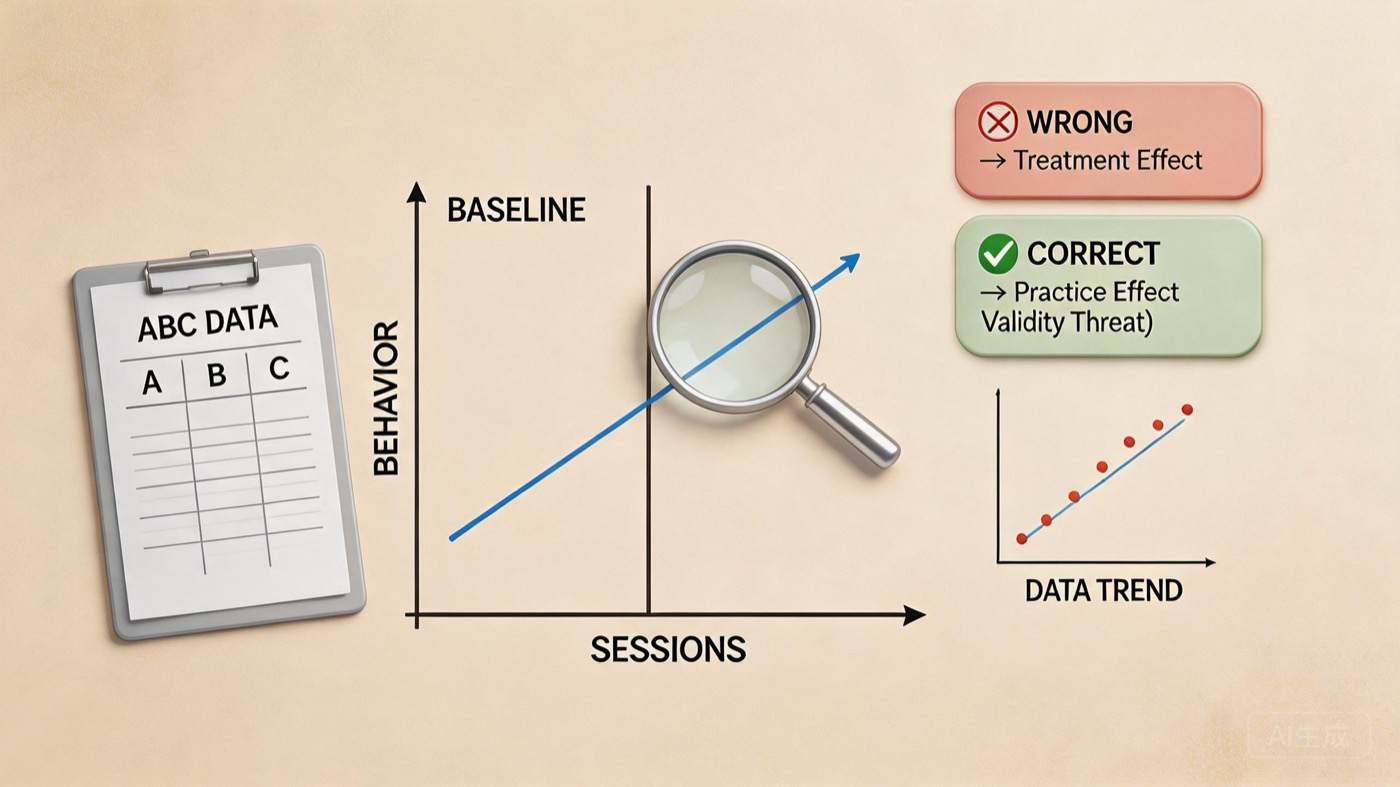
Questions may present a graph where behavior improves across baseline sessions. Candidates might incorrectly attribute this to an intervention. Instead, look for trend and variability: practice effects typically produce gradual improvements without a clear change in level at intervention onset. Always evaluate whether the data path indicates a stable baseline before claiming treatment effect.
Overreliance on Baseline Probe Data
In multiple baseline designs, repeated probes can cause baseline improvements, threatening internal validity. Candidates should assess whether baseline data are stable or trending. A rising trend in baseline suggests practice effects rather than a functional relation. The BACB expects you to identify such confounds.
Quick Checklist to Mitigate Practice Effects
Use this checklist during your final exam prep to avoid the pitfalls of practice effects:
- Vary your practice materials: Use multiple mock exams from different sources, not just one.
- Space out your tests: Avoid taking the same exam more than once in a short period.
- Analyze errors deeply: For each wrong answer, explain why the correct choice is right, rather than just memorizing.
- Simulate novel conditions: Occasionally practice in a new environment or with time constraints to test generalization.
- Track your performance across domains: If scores improve only on familiar topics, suspect practice effects.
- Seek feedback: Have a supervisor review your mock exam results to identify patterns of surface-level improvement.
Summary: Mastering Practice Effects for the BCBA Exam
Understanding practice effects is essential for accurate self-assessment and for correctly interpreting research scenarios on the BCBA exam. Remember that practice effects are temporary performance changes due to repeated exposure, not genuine learning. Differentiate them by looking for unstable baselines, lack of generalization, and superficial improvement patterns. Use the checklist above to ensure your study efforts lead to real mastery rather than inflated mock scores. For more tips on effective study strategies, check out our BCBA exam prep guide. Also, consult the BACB’s official resources for understanding experimental design threats.


