
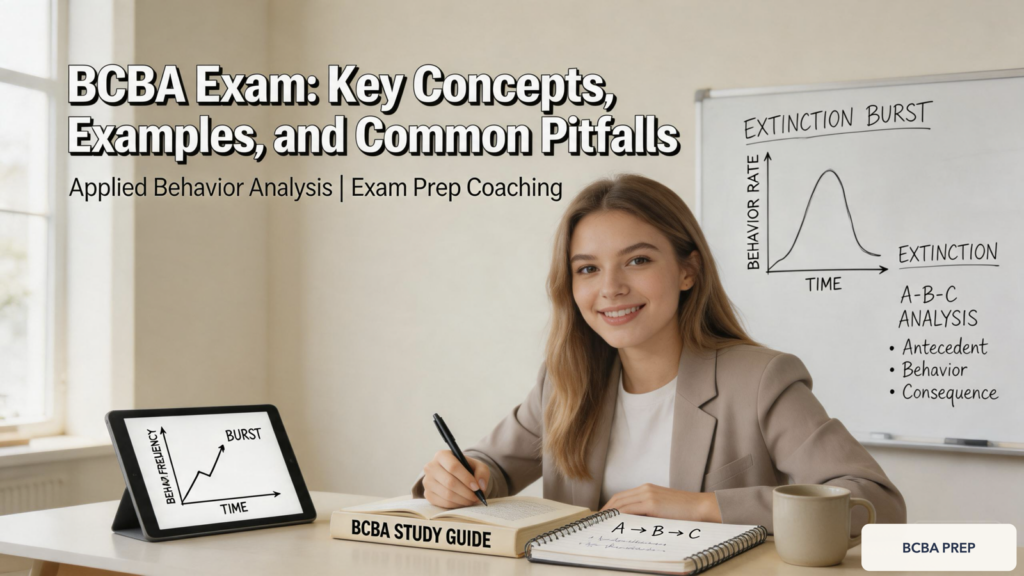
What Is the BCBA Exam? An Overview
The Board Certified Behavior Analyst (BCBA) exam is a rigorous assessment that certifies professionals in applied behavior analysis. It evaluates your knowledge of core principles, ethical guidelines, and practical applications. Passing this exam is essential for those seeking to practice independently in the field. This BCBA exam prep guide will help you focus on what matters.
Table of Contents
- What Is the BCBA Exam? An Overview
- Key Terms Every Candidate Must Know
- BCBA Example: ABC Analysis in Practice
- Common Exam Traps and How to Avoid Them
- Quick Study Checklist for the BCBA Exam
- Summary: Putting It All Together
BCBA Exam Content Areas
The exam is based on the BACB Task List (currently 6th Edition). Key domains include:
- Measurement: defining behavior, data collection methods, and graphing.
- Experimental Design: single-subject designs and internal validity.
- Behavior-Change Procedures: reinforcement, punishment, extinction, and chaining.
- Ethical Considerations: adhering to the BACB Ethics Code in all professional activities.
For a complete breakdown, refer to the official BACB Task List. Knowing these areas helps you prioritize your study time.
Key Terms Every Candidate Must Know
Familiarity with core terminology is non-negotiable for exam success. Many questions test your ability to distinguish between similar concepts.
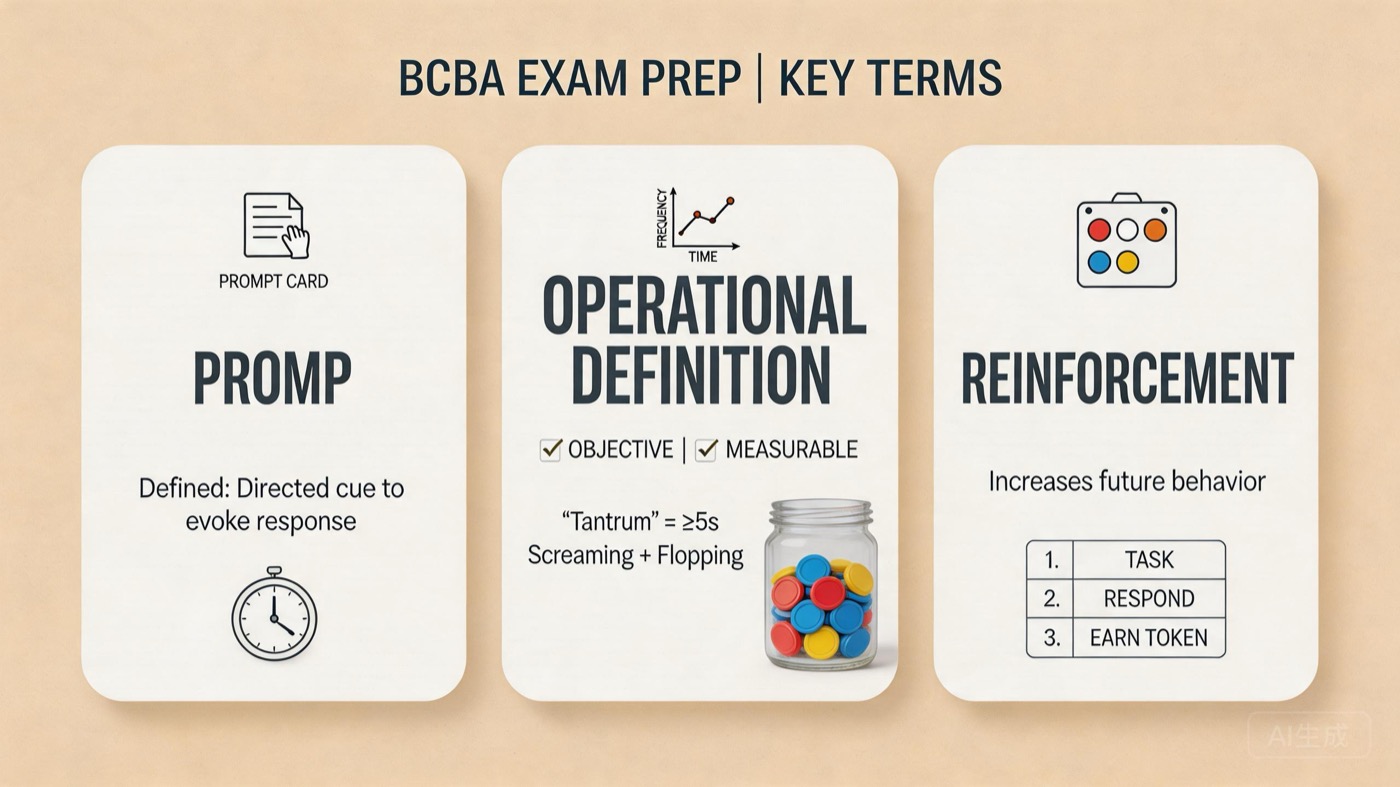
Understanding Behavioral Definitions and Measurement
Operational definitions must be objective and measurable. For example, ‘tantrum’ should be defined as ‘any instance of screaming and falling to the floor lasting >10 seconds.’ On the exam, you may be asked to select an appropriate operational definition for a target behavior. Measurement methods include continuous (e.g., frequency, duration) and discontinuous (e.g., partial interval). Interobserver agreement (IOA) ensures data reliability.
Reinforcement, Punishment, and Extinction
Positive reinforcement adds a stimulus to increase behavior; negative reinforcement removes an aversive stimulus. Similarly, positive punishment adds an aversive; negative punishment removes a preferred item. Extinction involves withholding the maintaining reinforcer. A common exam trap is confusing negative reinforcement with punishment. Remember: reinforcement always increases behavior, punishment always decreases it.
Motivating Operations and Discriminative Stimuli
Motivating operations (MO) alter the value of a reinforcer and the frequency of behavior. An establishing operation (EO) increases value, while an abolishing operation (AO) decreases it. Discriminative stimuli (SD) signal that a particular response will be reinforced. For example, a therapist's presence (SD) may evoke mands if the therapist has delivered reinforcers before. Distinguishing between MOs and SDs is critical for exam scenarios.
BCBA Example: ABC Analysis in Practice
Applying the three-term contingency (antecedent-behavior-consequence) is a core skill. Below are three examples that illustrate common functions. Understanding function is key to intervention.
Example 1: Escape from Demands
A child cries during math tasks. Antecedent: teacher presents math worksheet. Behavior: crying. Consequence: teacher removes worksheet. The function is negative reinforcement (escape). Exam questions might ask you to identify this pattern and select an appropriate intervention (e.g., break cards).
Example 2: Access to Tangible
A learner requests a favorite toy repeatedly. Antecedent: toy is visible but out of reach. Behavior: vocal request. Consequence: caregiver hands toy. Function: positive reinforcement (access). This scenario links to functional communication training (FCT), where a replacement mand is taught.
Example 3: Automatic Reinforcement
An individual rocks back and forth in isolation. No social consequence is observed. Antecedent: alone or no stimulation. Behavior: rocking. Consequence: sensory feedback. Function: automatic reinforcement. In exams, look for behaviors that persist without social interaction.
For more practice on identifying functions, check out our guide on the four functions of behavior.
Common Exam Traps and How to Avoid Them
Even well-prepared candidates fall into these traps. Being aware of them can save you points.
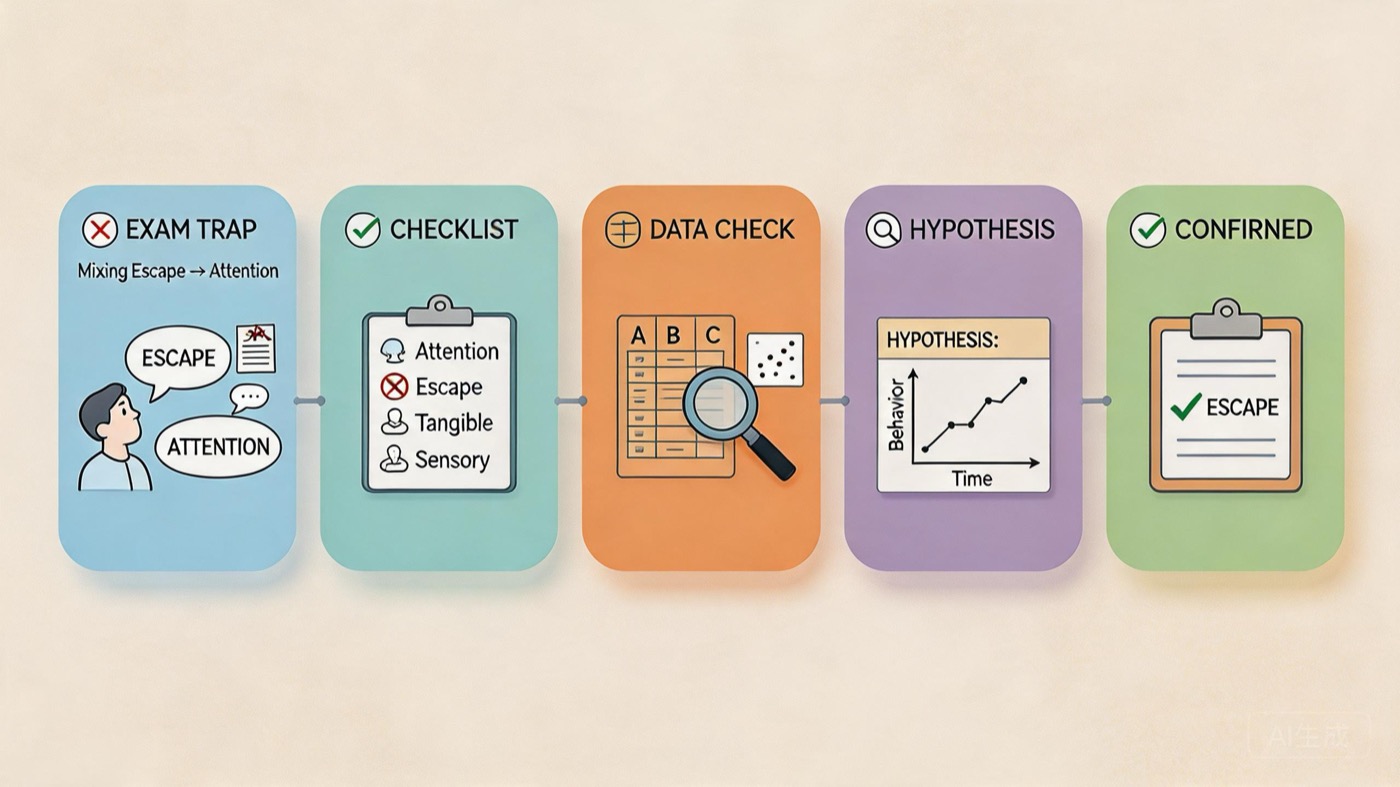
Confusing Functions of Behavior
Mixing up escape and attention is common. Use a quick checklist: does the behavior typically produce attention, remove demands, yield access to tangibles, or provide sensory input? Identifying the consequence pattern is the key.
Misidentifying Reinforcement Schedules
Fixed ratio (FR) produces high rates with pauses after reinforcement. Variable ratio (VR) yields high, steady rates. Fixed interval (FI) creates a scalloped response pattern. Variable interval (VI) produces moderate, steady rates. Exam questions often describe a pattern and ask which schedule is in effect. Practice with examples.
Overlooking Ethical Considerations
Many questions require ethical judgment. Always prioritize client well-being, informed consent, and least restrictive procedures. The BACB Ethics Code is your guide. When in doubt, choose the option that protects the client and upholds professional integrity.
For further ethical scenario practice, visit our ethics in ABA practice guide.
Quick Study Checklist for the BCBA Exam
Use this checklist to stay on track during your BCBA exam prep:
- Review the BACB Task List (6th Edition) and identify weak areas.
- Practice operational definitions using real-life behaviors.
- Create flashcards for key terms (e.g., reinforcement types, schedules).
- Complete ABC analyses for at least 10 scenarios.
- Take mock exams and review missed questions thoroughly.
- Read the BACB Ethics Code and apply to case studies.
- Form a study group or join a prep course.
This checklist ensures you cover both knowledge and application. Consistent practice is essential for success.
Summary: Putting It All Together
The BCBA exam demands a solid grasp of key concepts, functional analysis, and ethical principles. By mastering terminology, practicing ABC analyses, and avoiding common traps, you build confidence. Use the checklist daily, and complement your study with high-quality mock exams. For comprehensive resources, explore our 6th edition mock exam and other study tools. Stay consistent, and you will be well-prepared for test day.
External resource: BACB official website for the latest task list and ethics code.



