
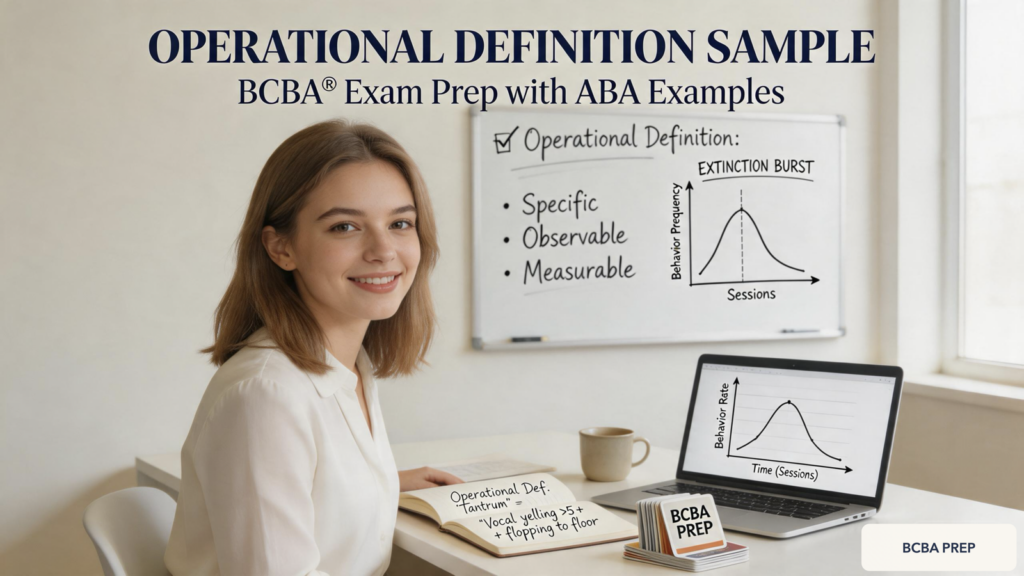
What Makes a Behavior Operational?
On the BCBA® exam, you will frequently be asked to identify or write an operational definition sample. An operational definition transforms a vague label (e.g., ‘aggression’) into a precise, observable, and measurable description. This is critical because behavior analysis relies on data—if you cannot see or count it, it is not behavior.
Table of Contents
- What Makes a Behavior Operational?
- Operational Definition Sample: 3 ABA Examples with ABC Data
- Common Exam Traps: What BCBA Candidates Get Wrong
- Quick Checklist for Writing Operational Definitions
- How to Practice for the BCBA Exam
- References
Target Behavior vs. Operational Definition
The target behavior is simply the name you give to the behavior you want to change, such as ‘elopement’ or ‘tantrum.’ The operational definition, however, tells you exactly what counts as an instance. For example, instead of ‘aggression,’ an operational definition would be: ‘Any instance of hitting, kicking, or biting that results in physical contact with another person.’ This clarity ensures interobserver agreement and reliable data collection. Without an operational definition, two observers might record different data for the same behavior, making it impossible to track progress accurately.
On the exam, you will often see a scenario with a loosely defined behavior and be asked to select the best operational definition from multiple choices. For instance, a question might describe a student who ‘talks out’ and ask you to pick the definition that includes measurable terms like ‘any vocalization not preceded by a teacher’s question or permission.’ Understanding the distinction between a target behavior label and its operational definition is a foundational skill that appears throughout the BCBA® test.
Operational Definition Sample: 3 ABA Examples with ABC Data
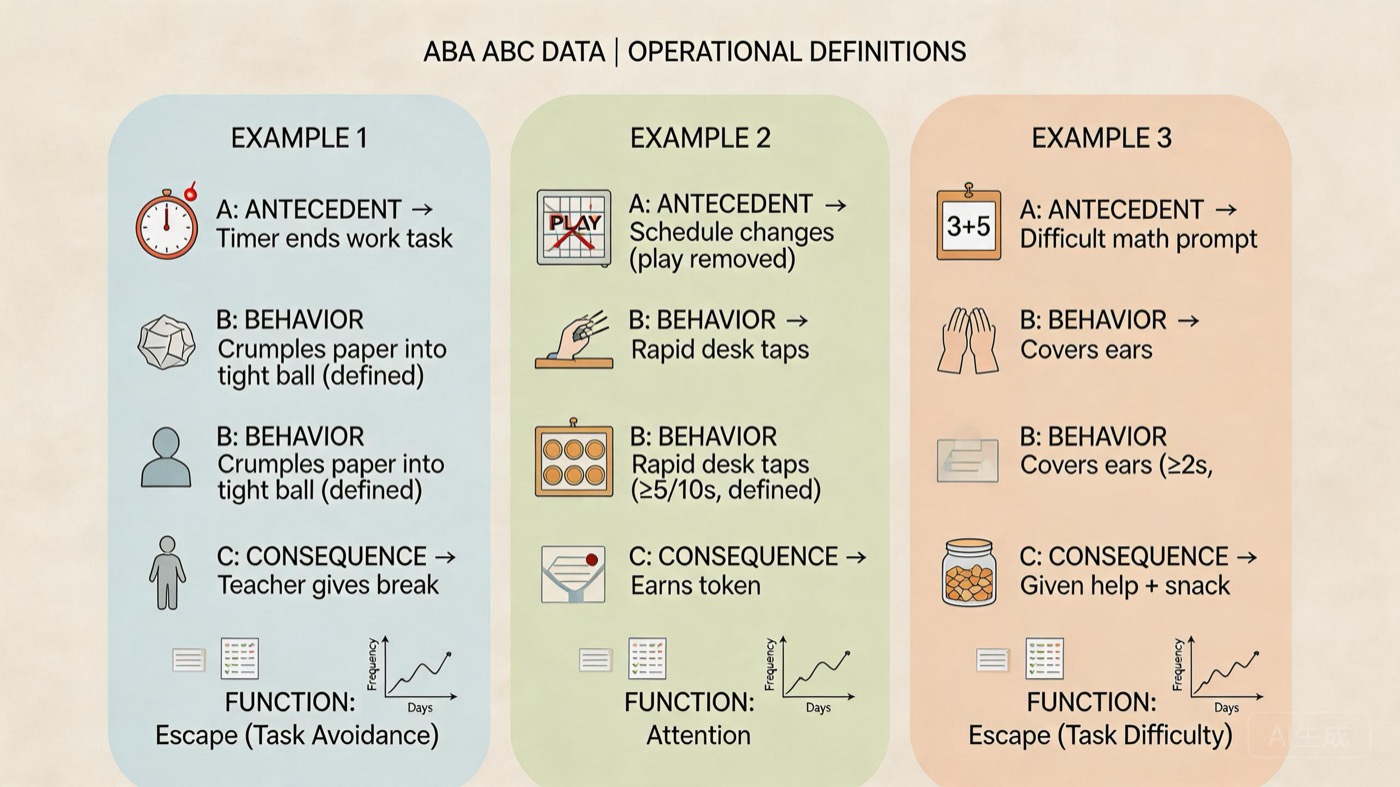
To help you apply these concepts, here are three operational definition samples with ABC data (Antecedent-Behavior-Consequence) and hypothesized functions. Study these closely—they mirror the type of analysis you will see on the exam. Each example shows how a clear definition leads to consistent data collection and function identification.
Example 1: Elopement in a Classroom
- Operational definition: Any instance of the learner leaving the designated area (e.g., desk, carpet, classroom) without permission.
- ABC data: Antecedent – teacher gives independent work; Behavior – stands up and walks to door; Consequence – teacher redirects verbally.
- Hypothesized function: Escape from task demands.
Note that the definition specifies ‘without permission’ and ‘designated area’ to avoid ambiguity. A common mistake would be to define elopement as ‘running away,’ which excludes walking or crawling. On the exam, watch for definitions that are too narrow or too broad.
Example 2: Hand Flapping in a Clinic
- Operational definition: Any instance of repetitive, rhythmic movement of one or both hands above the waist, lasting at least 3 seconds.
- ABC data: Antecedent – loud noise in waiting area; Behavior – flaps hands; Consequence – peer stares.
- Hypothesized function: Automatic/sensory stimulation.
The duration criterion (‘lasting at least 3 seconds’) is crucial here because brief movements may not be functionally relevant. Without that parameter, observers might disagree on what counts. This highlights the need to include temporal boundaries when the behavior naturally occurs in episodes.
Example 3: Verbal Protest During Transitions
- Operational definition: Any instance of vocalizing ‘no,’ ‘stop,’ ‘I don’t want to,’ or crying, occurring within 10 seconds of a transition cue.
- ABC data: Antecedent – therapist says ‘time to clean up’; Behavior – says ‘no’ and cries; Consequence – therapist delays transition.
- Hypothesized function: Escape from non-preferred activity.
This definition includes a time frame (‘within 10 seconds’) to link the behavior specifically to the transition. Without it, the same vocalization at another time might be counted incorrectly. When writing your own definitions, always consider the context and set clear temporal or spatial boundaries.
For more practice analyzing behavior, check out our guide on 4 functions of behavior.
Common Exam Traps: What BCBA Candidates Get Wrong
Many test-takers lose points on operational definition questions because they include inferred states or vague language. Avoid these common mistakes:
- Using words like ‘angry,’ ‘frustrated,’ or ‘trying to’ – these are internal states, not observable behaviors.
- Failing to set clear boundaries (e.g., what counts as an instance vs. non-instance). For example, a definition of ‘aggression’ that says ‘hitting’ but doesn’t specify whether an attempt to hit counts can lead to inconsistency.
- Leaving out a time frame or duration criterion when needed (e.g., ‘lasting at least 3 seconds’). Without this, observers may disagree on whether a brief hand flap is an instance.
- Confusing topography (what the behavior looks like) with function (why it occurs). The definition should describe the form, not the assumed purpose.
Another trap is writing definitions that rely on exclusion (e.g., ‘not following instructions’) rather than describing what the behavior is. Exclusionary definitions are harder to measure reliably. Instead, define the specific behavior: ‘failing to initiate a response within 5 seconds of a prompt.’ The exam rewards definitions that are objective and repeatable. Always ask yourself: Could two independent observers agree on whether the behavior occurred?
Quick Checklist for Writing Operational Definitions
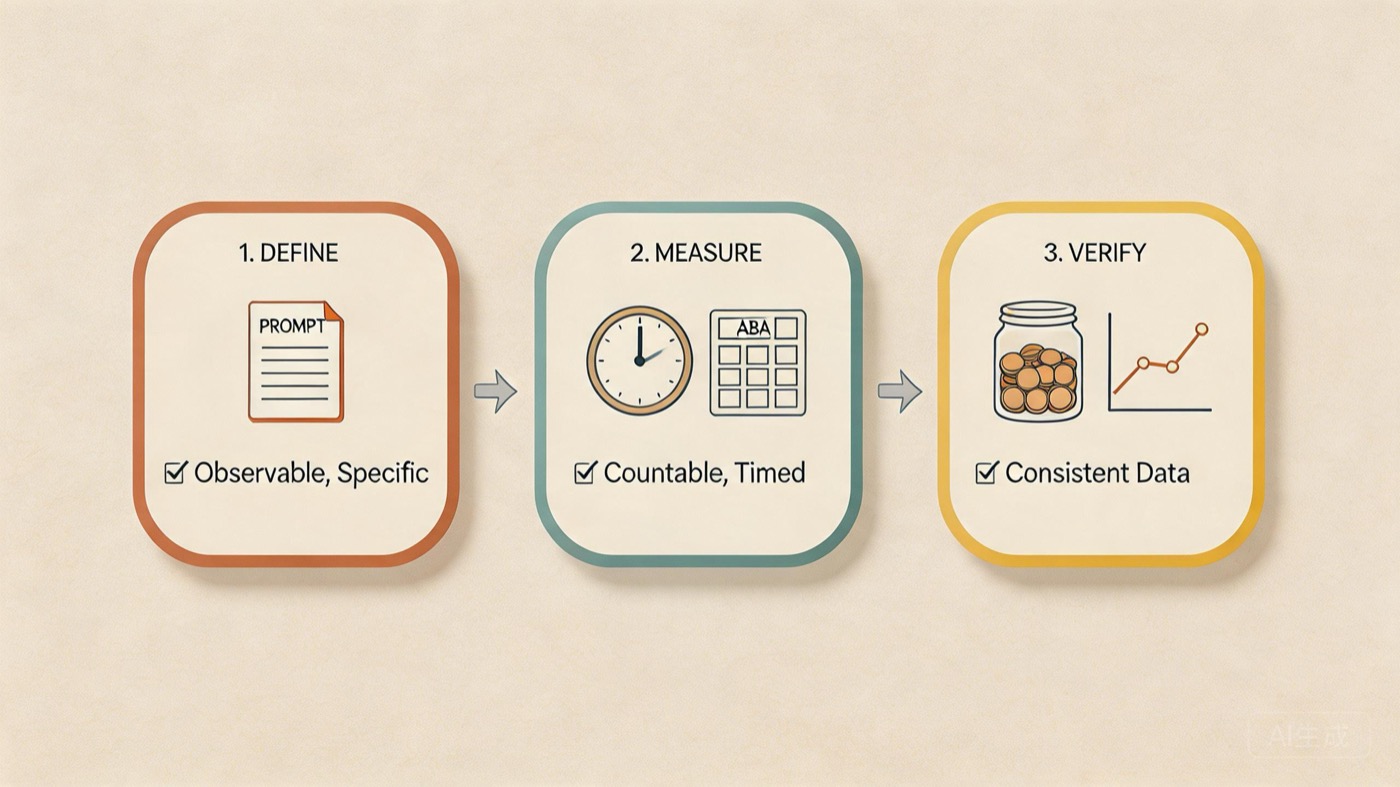
Use this checklist when writing or evaluating operational definitions for exam questions or real-life practice:
- ✅ Observable – Can you see or hear it?
- ✅ Measurable – Can you count frequency, duration, or intensity?
- ✅ Clear boundaries – Specifies start and end of behavior.
- ✅ Repeatable – Another observer would score the same way.
- ✅ Excludes inference – No mental states or intentions.
Keep this list handy during your study sessions. When you encounter a scenario-based question on the exam, mentally run through each item. For example, if a definition includes ‘the client feels frustrated,’ it fails the inference check. If it says ‘raises hand above shoulder while seated,’ it passes observability and measurability. For more exam-ready resources, explore our BCBA mock exam 6th edition.
How to Practice for the BCBA Exam
To master operational definitions, practice is key. Try these strategies:
- Write definitions for common behaviors you observe in your environment (e.g., a child raising a hand, a peer talking out of turn). Aim to be so precise that someone reading your definition could collect data without confusion.
- Partner with a study buddy: Have one person describe a behavior and the other write an operational definition; then compare. Discuss disagreements and refine your definitions until both agree—this mirrors the concept of interobserver agreement.
- Take mock exam questions that require identifying or selecting an operational definition. Focus on eliminating options that include inference. Many practice tests offer questions where you must choose the best definition among several choices; use the checklist above to analyze each option.
For a deeper dive into ABA measurement, read about data collection in ABA. With consistent practice, you will confidently identify and write operational definitions on exam day. Good luck!


