
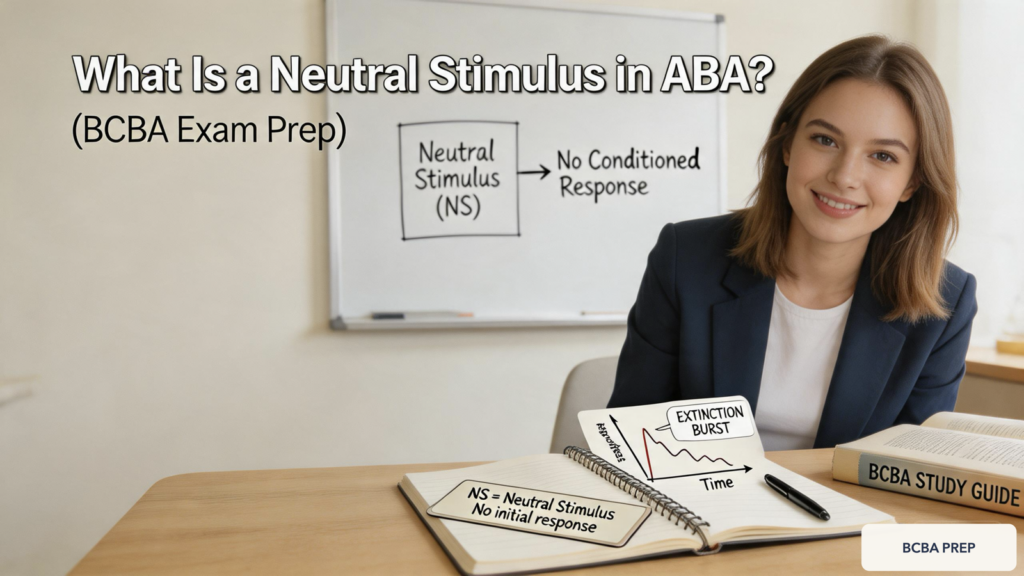
What Is a Neutral Stimulus? Definition in ABA
A neutral stimulus is an environmental event that initially elicits no reflexive or unconditioned response. In ABA, understanding neutral stimuli is essential for analyzing how new stimuli acquire behavioral functions through respondent conditioning. Neutral stimuli serve as the starting point for many learned associations—without them, conditioned responses could not develop. They are distinct from other stimuli because they have no inherent power to evoke a behavior; their function is entirely dependent on subsequent learning history.
Table of Contents
- What Is a Neutral Stimulus? Definition in ABA
- How a Neutral Stimulus Becomes a Conditioned Stimulus: The Pairing Process
- ABA Examples of Neutral Stimuli in Clinical Settings
- Neutral Stimulus and the BCBA Exam: Common Traps to Avoid
- Quick Reference: Neutral Stimulus Checklist
- Practice Questions to Test Your Knowledge
Key Characteristics
- Produces no reflexive response before pairing — for example, a bell does not make a dog salivate naturally.
- Can become a conditioned stimulus (CS) through repeated pairing with an unconditioned stimulus (US).
- Its function is context-dependent; a stimulus neutral in one setting may already be conditioned in another.
- Initial presentation of a neutral stimulus yields a neutral or orienting response, not a learned one.
- Neutral stimuli are not necessarily novel; a familiar stimulus can still be neutral if it has no history of being paired with a US.
Neutral Stimulus vs. Conditioned Stimulus
A neutral stimulus has no behavioral effect until it is paired. In contrast, a conditioned stimulus reliably evokes a conditioned response (CR) after successful pairing. The transformation from neutral to conditioned is the core of classical conditioning. For BCBA exam purposes, it is critical to distinguish between these two states: a stimulus is neutral only before conditioning; after conditioning, it is no longer neutral—it becomes a CS. Additionally, a stimulus that is neutral for one response might already be conditioned for another. For example, a buzzer might be neutral for salivation but already conditioned for an eye blink if previously paired with an air puff.
How a Neutral Stimulus Becomes a Conditioned Stimulus: The Pairing Process
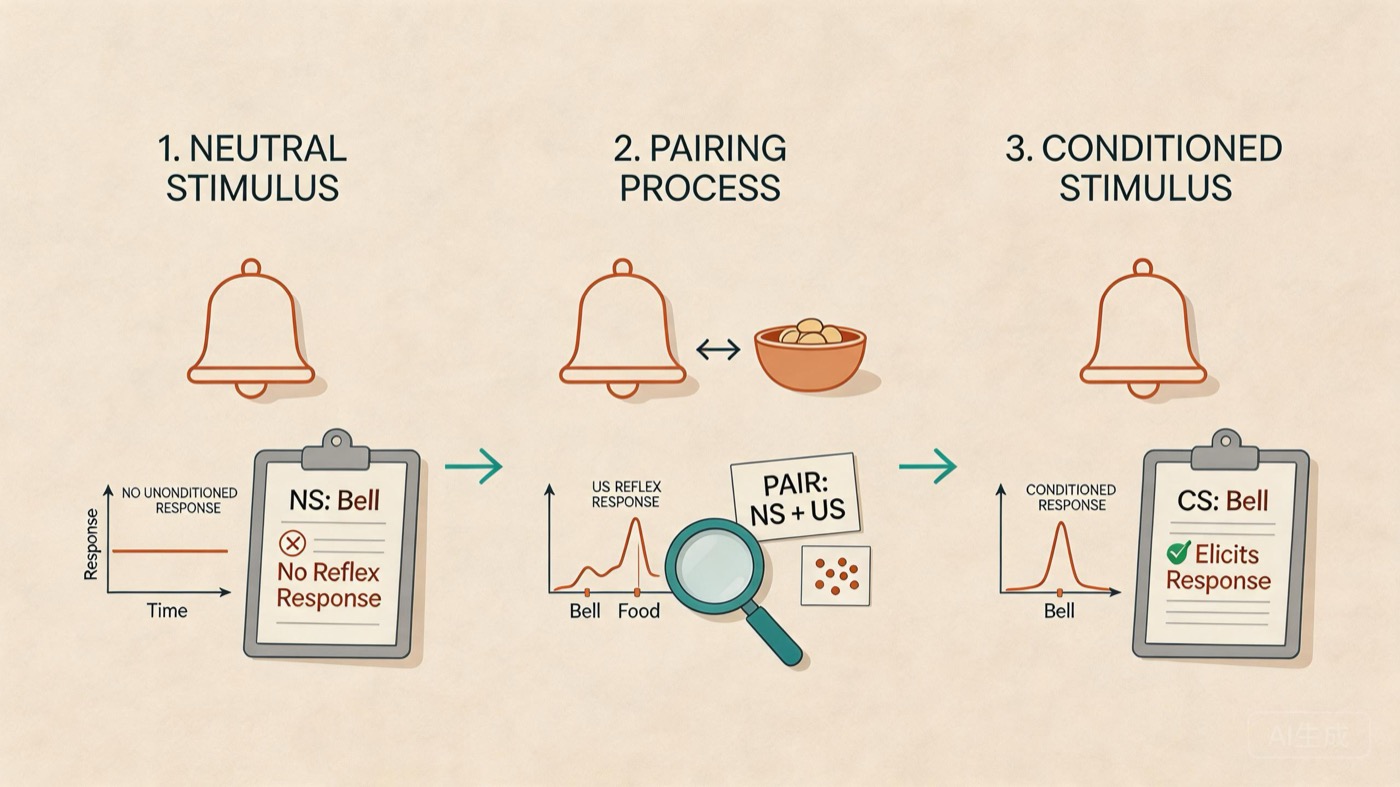
Respondent conditioning explains how a neutral stimulus acquires the ability to elicit a response. The process unfolds in three phases. Understanding each phase thoroughly is important for answering exam questions about the order of events and critical variables.
Before Pairing: NS Elicits No Response
Initially, the neutral stimulus (e.g., a metronome) produces no salivation. Only the unconditioned stimulus (food) naturally elicits the unconditioned response (salivation). At this stage, the NS is functionally inert—it might trigger an orienting response (turning toward the sound), but not the targeted reflexive behavior.
During Pairing: NS + US Repeatedly
The neutral stimulus is presented just before or simultaneously with the US. Temporal contiguity and contingency are critical for effective conditioning. Without repeated pairings, the neutral stimulus remains neutral. The order of presentation matters: in forward conditioning (NS before US), conditioning occurs most efficiently. Simultaneous or backward conditioning (US before NS) produces weaker or no conditioning. Additionally, the number of pairings, intensity of stimuli, and consistency of pairing affect how quickly the neutral stimulus becomes a CS.
After Pairing: NS Becomes CS Eliciting CR
Following sufficient pairings, the former neutral stimulus becomes a conditioned stimulus. Now it alone elicits a conditioned response similar to the UR. Note that the CR is rarely identical to the UR; it is typically a learned approximation. For example, while the UR to food might be robust salivation, the CR to a bell might be a smaller salivation. For more on this process, see our guide on respondent conditioning examples.
ABA Examples of Neutral Stimuli in Clinical Settings
Neutral stimuli appear frequently in behavior intervention plans. Below are three realistic ABA examples demonstrating how initially neutral events gain function. These examples illustrate how neutral stimuli can be leveraged for both skill acquisition and behavior reduction.
Example 1: Neutral Stimulus in DTT
A teacher’s instruction “point to blue” is initially neutral for a learner. After pairing with reinforcement for correct responses, the instruction becomes a discriminative stimulus (SD) evoking a correct selection. Note: In operant conditioning, the instruction transitions from neutral to SD; this differs from respondent conditioning, where the NS becomes a CS. However, the principle of acquiring function through pairing remains similar.
Example 2: Neutral Stimulus in Toilet Training
The sound of a flush is neutral at first. Over time, pairing the flush with preferred activities (e.g., washing hands, leaving the bathroom) may condition the flush sound to signal completion of the routine. In some cases, the flush sound may also become a CS for a feeling of relief if it has been consistently paired with the end of a discomforting situation (e.g., being wet).
Example 3: Neutral Stimulus in Phobia Reduction
A picture of a spider is neutral for someone without a fear. Through pairing with relaxing stimuli or counterconditioning, it may become a conditioned stimulus for calm responses. This is the basis for systematic desensitization: a hierarchy of feared stimuli, each initially neutral, is paired with relaxation to replace anxiety with a competing response.
Neutral Stimulus and the BCBA Exam: Common Traps to Avoid
Exam candidates often miss questions about neutral stimuli due to several common mistakes. Watch for these traps. Mastering these will help you avoid losing easy points on stimulus function questions.
Trap: Confusing NS with S-Delta
A neutral stimulus is associated with no consequence, whereas an S-delta signals extinction (no reinforcement available). In operant conditioning, S-delta is defined by its correlation with extinction, not by being neutral. An S-delta has a history of being correlated with extinction; a neutral stimulus has no such history. In everyday language, a neutral stimulus might be called “neutral,” but in behavior analysis, technical terms apply.
Trap: Assuming NS Always Becomes CS
A neutral stimulus only becomes a conditioned stimulus if pairing is effective. If the US no longer follows, or if contiguity is poor, the neutral stimulus remains neutral. For example, hearing a bell randomly without food never produces conditioning. Additionally, if extinction occurs (CS presented without US repeatedly), the CS returns to being a neutral stimulus—this is called respondent extinction.
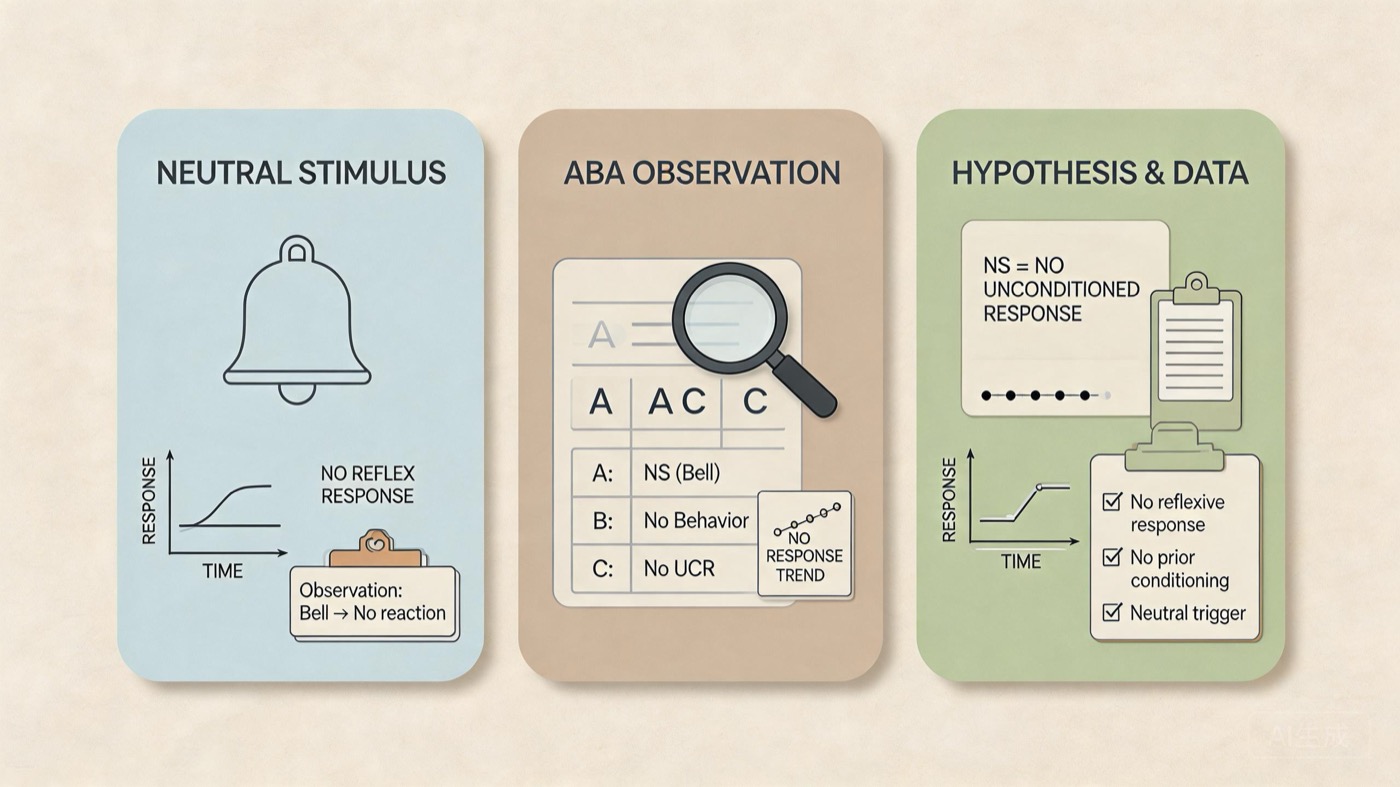
Trap: Misidentifying NS in ABC Data
In ABC records, a neutral stimulus is not an motivating operation (MO) or a discriminative stimulus. It does not alter the value of reinforcement or signal its availability. Check if the stimulus originally evoked any learned behavior. A common exam question gives an ABC data sheet in which a stimulus precedes a behavior but has no function; the answer may be “neutral stimulus.”
Quick Reference: Neutral Stimulus Checklist
- Identify whether the stimulus initially elicits a reflexive response.
- Confirm if pairing with a US has occurred (temporal contiguity + contingency).
- Distinguish NS from SD and MO functions.
- Remember that a stimulus can be neutral in one context but conditioned in another.
- If a stimulus has been conditioned, it is no longer neutral; do not call it neutral after pairing.
Practice Questions to Test Your Knowledge
Try these exam-style questions to reinforce your understanding.
1. Which of the following best describes a neutral stimulus?
A) A stimulus that evokes a conditioned response
B) A stimulus that initially elicits no reflexive response
C) A stimulus that signals reinforcement is available
D) A stimulus that increases the value of a reinforcer
Answer: B
2. A therapist presents a neutral stimulus before an unconditioned stimulus repeatedly. What is this procedure called?
A) Operant conditioning
B) Respondent conditioning
C) Extinction
D) Stimulus discrimination
Answer: B
3. A neutral stimulus that has been paired with a US is called a:
A) Discriminative stimulus
B) Conditioned stimulus
C) Motivating operation
D) Unconditioned stimulus
Answer: B
4. Which variable is most critical for a neutral stimulus to become a CS?
A) The stimulus being novel
B) Consistent pairing with a US
C) The stimulus being intense
D) The US being removed
Answer: B
For more practice, check out our free BCBA mock exam questions.
Neutral stimuli are a foundational concept in respondent conditioning. Mastering the definition, pairing process, and common exam traps will strengthen your understanding for the BCBA exam. For a deeper dive, see the BACB’s task list resources on BACB.org.


