
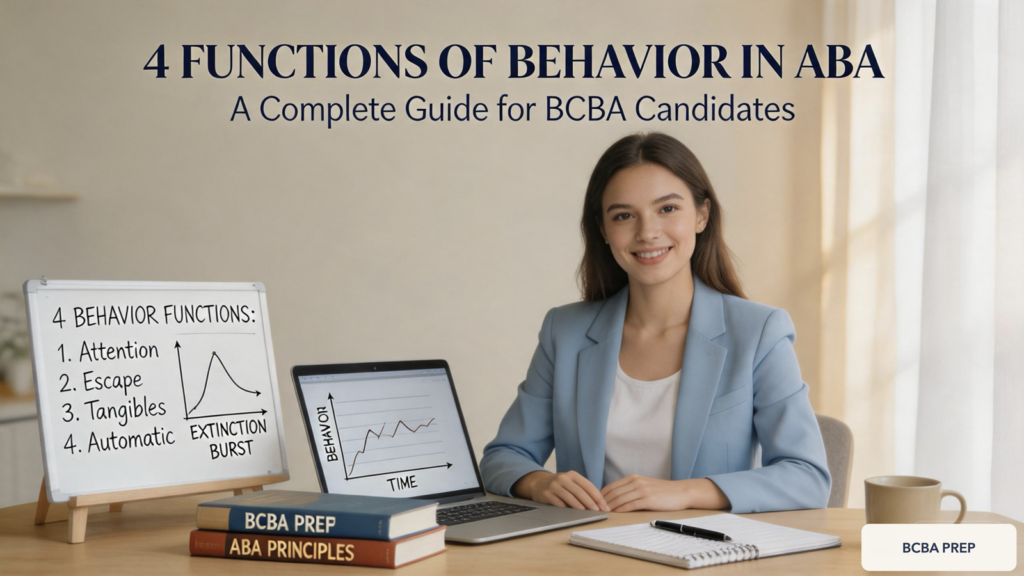
What Are the 4 Functions of Behavior in ABA?
In Applied Behavior Analysis, every behavior occurs for a reason. Understanding the 4 functions of behavior is essential for conducting functional assessments and designing effective interventions. For BCBA candidates, this concept appears repeatedly on the exam. Each function describes the maintaining consequence that reinforces the behavior. The four functions are: escape/avoidance, attention, access to tangibles/activities, and sensory stimulation (also called automatic reinforcement). Identifying the function allows behavior analysts to develop function-based interventions, which are more effective and ethical than one-size-fits-all approaches. On the BCBA exam, you will be tested on your ability to hypothesize the function from brief scenarios, distinguish between overlapping functions, and select the best intervention based on the function.
Table of Contents
- What Are the 4 Functions of Behavior in ABA?
- Worked ABC Examples: Identifying the Function
- Determining the Function: Exam Relevance and Common Traps
- Quick Checklist for Function Identification
- Summary: Master the 4 Functions for BCBA Exam Success
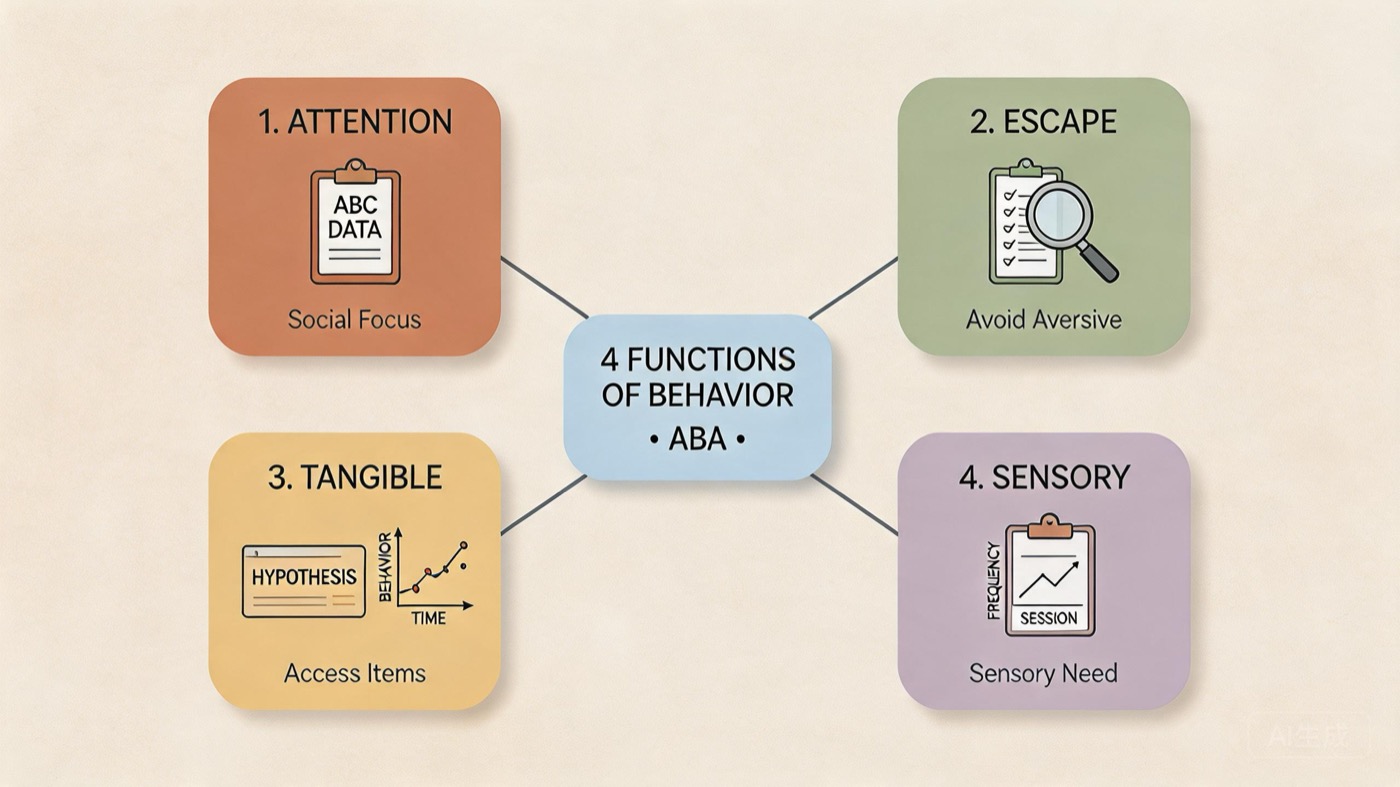
Escape or Avoidance
Escape-maintained behavior occurs when the individual removes or avoids an aversive stimulus. For example, a teacher gives a math worksheet (antecedent), the student throws the pencil (behavior), and the teacher sends the student to a break (consequence). The behavior is reinforced by escaping the task. Avoidance is a closely related function: the behavior occurs before the aversive event to prevent it entirely. For instance, a student may ask to go to the bathroom every time the teacher announces a quiz. Both escape and avoidance are considered under the same function. A common exam trap is confusing escape with attention: if the consequence removes a demand but also involves social interaction (e.g., a teacher calmly tells the student to take a break), the primary function is still escape because the demand is removed. The reinforcer is the termination of the aversive stimulus, not the teacher’s words. Sometimes, escape behavior can be reinforced by a delay in task completion; the longer the delay, the more likely the behavior will recur.
Attention Seeking
Attention can be positive (praise, eye contact) or negative (reprimands, scolding). A child whining until a parent looks at them is an example. The maintaining consequence is access to social attention. Importantly, even negative attention (e.g., yelling) can reinforce behavior if it increases the likelihood of the behavior in the future. On the exam, look for scenarios where the behavior results in someone looking, talking, or otherwise interacting with the individual. A common mistake is to assume that only positive attention functions as a reinforcer; however, any form of attention that follows the behavior can serve as a reinforcer. For example, a student who shouts out in class may receive a reprimand from the teacher (negative attention), but if the shouting increases, the function is attention. Also, note that attention can come from peers or even from online interactions. When analyzing an ABC sequence, if the consequence includes a social response directed at the individual, the function is likely attention.
Access to Tangibles or Activities
When behavior produces a preferred item or activity, it is maintained by tangible reinforcement. Crying until given a tablet is a classic example. The behavior gains access to the desired item. This function also includes access to activities, such as being allowed to play a game or go outside. A common exam scenario: a child refuses to clean up their toys (behavior) and then the parent allows them to watch TV instead (consequence). The function is access to tangibles (TV time). Distinguishing tangible from escape can be tricky: if the behavior removes a non-preferred task (escape) but also results in access to a preferred activity, you must determine which consequence is the primary reinforcer. Typically, if the aversive demand is removed entirely, it’s escape; if the individual is simply given a preferred item while the demand remains, it’s tangible. For example, a child screams during math homework, and the parent gives them candy to stop screaming (tangible) but still expects them to finish homework later—the function is tangible (access to candy).
Sensory Stimulation (Automatic/Self-Stimulatory)
Automatic reinforcement occurs when the behavior produces its own sensory consequence. Hand-flapping that creates visual input is reinforced internally, without social mediation. This function can be difficult to identify because the reinforcer is not observable. On the exam, look for behaviors that occur in isolation or persist even when no one else is present. Also, if the behavior appears repetitive or stereotyped (e.g., rocking, spinning objects, humming), the function is often sensory. Automatic reinforcement can be positive (the behavior feels good) or negative (the behavior reduces an aversive internal state, such as pain). For example, scratching an itch is maintained by automatic negative reinforcement (removal of itch sensation). In ABA, automatic functions are often assessed through alone conditions in a functional analysis. A common trap is to assume that all repetitive behaviors are sensory; however, some may be maintained by attention (e.g., a child flaps hands to get a parent’s reaction). Careful observation of the consequences is required.
Worked ABC Examples: Identifying the Function
Applying the ABC contingency (Antecedent-Behavior-Consequence) helps hypothesize the function. Below are three examples from the BCBA exam context. Each example includes a detailed analysis to help you practice.
Example 1: Escape from Task Demands
- Antecedent: Teacher gives a difficult worksheet
- Behavior: Student throws pencil
- Consequence: Teacher sends student to take a break
- Hypothesized function: Escape
Analysis: The antecedent (difficult worksheet) is aversive. The behavior (throwing pencil) results in removal of the worksheet (break). The consequence is the end of the task. If the student consistently throws the pencil when given difficult work, the function is escape. This is a classic escape-maintained behavior.
Example 2: Attention from Peer
- Antecedent: Peer plays alone
- Behavior: Child shouts loudly
- Consequence: Peer looks and says ‘stop’
- Hypothesized function: Attention
Analysis: The behavior (shouting) is followed by a social response (peer looks and says ‘stop’). Even though the peer’s response is negative, it still provides attention. If the shouting increases, the function is attention. Note that the antecedent (peer playing alone) indicates that the child may be seeking interaction.
Example 3: Access to Snack
- Antecedent: Snack is out of reach
- Behavior: Child screams
- Consequence: Parent gives snack
- Hypothesized function: Tangible
Analysis: The behavior (screaming) produces access to the snack. The snack is a tangible item. If the screaming occurs only when the snack is withheld, the function is tangible. This is straightforward, but be aware that the same child might scream to escape a demand in a different context. Functions are context-specific.
For more practice, see our detailed functions analysis guide.
Determining the Function: Exam Relevance and Common Traps
The BCBA exam often tests your ability to identify the function from a scenario. Many questions present subtle cues. Common traps include:
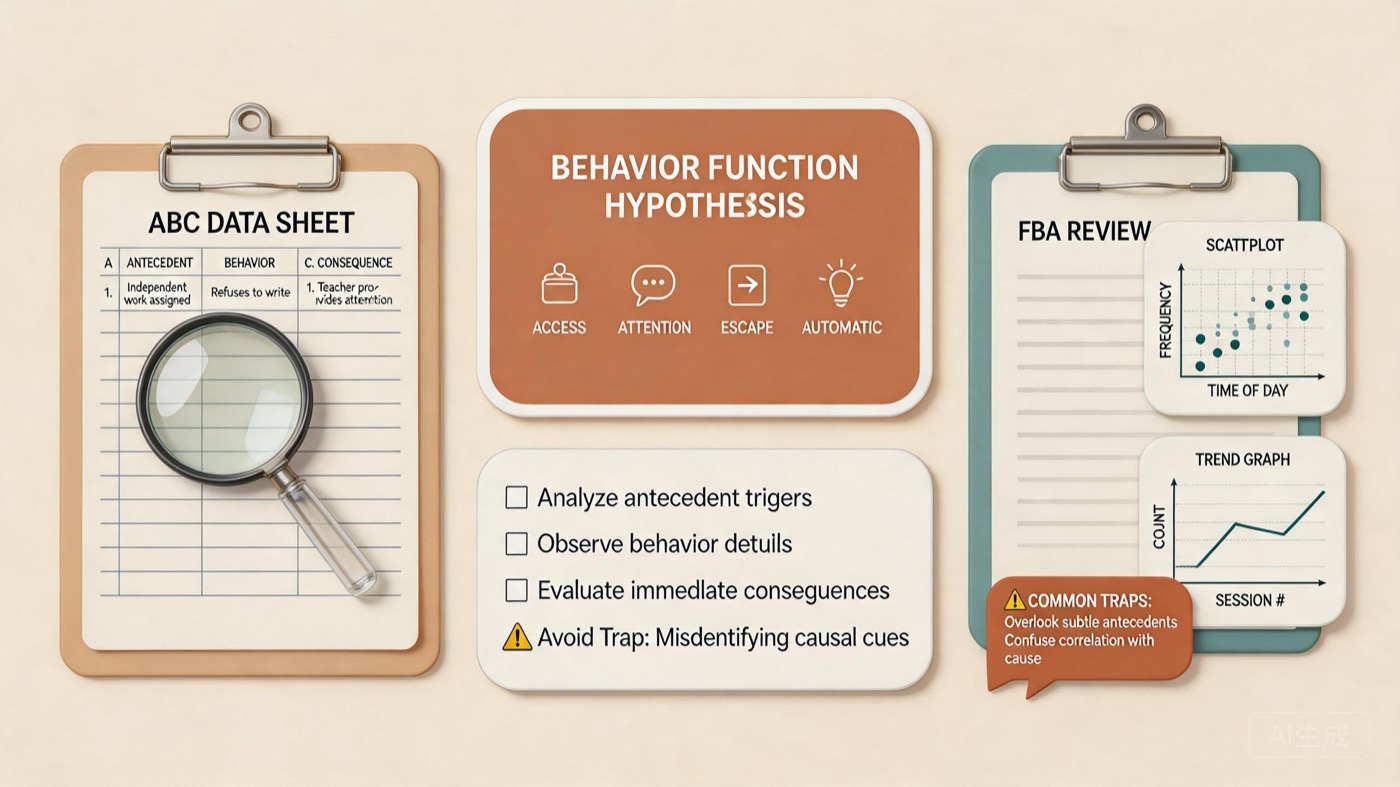
Common Exam Traps
- Escape vs. Attention: If the consequence removes a demand, it is escape. If it provides a reaction, it is attention. Watch for scenarios where both occur. For example, if a child tantrums and the teacher removes the task AND then comforts the child, the primary function is likely escape because the task was removed. However, if the child continues to tantrum even after the task is removed, attention may also play a role. Always ask: What was the immediate consequence? What changed first?
- Multiple functions: One behavior can serve different functions in different contexts. Be prepared to select the most likely primary function. In some cases, a behavior may be maintained by the same function across contexts, but the exam may describe a scenario where the behavior occurs in multiple settings with different outcomes. You may need to identify the function for a specific instance. Also, note that a single behavior can have multiple functions simultaneously (e.g., head-slapping may provide both sensory input and escape from demands), but the exam typically asks for the most likely function based on the information given.
- Automatic vs. socially mediated: If the reinforcer is internal, the function is sensory. Exam items may describe solitary behavior with no clear social consequence. For example, a child rocks back and forth in a corner alone. If the rocking continues even when no one is present, the function is automatic. However, if the child rocks only when a parent is nearby and then the parent comforts the child, the function may be attention. Look for clues about whether the behavior occurs in isolation or in the presence of others.
- Tangible vs. Escape: Sometimes access to a tangible item also involves removal of a demand. For example, a child is asked to clean up (antecedent), screams (behavior), and then the parent allows him to play with a toy instead of cleaning (consequence). Here, the demand (cleaning) is removed and a tangible (toy) is provided. Is the function escape (from cleaning) or tangible (access to toy)? Typically, if the demand is completely removed, escape is the primary function; if the demand remains but the child gets the toy, it’s tangible. In this scenario, because cleaning is no longer required, escape is more likely. The exam may test this distinction.
Review functional behavior assessment for deeper insight.
Quick Checklist for Function Identification
Use this checklist when analyzing behavior for the exam or in practice. This step-by-step guide will help you avoid common errors and systematically identify the function.
- Identify the antecedent – what happened immediately before the behavior? Look for demands, denied access, alone time, or presence of a specific person.
- Describe the behavior objectively – avoid labels like ‘aggressive’ or ‘disruptive’. Use specific, measurable terms: ‘hit peer with open hand’, ‘screamed at 80 dB’, ‘turned away from task’.
- Note the consequence – what changed in the environment? Did the behavior result in removal of something, provision of something, or no change?
- Ask: Does the consequence remove something? (escape) – For example, removal of task, person, or demand.
- Ask: Does the consequence provide social interaction? (attention) – Look for eye contact, verbal statements, physical proximity, or any social response.
- Ask: Does the consequence give access to an item or activity? (tangible) – The individual gets a preferred item or access to a preferred activity.
- Ask: Is the consequence internal and sensory? (automatic) – The behavior itself produces reinforcement (e.g., visual stimulation, tactile sensation, reduction of pain). This is often inferred when no social or tangible consequence is observed.
- Consider the context: Does the behavior occur in multiple settings? Is it consistent across people? If the behavior only occurs in the presence of a specific person, the function is likely socially mediated (attention or escape from that person). If it occurs across settings and people, automatic or tangible functions may be more likely.
- Look for pattern consistency: If the behavior reliably follows a specific antecedent and leads to a specific consequence, the function is stable. Use this pattern to hypothesize the function.
For more exam prep tools, check our BCBA mock exam questions.
Summary: Master the 4 Functions for BCBA Exam Success
The 4 functions of behavior – escape, attention, tangible, and sensory – form the foundation of functional analysis. On the BCBA exam, you will be expected to identify functions from scenarios, differentiate between similar functions, and understand how to use this information to design interventions. Practice with ABC analysis and review the BACB task list for official standards. Keep a sharp eye on those exam traps, and you will be well-prepared. Remember that accurate function identification is not only a key exam skill but also a critical component of ethical and effective ABA practice. By mastering these four functions, you will be better equipped to conduct functional behavior assessments and develop interventions that address the root cause of behavior. Good luck with your studies!


