
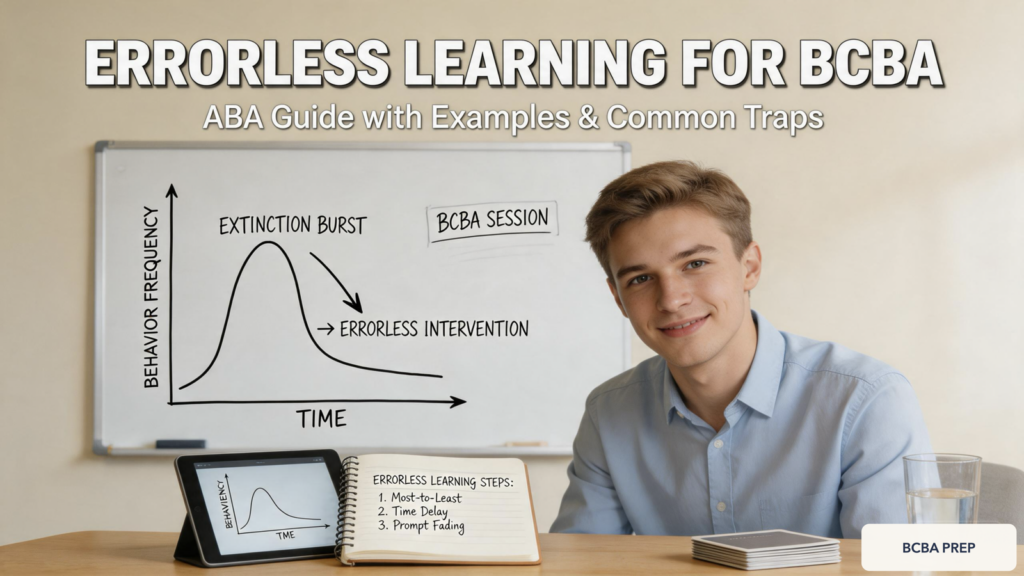
What Is Errorless Learning in Applied Behavior Analysis?
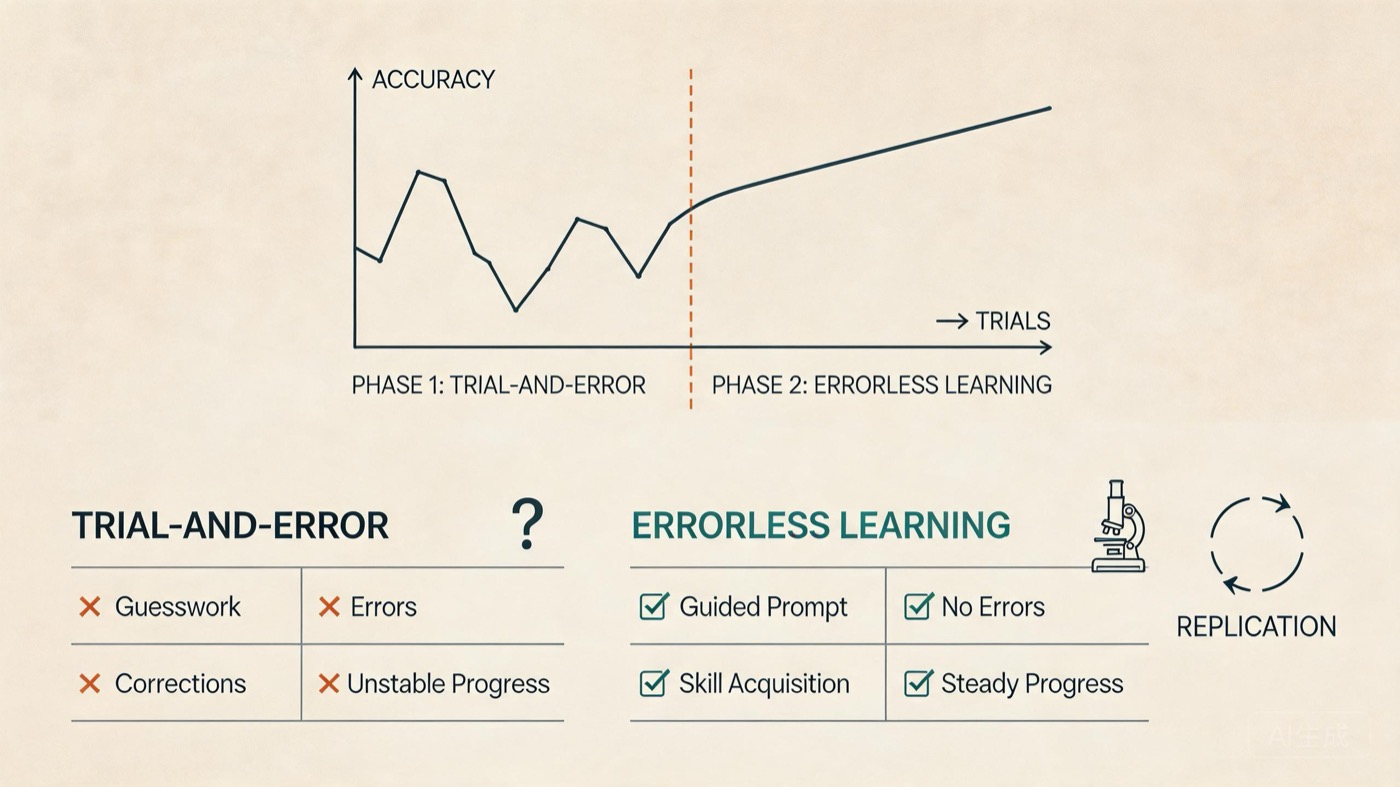
Errorless learning is a teaching procedure designed to minimize or prevent learner errors during skill acquisition. Instead of allowing a learner to guess and learn from mistakes (trial-and-error), the instructor provides a prompt that ensures a correct response from the start. The goal is to build accurate stimulus control quickly and reduce frustration. This approach is particularly valuable for learners who are prone to frustration or who engage in challenging behavior when they make errors, such as individuals with autism spectrum disorder or intellectual disabilities. By avoiding errors, errorless learning also reduces the likelihood that incorrect responses will be practiced and strengthened.
Table of Contents
- What Is Errorless Learning in Applied Behavior Analysis?
- Errorless Learning Procedure: Step-by-Step Guide
- Real-World ABA Examples of Errorless Learning
- Exam Relevance: How Errorless Learning Appears on the BCBA Test
- Quick Checklist for Errorless Learning Implementation
- Summary: Why Errorless Learning Matters for BCBA Candidates
This approach originated from Terrace’s work on discrimination training and is widely used in ABA to teach new skills, especially to learners who may be sensitive to errors. Key components include:
- Prompt hierarchy: Use the most intrusive prompt needed to guarantee success (e.g., physical guidance, echoic).
- Prompt fading: Gradually reduce prompt intensity or delay it over time.
- Reinforcement: Deliver strong reinforcement for each correct response, even if prompted.
- Stimulus control transfer: The goal is for the natural discriminative stimulus (SD) to evoke the behavior without prompts.
Errorless Learning Procedure: Step-by-Step Guide
Implementing errorless learning requires careful planning and systematic fading. Follow these steps:
Selecting the Appropriate Prompt
Choose a prompt that ensures a correct response on the first trial. For motor skills, physical guidance is often used; for verbal behavior, an echoic prompt (modeling the word) works well. Consider the learner’s current skill level and the task demands. The prompt should be the least intrusive one that still guarantees success, but when in doubt, start with a more intrusive prompt to ensure errorless trials initially.
Fading Prompts Systematically
Fade prompts using either most-to-least prompting or time delay. In most-to-least, you move from full physical to partial to gestural to independent. In time delay, you insert a short delay (e.g., 0s, 2s) before delivering the prompt. If an error occurs, return to the last successful prompt level and try again. The key is to fade gradually enough that the learner remains successful throughout the process. For example, if you are using a physical prompt for teaching a child to clap, you might start with full hand-over-hand guidance, then reduce to a light touch on the wrist, then a tap on the elbow, and finally a gesture toward the hands.
- Identify the target behavior and SD.
- Select a controlling prompt.
- Deliver the SD plus prompt, reinforce correct response.
- Fade the prompt gradually (e.g., reduce intensity or increase delay).
- Continue until the response occurs under the SD alone.
One common mistake is fading too quickly. If the learner starts making errors, it means the fading steps were too large. The rule of thumb is to maintain a low error rate (ideally below 10% of trials). Data collection on correct prompted and unprompted responses is critical to guide fading decisions.
Real-World ABA Examples of Errorless Learning
Here are two practical examples to illustrate how errorless learning is applied in ABA programs.
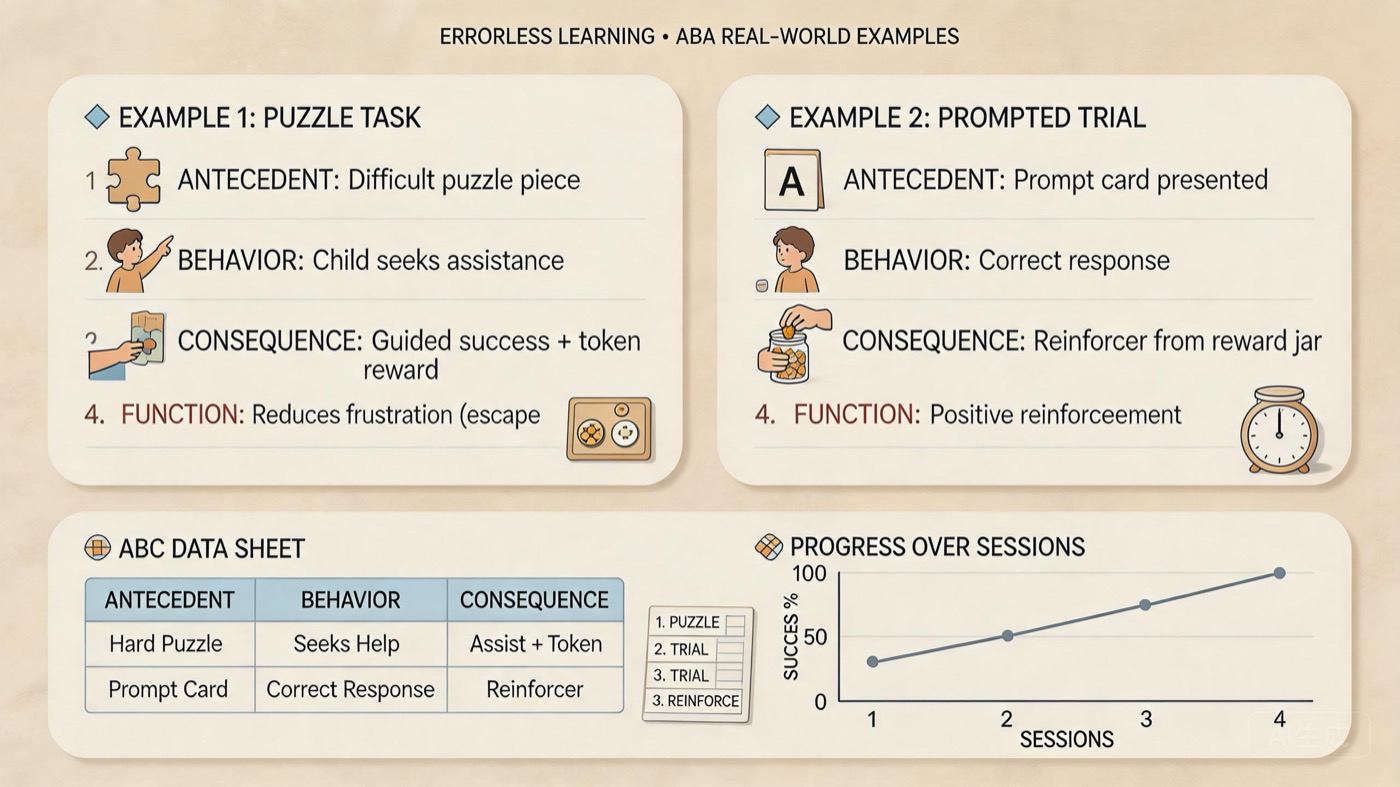
Example 1: Teaching a Child to Request ‘Help’
ABC Data: Antecedent = difficult puzzle piece; Behavior = child reaches toward helper; Consequence = helper provides assistance. Hypothesized function: escape from frustration or access to help. The errorless procedure: Immediately prompt the child to say ‘help’ (echoic) upon seeing the puzzle piece. Reinforce with assistance and praise. Fade by delaying the prompt by 2 seconds, then 4 seconds. Collect data on unprompted ‘help’ requests. It is important to also teach the child to emit the request in different contexts (e.g., with different puzzles or in other settings) to promote generalization.
Example 2: Teaching a Student to Identify the Letter ‘A’
ABC Data: Antecedent = card with ‘A’ among three other letters; Behavior = student points to ‘A’; Consequence = praise and access to a preferred toy. Hypothesized function: attention/access to preferred activity. The errorless procedure: Place the ‘A’ card closest to the student (positional prompt). After correct selection, gradually move ‘A’ to random positions. Fade by using a smaller positional difference until the student selects ‘A’ correctly in a random array. Include a transfer trial where no prompt is given. One advantage of this approach is that the student never points to an incorrect letter, which avoids practicing errors.
Exam Relevance: How Errorless Learning Appears on the BCBA Test
The BCBA exam often tests your ability to identify, compare, and apply errorless learning. Questions may ask you to choose the correct procedure for a given scenario or to recognize when an errorless approach is contraindicated. For instance, a question might describe a learner who becomes aggressive after making a mistake, making errorless learning the best choice. Another scenario might present a simple discrimination where trial-and-error is more efficient, testing your knowledge of when each approach is appropriate.
Common Exam Traps
Watch out for these frequent pitfalls:
- Trap 1: Confusing errorless learning with no prompting. Errorless learning uses prompts heavily at first.
- Trap 2: Thinking errorless learning means zero errors forever. Some errors may occur during fading, but they should be minimal.
- Trap 3: Mixing up most-to-least (errorless) with least-to-most (error-based). Most-to-least is the errorless approach.
- Trap 4: Forgetting that reinforcement must still occur after correct responses, even if prompted.
- Trap 5: Assuming errorless learning can be used for all learners and all skills. It works best for new skills and learners who benefit from low error rates; for highly similar discriminations, errorless learning may not be necessary or efficient.
Comparison to Trial-and-Error Learning
| Aspect | Errorless Learning | Trial-and-Error |
|---|---|---|
| Prompts | Heavy prompts initially | Minimal or no prompts |
| Error rate | Very low | High initially |
| When to use | New skills, learners sensitive to errors | Simple discriminations, robust learners |
| Efficiency | May require more trials initially | May be faster for some skills |
On the exam, you might be asked to select the best teaching strategy for a child who engages in self-injurious behavior after incorrect responses. In such cases, errorless learning is the safest and most effective choice.
Quick Checklist for Errorless Learning Implementation
- Identify the target behavior and the natural SD.
- Select a prompt that guarantees a correct response.
- Reinforce immediately after each correct response.
- Fade prompts systematically (most-to-least or time delay).
- Return to last successful prompt level if errors occur.
- Collect data on prompted vs. unprompted responses.
- Plan for generalization and maintenance (e.g., use multiple exemplars, teach across settings).
- Monitor for prompt dependency and adjust fading as needed.
Summary: Why Errorless Learning Matters for BCBA Candidates
Errorless learning is a core ABA procedure that reduces learner frustration and builds accurate stimulus control. For BCBA candidates, understanding the step-by-step implementation, common traps, and when to use it over trial-and-error is essential. Master this topic to answer exam questions confidently and apply it effectively in practice. For more study resources, check out our comprehensive guide on errorless learning in ABA and explore prompt dependency strategies. Additionally, see the BACB website for the latest task list and ethical guidelines.


