
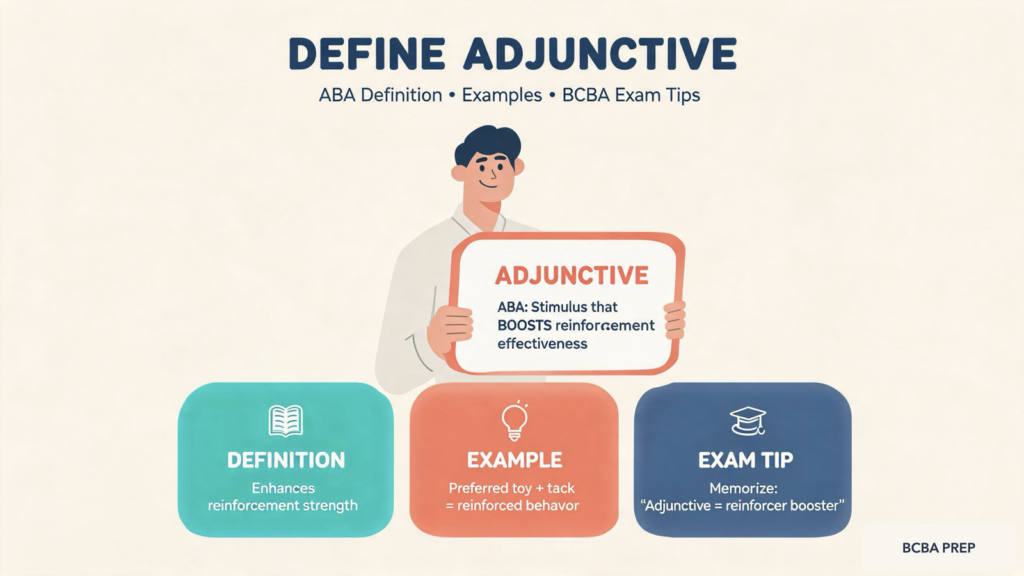
What Does Adjunctive Mean? The ABA Definition
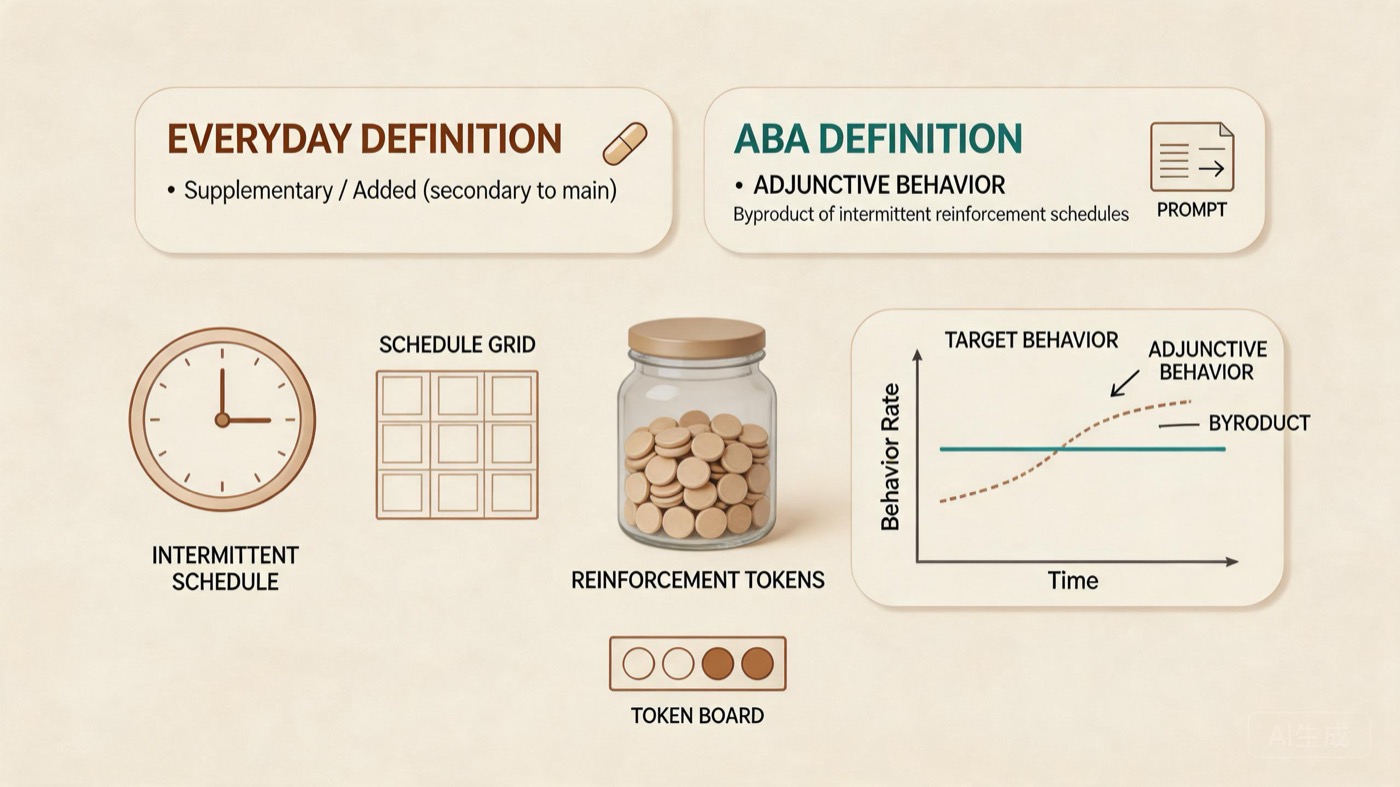
In everyday language, ‘adjunctive’ refers to something added or supplementary. But in applied behavior analysis, the term has a precise meaning. Adjunctive behavior is behavior that occurs as a byproduct of an intermittent schedule of reinforcement for another behavior. It is not directly reinforced by the schedule but emerges during the inter-reinforcement interval. This phenomenon was first systematically studied by Staddon and Simmelhag (1971), who observed that pigeons engaging in schedule-induced activities like pacing or pecking the chamber walls between food deliveries. These behaviors are not required by the schedule and are not reinforced, yet they reliably appear under certain conditions.
Table of Contents
- What Does Adjunctive Mean? The ABA Definition
- 3 ABA Examples of Adjunctive Behavior (with ABC Analysis)
- Why Adjunctive Behavior Matters on the BCBA Exam
- Quick Checklist: Is It Adjunctive?
- Common Exam Traps and How to Avoid Them
- Summary: Adjunctive Behavior Simplified
- References
For example, a pigeon in a Skinner box receiving food every 60 seconds may start pacing or pecking at the wall between deliveries. That pacing is adjunctive. The key is that the schedule of reinforcement (not the behavior itself) creates the conditions for the adjunctive response. In human settings, similar patterns emerge: individuals waiting for a delayed reward may engage in finger tapping, doodling, or other seemingly irrelevant actions.
3 ABA Examples of Adjunctive Behavior (with ABC Analysis)
To help you recognize adjunctive behavior on the BCBA exam, here are three practical examples. Each includes an ABC analysis (antecedent, behavior, consequence) and a hypothesized function.
Example 1: Pacing During Lean Reinforcement
Setting: Therapy room. A child receives praise and a token for every third correct response (FR3 schedule). Between trials, the child gets up and paces around the room.
- Antecedent: Token delivered, then no immediate reinforcer available.
- Behavior: Pacing in circles.
- Consequence: Movement provides sensory stimulation.
- Hypothesized function: Automatic reinforcement (movement).
Example 2: Water Bottle Flipping in Classroom
Setting: Inclusive classroom during independent work time. The teacher delivers praise and stickers every 10 minutes for on-task behavior (FI10). A student begins flipping a water bottle repeatedly.
- Antecedent: Long interval with no attention.
- Behavior: Flipping water bottle.
- Consequence: Peers laugh and look at the student.
- Hypothesized function: Attention from peers.
Example 3: Humming During Delayed Tangible
Setting: Home. A child requests a preferred toy; parent says ‘in two minutes’ (delay schedule). While waiting, the child hums a tune.
- Antecedent: Access to toy delayed.
- Behavior: Humming.
- Consequence: Auditory self-stimulation.
- Hypothesized function: Automatic stimulation (auditory).
Note that in each case, the adjunctive behavior is not directly taught—it arises because the schedule of reinforcement creates ‘down time’. The function of the adjunctive behavior often differs from the target behavior. For instance, in Example 2, the target behavior is on-task work maintained by teacher praise, while the adjunctive water bottle flipping is maintained by peer attention.
Why Adjunctive Behavior Matters on the BCBA Exam
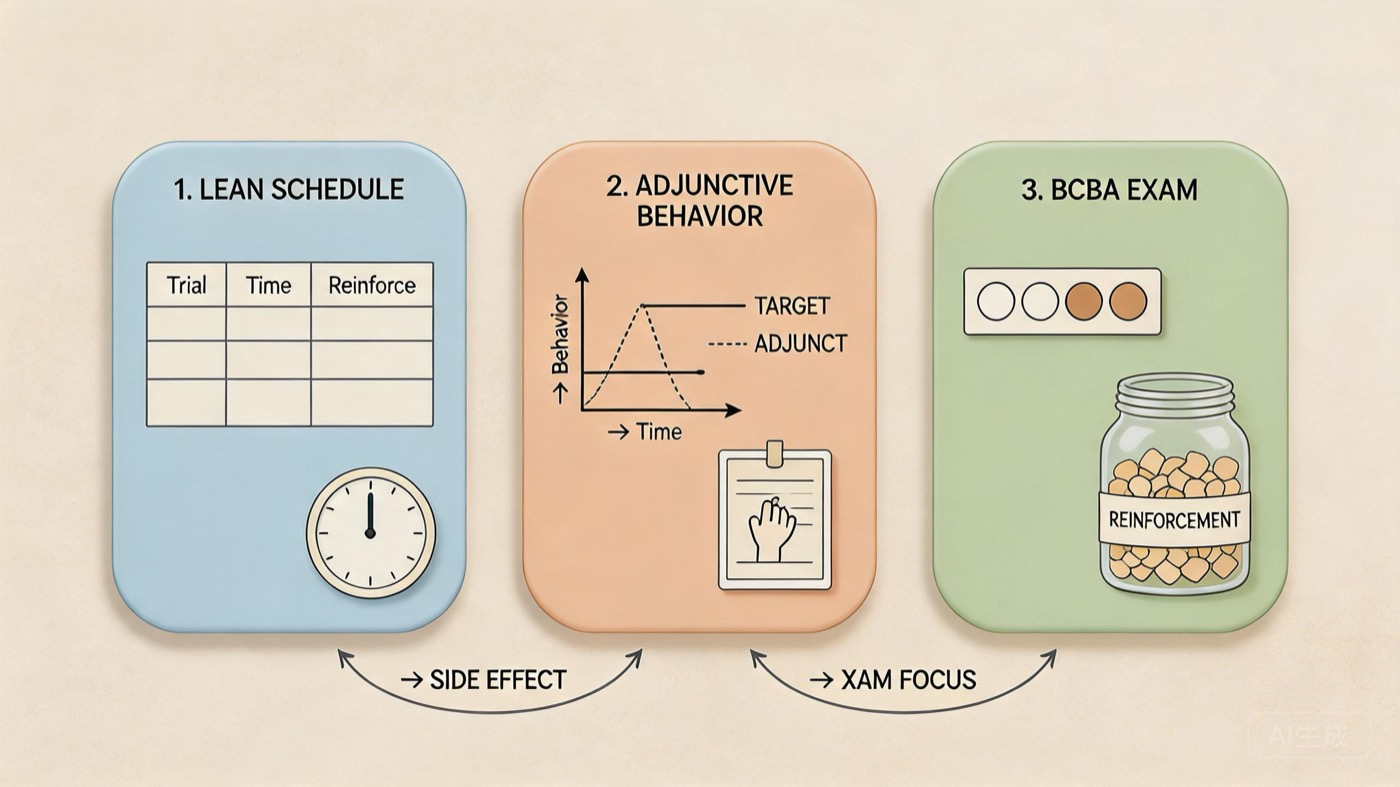
The BCBA exam tests your ability to identify how schedules of reinforcement affect behavior beyond the target response. Adjunctive behavior appears in questions about behavioral side effects of lean schedules. Understanding this concept is crucial because it demonstrates that reinforcement schedules can produce unintended behaviors that may interfere with or complicate intervention. Common traps include:
- Confusing adjunctive behavior with superstitious behavior (which is maintained by accidental reinforcement). Adjunctive behavior is schedule-induced, not necessarily reinforced.
- Thinking adjunctive behavior always has the same function as the target behavior. It often has a different function (e.g., automatic vs. social).
- Missing the antecedent: adjunctive occurs when the schedule is lean or there is a delay to reinforcement.
For more on how schedules affect behavior, check our guide on compound vs. simple schedules of reinforcement.
Quick Checklist: Is It Adjunctive?
When you read a scenario on the exam, ask yourself these five questions to determine if the behavior is adjunctive:
- Is the behavior occurring during an inter-reinforcement interval (i.e., between deliveries of reinforcement for a different behavior)?
- Does the behavior appear stereotyped or repetitive?
- Is the behavior not required by the schedule and not directly reinforced?
- Does the behavior cease when the schedule is removed or changed to a continuous schedule?
- Could the behavior serve an automatic or socially mediated function unrelated to the target behavior?
If most answers are ‘yes,’ it is likely adjunctive. For more practice, visit our free BCBA mock exam for scenario-based questions.
Common Exam Traps and How to Avoid Them
On the BCBA exam, test writers often include distractors that resemble adjunctive behavior but differ in key ways. One common trap is confusing adjunctive with schedule-induced polydipsia, a specific form of adjunctive drinking. While polydipsia is a well-known example, not all adjunctive behavior involves drinking. Another trap is assuming adjunctive behavior is always automatically maintained. In reality, it can be maintained by social consequences (like peer attention) as illustrated in Example 2. Finally, watch for scenarios where the behavior is directly reinforced by the schedule (e.g., a pigeon pecking a key under an FI schedule) – that is operant behavior, not adjunctive. A useful rule of thumb: if the behavior is required or reinforced by the schedule, it is not adjunctive.
Summary: Adjunctive Behavior Simplified
Adjunctive behavior is behavior induced by an intermittent schedule of reinforcement, not directly reinforced by that schedule. It often looks like repetitive, schedule-induced actions that serve automatic or social functions. On the BCBA exam, remember that lean schedules set the stage for adjunctive behaviors, and the function may differ from the target response. Keep this quick checklist handy, and you will recognize adjunctive behavior with confidence.


