
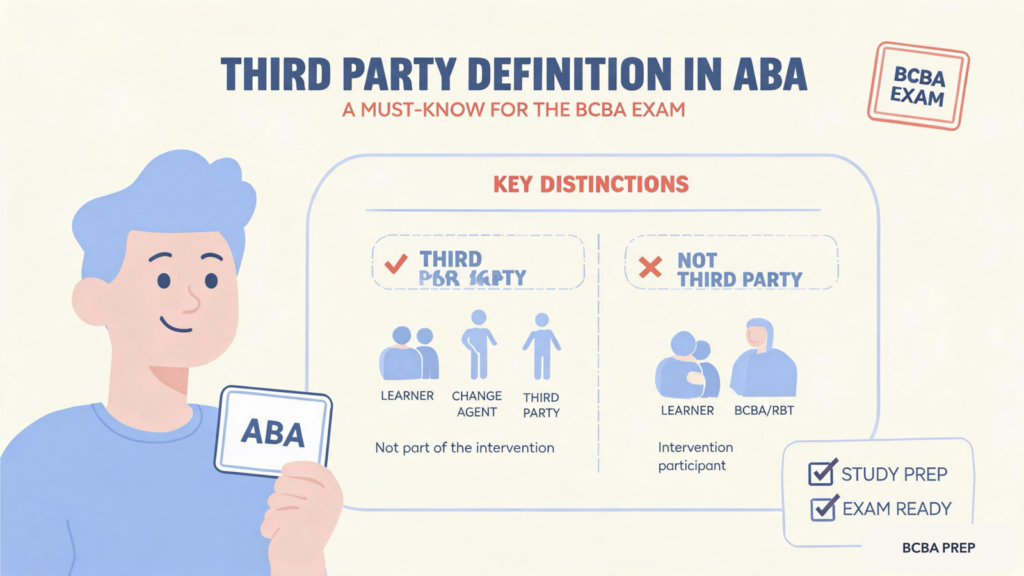
What Does ‘Third Party’ Mean in ABA?
In applied behavior analysis, the third party definition aba refers to any individual or entity that is neither the client nor the behavior analyst but is involved in the delivery or oversight of services. Unlike a general definition, where a third party might simply be an unrelated observer, in ABA a third party actively participates by funding, referring, or supervising services. Understanding this distinction is critical for the BCBA exam because it affects ethical obligations, informed consent, and data sharing.
Table of Contents
- What Does ‘Third Party’ Mean in ABA?
- Who Can Be a Third Party in ABA?
- Third Party in ABA: Key Examples for the BCBA Exam
- BCBA Exam Relevance: Why Third Party Matters
- Quick Checklist: Third Party in ABA
- Final Summary
General vs. ABA Definition
In everyday language, a third party is anyone outside a direct interaction. However, in ABA, a third party is specifically someone who has a stake in the behavior-analytic services. For example, an insurance company that authorizes sessions is a third party, as is a school district that contracts a BCBA. The BACB Ethics Code requires behavior analysts to clarify roles and obtain consent from both clients and third parties when involved.
Who Can Be a Third Party in ABA?
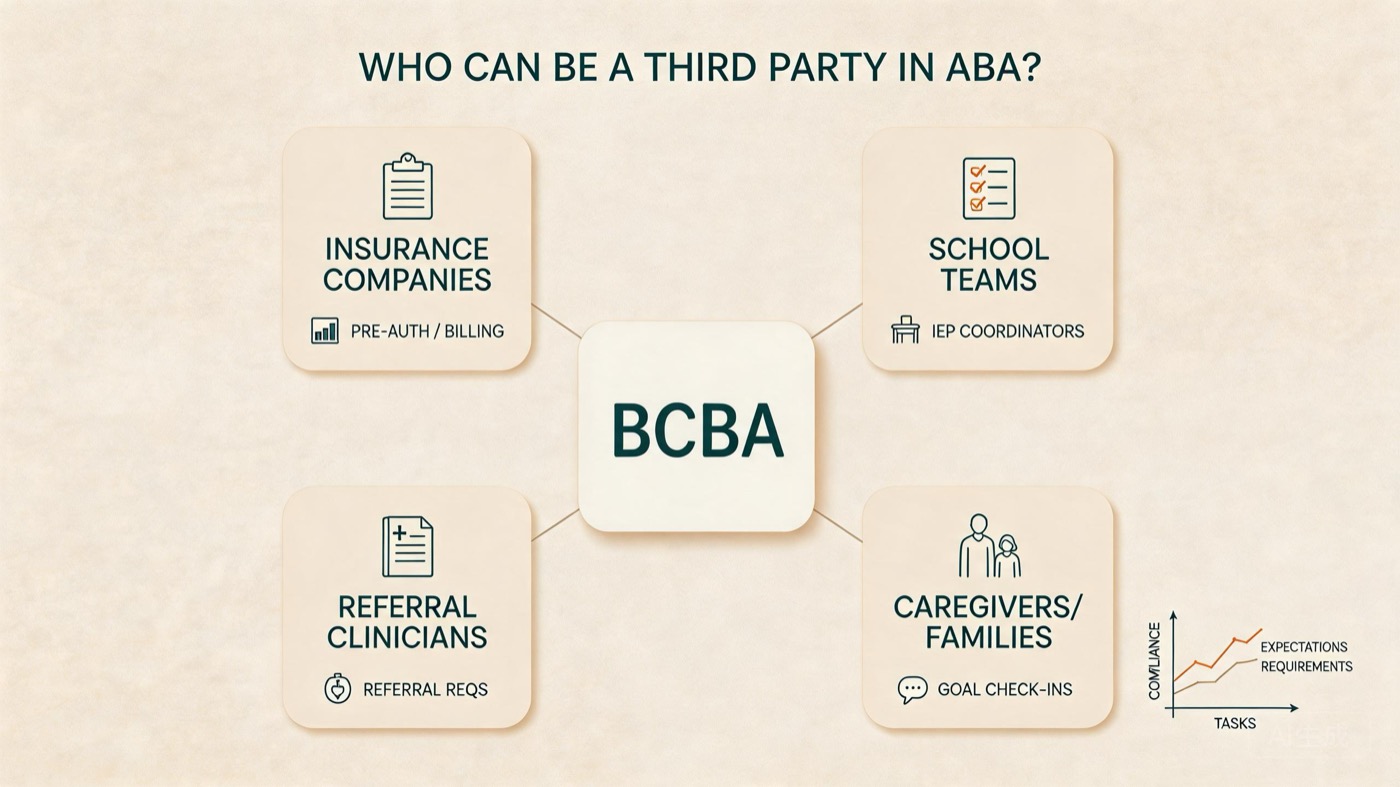
Common third parties in ABA practice include:
- Insurance companies that fund and authorize treatment
- School districts that contract behavior analysts for student support
- Parents or guardians when they are not the primary client (e.g., in early intervention, the child is the client)
- Other professionals such as speech therapists or physicians who collaborate on a case
- State agencies overseeing developmental disability services
Each third party has specific expectations and requirements that a BCBA must navigate.
Third Parties in School Systems
In a school setting, the district often serves as a third party. For instance, a teacher requests a behavior plan, the BCBA conducts a functional behavior assessment (FBA), and the district funds and oversees the plan. The district’s approval is a consequence that maintains the BCBA’s work.
Third Parties in Healthcare Funding
Insurance companies are frequent third parties. They authorize ABA sessions, require documentation, and reimburse services. The BCBA must balance the client’s needs with the insurer’s requirements, such as session note submission.
Third Party in ABA: Key Examples for the BCBA Exam
Exam questions often test your ability to identify who is a third party and how to respond ethically. Here are three worked examples:
Example 1: School District as Third Party
Antecedent: Teacher requests behavior plan for a student. Behavior: BCBA conducts FBA and writes BIP. Consequence: District approves plan and allocates resources. Hypothesized function: Access to services. The district is a third party funding and overseeing the plan.
Example 2: Insurance Company as Third Party
Antecedent: Authorization needed to continue sessions. Behavior: BCBA submits session notes and progress reports. Consequence: Reimbursement. Function: Maintain funding. The insurer is a third party controlling access to resources.
Example 3: Parent as Third Party
When a parent implements a behavior plan but the child is the client, the parent can be a third party. The BCBA must obtain informed consent from the parent while the child remains the primary client.
BCBA Exam Relevance: Why Third Party Matters
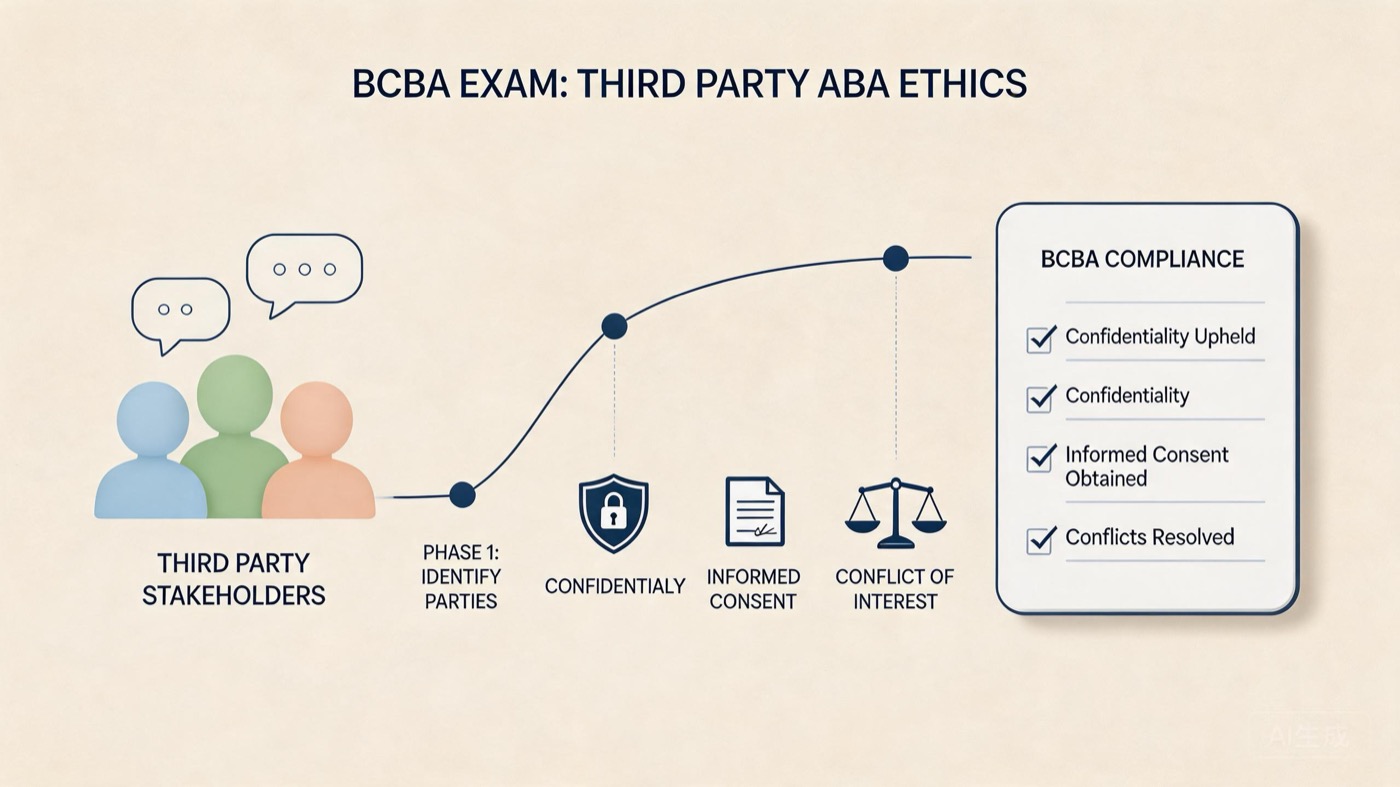
The BCBA exam frequently includes questions about third-party involvement, especially regarding ethics. You must know how to handle conflicts of interest, confidentiality, and consent when multiple parties are involved.
Ethical Responsibilities to Third Parties
The BACB Ethics Code outlines several responsibilities:
- Section 1.04: Clarify roles and responsibilities with clients and third parties
- Section 2.15: Obtain informed consent from both client and third party
- Section 3.01: Avoid conflicts of interest and ensure third-party demands do not compromise ethical practice
Common Exam Traps
Watch out for these frequent mistakes:
- Confusing third party with stakeholder or client — not all stakeholders are third parties
- Assuming you must always follow third-party directives even if they are unethical or harm the client
- Forgetting to get client consent before sharing data with third parties
Quick Checklist: Third Party in ABA
- Identify who is the client and who is the third party in each scenario
- Obtain informed consent from all relevant parties
- Clarify roles and responsibilities early in the relationship
- Withhold confidential information unless authorized
- Prioritize client welfare over third-party demands
- Document all third-party communications and agreements
Final Summary
The third party definition aba is essential for BCBA exam success. A third party is anyone other than the client or behavior analyst who is involved in service delivery. Examples include insurance companies, school districts, and sometimes parents. Ethically, you must balance client needs with third-party requirements while following the BACB Code. Use the checklist above to review, and practice identifying third parties in mock scenarios. For more exam prep strategies, visit our BCBA exam prep guide. Also review the BACB Ethics Code for official standards.


