
What Is a Generalization Stimulus?
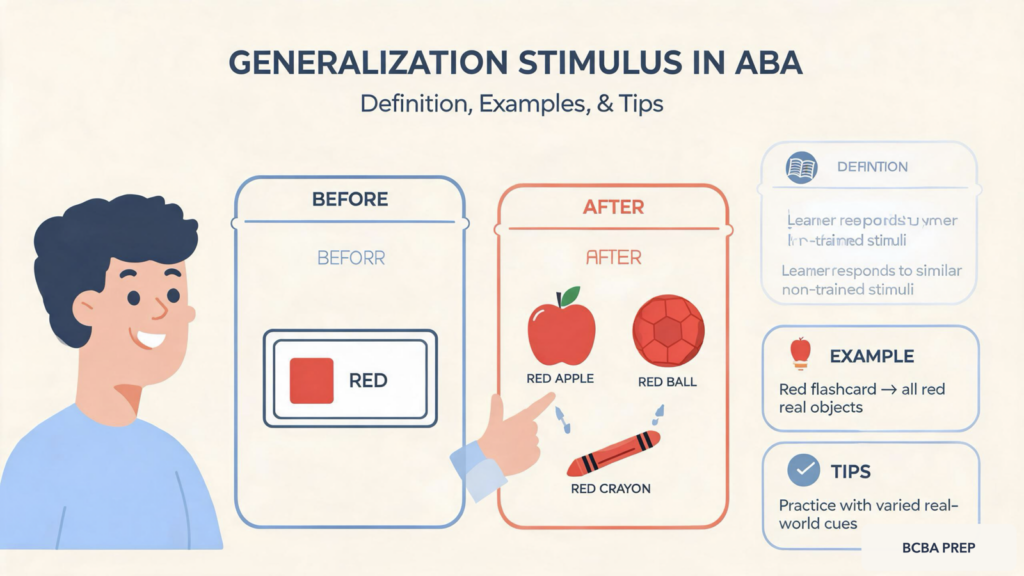
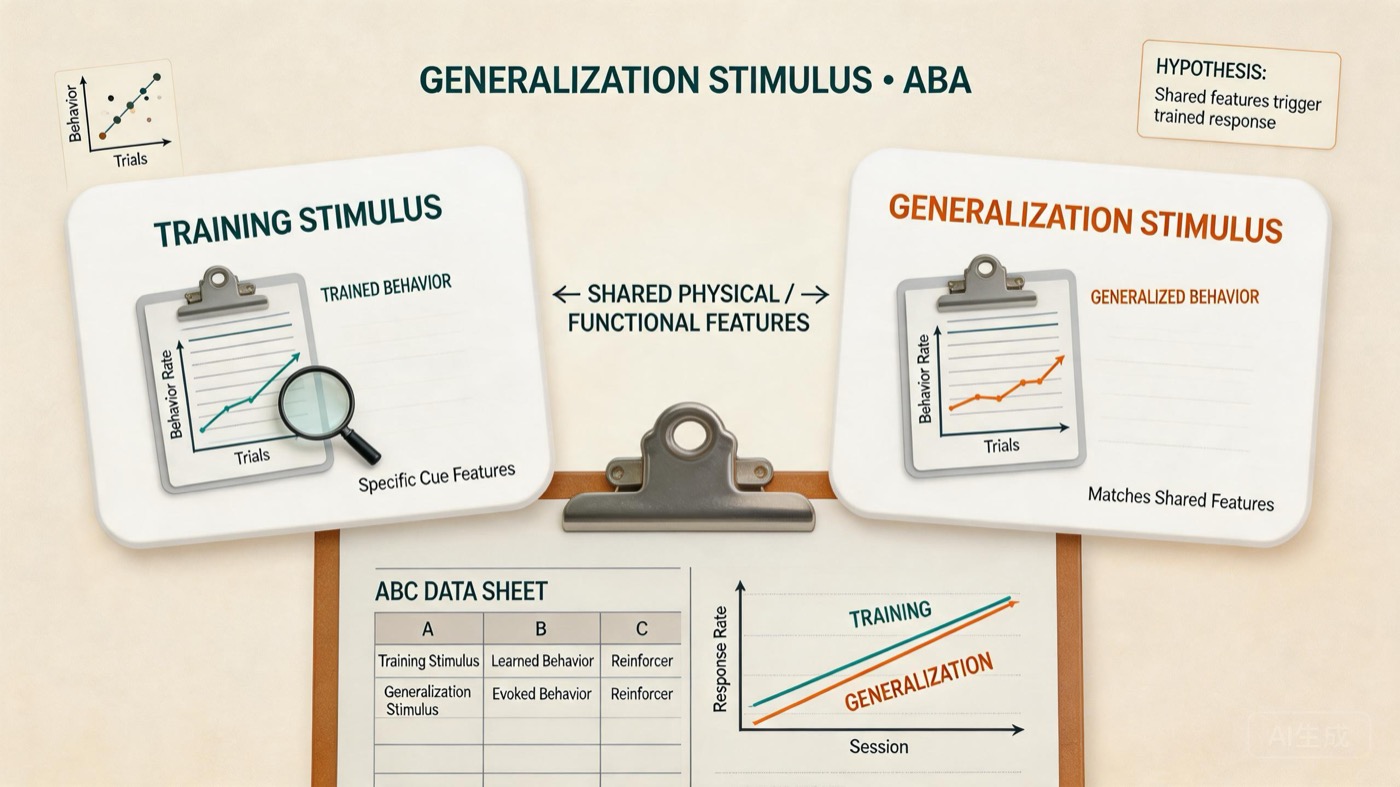
In applied behavior analysis, a generalization stimulus is any antecedent stimulus that evokes a behavior because it shares physical or functional features with a training stimulus. This concept is central to understanding how learned behaviors extend beyond the original teaching context.
Table of Contents
- What Is a Generalization Stimulus?
- Real-World ABA Examples of Generalization Stimulus
- Exam Relevance and Common Traps
- Quick Checklist for Generalization Stimulus
- Summary: Generalization Stimulus in ABA
- References
To clarify, stimulus generalization is the behavioral process of responding to novel stimuli that are similar to the training stimulus. The generalization stimulus itself is the actual stimulus that triggers the response due to that similarity. For example, if a child learns to say ‘ball’ when shown a red ball, they may also say ‘ball’ when shown a blue ball. The blue ball is a generalization stimulus because it shares features (round, bouncy) with the training stimulus.
Generalization Stimulus vs. Stimulus Generalization
Many learners confuse these two terms. Stimulus generalization refers to the tendency to respond to stimuli that are similar to the discriminative stimulus (SD). In contrast, a generalization stimulus is the specific stimulus that occasions the behavior without direct training. In discrimination training, an SD is correlated with reinforcement, while an S-delta is correlated with extinction. A generalization stimulus falls somewhere in between—it has not been explicitly taught but evokes the behavior because of shared properties.
Role in Stimulus Control
Generalization stimuli play a key role in stimulus control. When a behavior occurs in the presence of multiple stimuli that share common features, those stimuli collectively exert stimulus control. For instance, a child trained to request ‘cookie’ only from Mom may also request from Dad if Dad has similar physical features (e.g., both adults). This is adaptive because it allows skills to transfer across natural environments without exhaustive training.
For more on stimulus control, see our guide on stimulus control in ABA.
Real-World ABA Examples of Generalization Stimulus
Understanding through examples helps solidify the concept for the BCBA exam. Below are three scenarios with ABC analysis.
Example 1: The Red Ball and Other Round Toys
A child is taught to vocally say ‘ball’ when shown a red beach ball (training SD). Later, the child says ‘ball’ when seeing a blue soccer ball and a green tennis ball. Antecedent: round toy (blue ball). Behavior: says ‘ball’. Consequence: caregiver praise. The generalization stimulus is the blue ball (and other round toys) because it shares the feature ’round’ with the training stimulus. The likely function is social positive reinforcement (access to praise).
Example 2: Saying ‘Thank You’ to Different People
After learning to say ‘thank you’ when Mom hands them a snack, the child says ‘thank you’ when Dad hands them a toy and when Grandma hands them a book. Antecedent: person (Dad) giving an item. Behavior: says ‘thank you’. Consequence: smile and continued interaction. The generalization stimulus is any adult who delivers an item, as they share the common feature ‘adult giving something’. The function is social positive reinforcement (access to social attention).
Example 3: Stopping at Red Traffic Lights vs. Red Signs
A learner is taught to stop walking when a red traffic light appears during community safety training. Later, they also stop when seeing a red stop sign. Antecedent: red octagonal sign. Behavior: stops walking. Consequence: avoids danger (negative reinforcement). The generalization stimulus is the red stop sign because it shares the color red (and possibly the shape) with the trained traffic light. The function is negative reinforcement (escape from potential harm).
Exam Relevance and Common Traps
The BCBA exam frequently tests your ability to identify a generalization stimulus in a scenario and distinguish it from related concepts. Here are key areas to focus on.
How the BCBA Exam Tests Generalization Stimulus
- You may be given a vignette and asked to identify the generalization stimulus among several antecedents.
- Questions may contrast generalization stimulus with discriminative stimulus (explicitly trained) and S-delta (correlated with extinction).
- Some items ask which feature of a stimulus is responsible for generalization (e.g., shape, color, size).
- Expect scenario-based questions requiring you to describe the shared features between training and generalization stimuli.
Common Mistakes Candidates Make
- Confusing generalization stimulus and response generalization: Response generalization involves different behaviors (e.g., saying ‘ball’ and throwing ‘ball’), while generalization stimulus involves the same behavior in response to different stimuli.
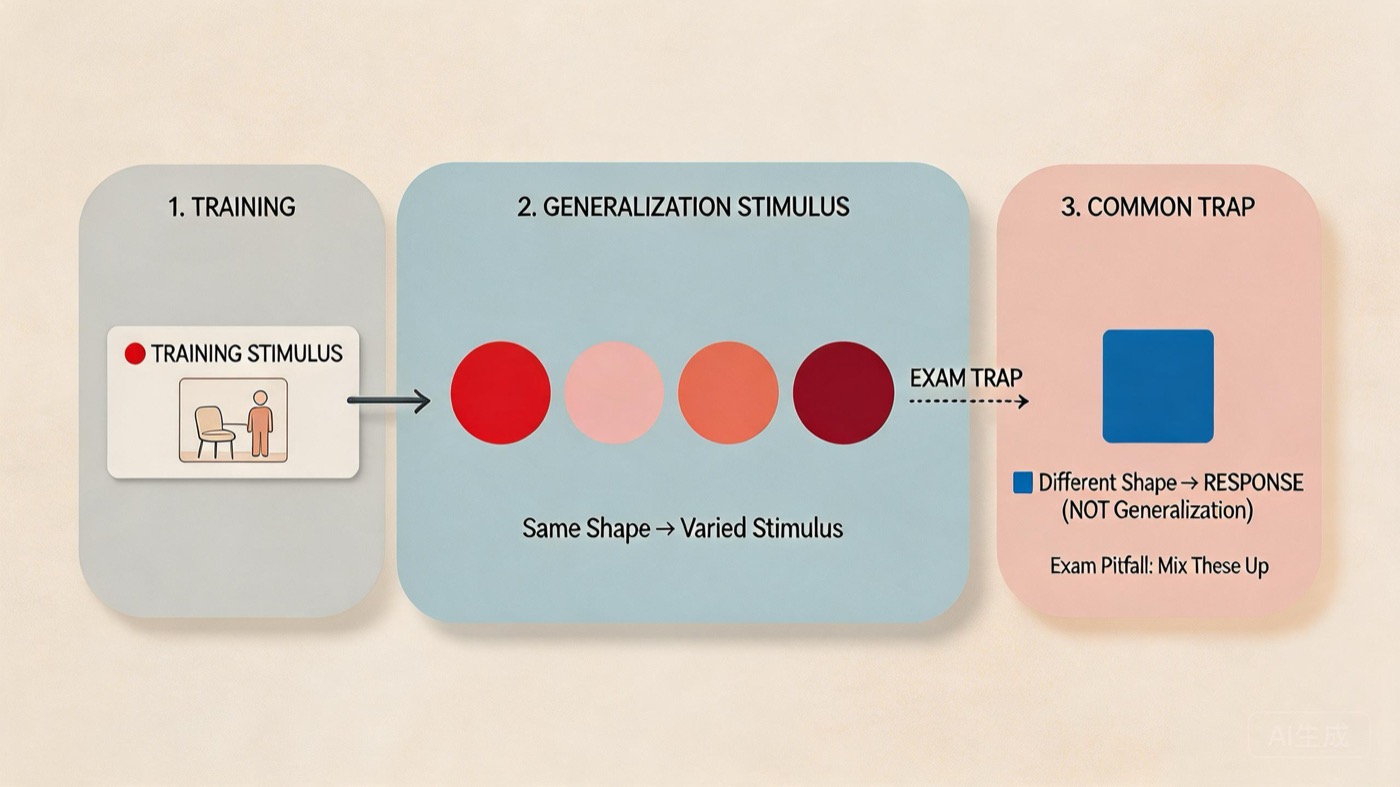
- Assuming any novel stimulus is a generalization stimulus: A novel stimulus must share features with the training stimulus to be a generalization stimulus. If it shares no features, it is simply an unrelated stimulus.
- Overlooking the role of similarity: The degree of similarity affects the strength of generalization. Stimuli very similar to the SD will likely evoke the behavior; dissimilar ones may not.
For more on related concepts, see our article on stimulus generalization vs. response generalization.
Quick Checklist for Generalization Stimulus
Use this checklist to quickly analyze exam scenarios:
- Identify the training stimulus (SD) that was directly taught.
- Look for a novel stimulus that evokes the same behavior without explicit training.
- Determine the shared features between the novel stimulus and the training stimulus (e.g., shape, color, function).
- Confirm that the behavior is the same operant class (not a different response).
- Check the consequence: if the behavior is reinforced in the presence of the novel stimulus, it strengthens generalization.
- Rule out response generalization if the behavior is different.
Summary: Generalization Stimulus in ABA
A generalization stimulus is a stimulus that evokes a learned behavior due to its similarity to a previously trained stimulus. It is distinct from stimulus generalization (the process) and is critical for skill transfer in everyday settings. On the BCBA exam, watch for questions that require you to pinpoint the generalization stimulus in a scenario and avoid confusing it with response generalization or unrelated stimuli.
Remember the three examples: round toys for ‘ball’, different adults for ‘thank you’, and red signs for stopping. Mastering this concept will help you design effective generalization strategies in practice and ace exam questions. For more ABA exam prep, explore our BCBA mock exam resources.


