
A fast BCBA exam decision guide for separating BACB reporting, self-reporting, another agency, and supervisor-level action. When a BCBA exam question asks, “Which of the following should you report to the BACB?”, the best answer is rarely the one with the most dramatic wording. Start by identifying who is involved, what happened, whether the BACB has jurisdiction, what evidence exists, and whether another agency must be contacted first. Then choose the route that fits the facts.
Table of Contents
- The short answer: route the scenario to the right place
- Use the four-question reporting filter
- What types of situations point toward the BACB?
- Reporting routes: the exam quick grid
- Common distractors in reporting questions
- A 60-second method for choosing the answer
- Use practice to find the reasoning gap
- Which of the following should you report to the BACB? FAQ
- The bottom line
- Official sources to recheck
- Take the Free BCBA Mock Exam
This is an exam-preparation framework, not individualized legal or ethics advice. The BACB’s current Ethics Department pages and reporting documents control real submissions. A concern may be reportable, but an allegation is not proof that a violation occurred. Important distinction: reporting another applicant or certificant is not the same as self-reporting your own qualifying event. A Notice of Alleged Violation is also not the form for reporting yourself.
The short answer: route the scenario to the right place
On a BCBA exam question, choose BACB reporting when the scenario describes a possible ethics or certification issue involving a BACB applicant or certificant, or when the official examination rules require reporting misconduct. But do not stop at the word “ethical.” The answer still depends on jurisdiction, safety, evidence, timing, and the proper form.
| Scenario in the question | Likely first route | Reasoning cue |
|---|---|---|
| Another candidate cheats or shares confidential exam content | Report the examination misconduct to the BACB through the current channel. | The exam-security rule is the central fact; do not copy or circulate the content. |
| Possible violation by a BCBA, BCaBA, applicant, or other person within BACB jurisdiction | Use the current BACB reporting pathway after checking documentation and safety. | Report a concern with context; do not claim that the violation is already proven. |
| Your own qualifying conduct, investigation, or required event | Use BACB self-reporting, not a Notice against yourself. | The actor is you, so the form and timing are different. |
| Immediate danger, abuse, suspected crime, or a state-regulated matter | Contact the required emergency, legal, licensure, or mandatory-reporting agency first when applicable. | Do not treat the BACB as a substitute for an emergency or state regulator. |
| Concern about a trainee who is not an applicant or certificant | Consider the direct supervisor, employer, or proper agency. | The BACB may not have jurisdiction over that person. |
These are routing patterns, not a substitute for reading the facts. If a question gives you a specific current BACB procedure, use that wording. If it gives you a safety emergency, a state-license issue, or a person outside BACB jurisdiction, the most familiar “report to the BACB” answer may be a distractor.
Use the four-question reporting filter
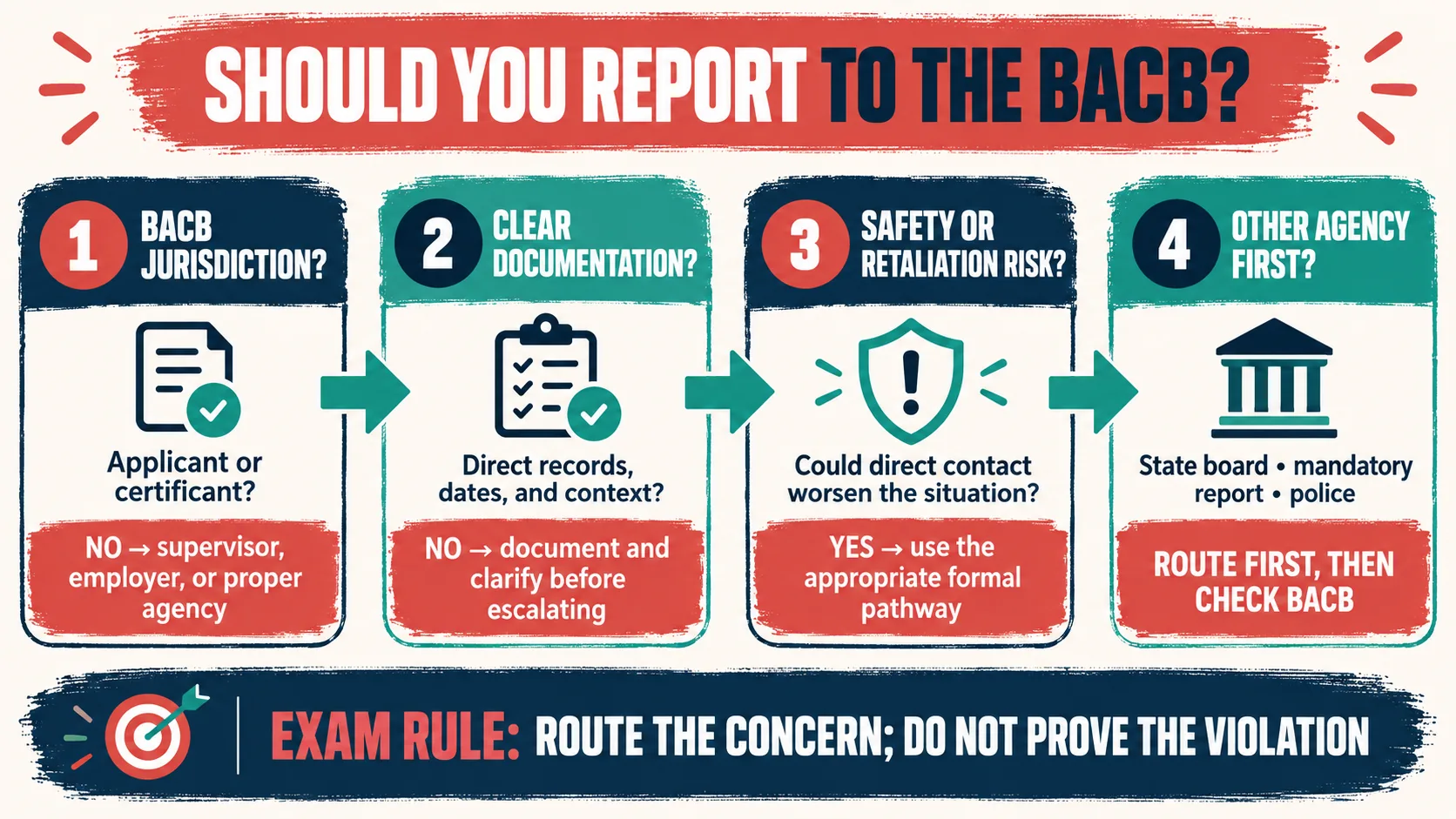
Use this sequence when the answer choices all sound responsible:
- Who is the person involved? Is the person a BACB applicant or certificant, or is the question about an RBT, trainee, employer, client, or another professional? The BACB can enforce its ethics requirements only within its jurisdiction.
- What is the evidence? Look for direct records, dates, messages, reports, or other documentation. A rumor, vague impression, or copied story should not be treated as a completed finding.
- Would direct contact be safe and appropriate? The BACB’s reporting considerations say that if a direct conversation could resolve the concern and would not worsen the situation, addressing it directly should be considered and documented. If contact could create retaliation or additional harm, do not force that step.
- Does another agency come first? State licensure, mandatory-reporting, law-enforcement, employer, funder, or school obligations may control the first action. Route that matter first when the facts require it, then evaluate whether a BACB submission is also appropriate.
- Identify the actor before choosing a reporting form.
- Separate direct documentation from assumptions or rumors.
- Protect safety, privacy, and any required agency sequence.
- Use the current BACB form and handbook when the question turns into a real submission.
The exam skill is not memorizing a single “report” word. It is recognizing the decision point that comes before the report: jurisdiction, evidence, safety, or agency routing.
What types of situations point toward the BACB?
Possible ethics violations by an applicant or certificant: The BACB’s reporting considerations are designed for alleged violations involving a BCaBA or BCBA. The document asks the notifier to consider clear supporting documentation, other agencies, direct-contact risk, jurisdiction, the alleged ethics requirement, and timing. You do not need to guess a perfect code number to answer an exam question; describe the concern and context accurately, then use the current process.
For a real notice, the March 2026 BACB checklist says that supporting material should be clear and direct, identifying information should be redacted, and supporting documentation should generally be organized into one PDF of no more than 20 pages. These details are useful exam cues because they point to evidence and privacy—not public accusations or social-media escalation.
Exam misconduct
Exam-security questions are usually more direct. If another candidate cheats, shares exam content, impersonates someone, or obtains prohibited access to exam materials, the scenario points to reporting the misconduct through the BACB’s current channel. Do not download, repost, or “save evidence” by spreading the confidential content. Select the answer that protects exam security and follows the official reporting route.
Your own qualifying event
Self-reporting is a separate lane. The BACB lists categories such as ethics-code violations, qualifying health or substance-use conditions, investigations, and certain agreements or actions. The current self-reporting page instructs the individual to use the self-reporting process and specifically says not to complete a Notice of Alleged Violation for yourself. On an exam, “report yourself using the Notice” is therefore a strong distractor.
Situations that are not automatically a BACB notice
A disagreement with a coworker, a performance problem involving a trainee, an ordinary employer complaint, or a state-license matter is not automatically a BACB Notice. Ask what rule, role, agency, and evidence the vignette actually gives you. A workplace solution, supervisor response, state board, funder, or emergency service may be the correct first action.
Reporting routes: the exam quick grid
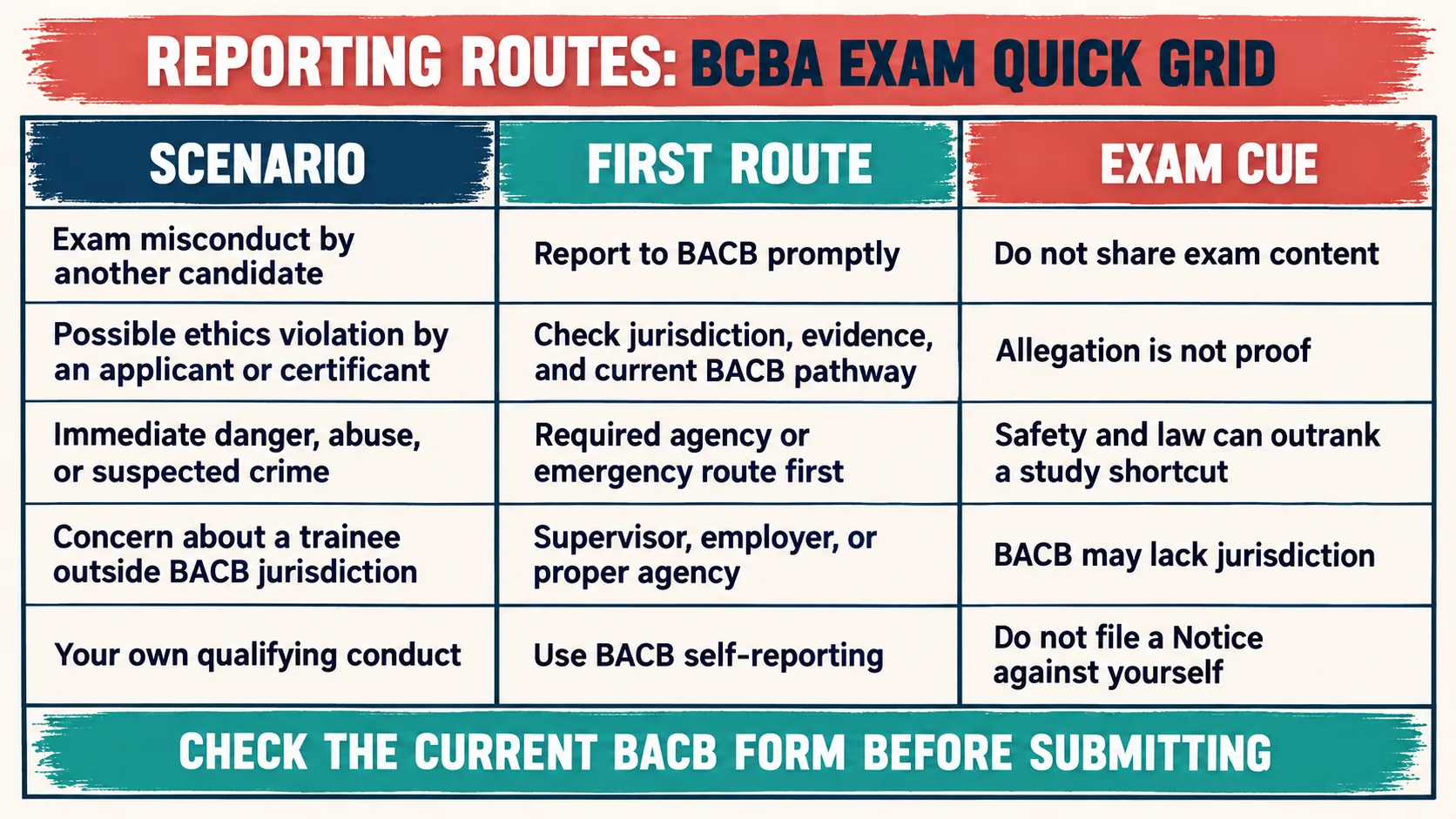
Use the grid as a memory aid, then return to the facts in the stem. The “first route” is not always the only later action; a state or emergency report and a BACB report can both be relevant, but the sequence matters.
| If the stem emphasizes… | Ask yourself… | Avoid choosing… |
|---|---|---|
| An applicant or certificant and a possible Code concern | Is there jurisdiction, clear context, and a safe reporting path? | A public accusation or a claim that the violation is proven. |
| Your own conduct or an investigation involving you | Does the self-reporting page or handbook require action and a deadline? | A Notice of Alleged Violation against yourself. |
| Danger, abuse, crime, or licensure | Which emergency, legal, mandatory, or state route is required first? | Waiting for the BACB to replace an emergency response. |
Common distractors in reporting questions
“Report every concern immediately.” Reporting can be appropriate, but the official checklist asks you to consider evidence, jurisdiction, other agencies, and whether direct contact is safe. An answer that skips all facts may be too broad.
“The BACB investigates and interviews everyone.” The official BCaBA/BCBA considerations state that the BACB evaluates the documentation submitted; it does not conduct the notifier’s investigation for them. Choose the response that preserves records and context.
“Name the exact ethics standard or the report is invalid.” The checklist says a notifier is not required to identify a specific standard, although up to five can be indicated if the notifier chooses. Clear facts and context matter more than guessing a code number. “Use a Notice for yourself.” Self-reporting is the correct lane for your own qualifying event. The wording of the form is a common exam trap. “Send the client’s full chart as proof.” Protect privacy. Redact identifying information and submit only relevant documentation through the current official process.
- Do not turn a concern into a public accusation.
- Do not use a self-report form for another person’s alleged violation.
- Do not let a study shortcut replace a required emergency or state route.
- Do not share confidential examination content while documenting misconduct.
A 60-second method for choosing the answer
- Underline the actor: another candidate, BCBA, applicant, trainee, employer, or yourself.
- Circle the risk: exam security, client safety, legal conduct, billing, privacy, supervision, or ordinary workplace conflict.
- Label the route: BACB, self-report, state/emergency agency, supervisor/employer, or no immediate escalation.
- Check the evidence verb: “alleged,” “suspected,” and “confirmed” are not interchangeable.
- Reject overreach: eliminate answers that promise a BACB outcome, publish an accusation, expose client data, or skip a required first agency.
Then choose the answer that is proportionate and closest to the facts. A high-quality exam response protects the client and the profession while respecting jurisdiction, due process, privacy, and the official reporting sequence.
Use practice to find the reasoning gap
Reading a reporting checklist is useful, but the difficult part is applying it when several answer choices sound ethical. Try original scenario practice after studying the route filter. The Free BCBA Mock Exam can help you see whether the gap is in ethics terminology, jurisdiction, evidence, or choosing the least overreaching next step. It is a study diagnostic—not a BACB form, CE event, legal opinion, or passing-score guarantee.
Which of the following should you report to the BACB? FAQ
Should every ethics concern be reported to the BACB immediately?: No. On an exam, first check the person’s BACB jurisdiction, documentation, safety of direct contact, and whether another agency must be contacted first. In real life, use the current BACB materials and appropriate professional or legal advice for your situation.
What should you report if another candidate shares BCBA exam content?: Exam misconduct should be reported to the BACB through the current official channel. Do not share or repost the examination content while trying to document the concern.
Is self-reporting the same as filing a Notice of Alleged Violation?: No. A Notice addresses an alleged violation involving another person within the applicable process. Self-reporting uses the BACB’s self-reporting pathway for qualifying events involving you. The current form and handbook control the details and deadlines.
What if the person is a trainee and not a BCBA applicant or certificant?: The BACB may not have jurisdiction. Consider the direct supervisor, employer, licensure or regulatory agency, funder, school, or other appropriate route described by the facts. Do not choose BACB reporting solely because the setting uses ABA.
Do I have to know the exact BACB ethics standard?: Not necessarily. The current BCBA/BCaBA reporting considerations say that a notifier can describe the potential violation and context without identifying a specific standard. Accurate facts and relevant documentation are more important than guessing a number.
The bottom line
For the question “Which of the following should you report to the BACB?”, look for the complete decision: the actor is within BACB jurisdiction, the concern is supported by relevant documentation, the route is safe and appropriate, and no required agency is being skipped. Separate another person’s alleged violation from your own self-report, protect confidential information, and never confuse reporting a concern with proving the case.
Official sources to recheck
- BACB Ethics Department
- BACB Self-Reporting
- BACB Considerations for Reporting an Alleged Violation Against a BCaBA/BCBA
- BACB BCBA Handbook
- BACB reporting-process guide
Take the Free BCBA Mock Exam
A useful next step is to apply this idea in a fresh set of BCBA-style practice questions and review the feedback. Take the Free BCBA Mock Exam



