
Understanding BCBA Exam Day Logistics
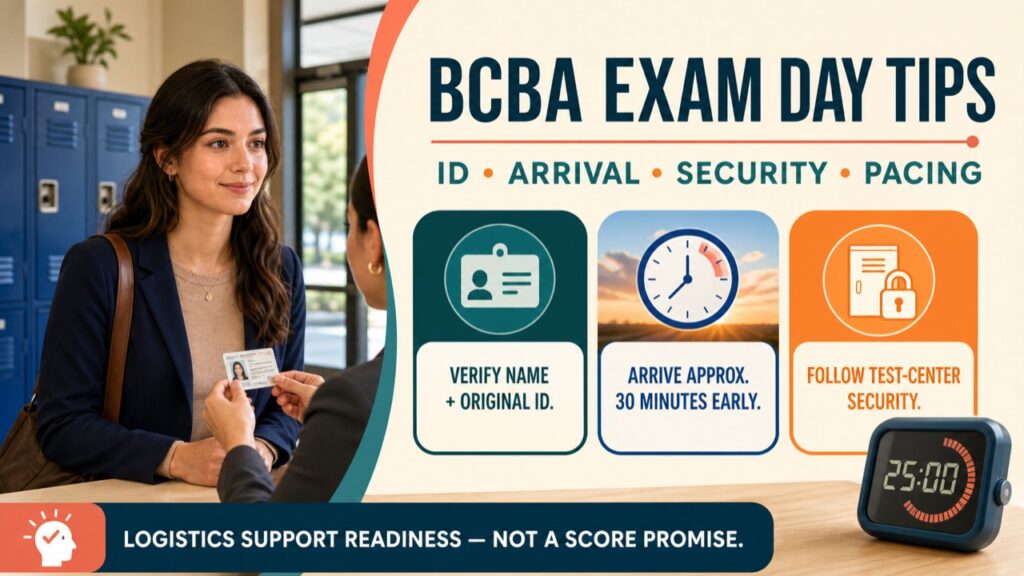
Useful bcba exam day tips should remove preventable logistical problems without pretending to determine an examination result. The official process separates preparation into three practical questions: Can the candidate be admitted with the required identification? Can the candidate complete check-in and test-center security on time? Can the candidate manage the four-hour computer-based session without relying on prohibited materials? This guide answers those questions using the Pearson VUE BACB page, the BACB Examination Information page, and the current BCBA Handbook. Recheck those pages and the appointment confirmation before traveling because operational details can change.
Table of Contents
- Understanding BCBA Exam Day Logistics
- The Night Before: Verify Identification and Travel
- Test-Center Security and Check-In
- Breaks, Food, and Medication
- Pacing and the Pearson Demo Test
- Confidentiality and Content Boundaries
- Final Preparation Checklist
- Conclusion
The Night Before: Verify Identification and Travel
Start with the exact name match rule. The current instructions require one original, current, government-issued identification document with a recognizable photo and signature. Its first and last name must match the first and last name in the candidate’s BACB portal account. A photocopy or an image stored on a phone does not satisfy the stated requirement. Examples listed in the handbook include an international travel passport, driver’s license, military ID, national or state identification card, and qualifying alien-registration documentation. If the first or last name differs, resolve the issue through the appropriate account process before the appointment rather than expecting test-center staff to waive it.
- Open the BACB portal and compare the first and last name character by character with the planned ID.
- Confirm that the identification is original, current, government issued, signed, and has a recognizable photo.
- Put the ID in a specific travel location that will not be left behind.
- Review the confirmation email for the correct center address, date, local time, and any center-specific notice.
Next, plan the physical trip. Check the route, parking or transit, building entrance, and expected travel time. Add a reasonable buffer for traffic, weather, or finding the suite, while using the confirmation rather than an unofficial map listing as the final location reference. Pearson advises arriving approximately 30 minutes before the appointment so there is time for check-in. The handbook separately states that arriving more than 30 minutes after the appointment results in being turned away and forfeiting the scheduling fee; early-arrival guidance and the late-arrival cutoff are different rules.
Keep personal readiness practical and individualized. Choose a familiar sleep schedule, meal, hydration plan, clothing, and medication routine that fits existing health guidance. Do not experiment with a new supplement, extreme caffeine intake, or unfamiliar food because a forum labels it an exam-day advantage. Pack only what can remain outside the testing room, and check the site’s current storage instructions if medication, food, or another necessary item will be needed during a break.
Test-Center Security and Check-In
At check-in, follow the administrator’s instructions and allow time for each step. The current handbook describes identification verification, agreement to testing-center rules, palm-vein scanning, and a digital photograph. Check-in is conducted in English unless an approved accommodation applies. The administrator controls admission and workstation assignment; a saved appointment email does not replace valid identification or completion of the security process.
- Present the qualifying government-issued identification when requested and keep it with you after check-in.
- Store personal belongings in the provided secure area rather than taking them to the workstation.
- Listen to staff directions and read the testing-center rules and examination Terms and Conditions carefully.
- Ask an administrator about a procedural problem instead of attempting to solve it with a phone or stored note.
Current prohibited-room items include phones, cameras, recording devices, watches, electronic transmitters, notes, reference materials, textbooks, bags, scratch paper, calculators, rulers, food, and beverages. The handbook identifies the candidate’s ID and locker key as the items permitted into the examination area. A dry-erase board is provided, earplugs are available on request, and some sites have noise-canceling headphones. Those details matter: planning to use personal paper, a watch, or a calculator creates a conflict at check-in even if the item was intended only for pacing.
Breaks, Food, and Medication
The BCBA examination does not include a clock-stopping break. A candidate may take a break, but examination time continues and security procedures apply when leaving and re-entering the room. During a break, the candidate cannot access phones, electronic devices, notes, or other prohibited stored materials and cannot leave the building. The current handbook allows access to food, drink, or medication during breaks. Because storage and accommodation details can be situation specific, review the confirmation and contact the proper support channel before exam day if a medical need could affect check-in or break planning.
- Decide in advance whether an optional break is likely to be worth the time it uses.
- Keep food, drink, or medication in the location directed by testing-center staff.
- Expect security steps when re-entering the testing room.
- Do not use a break to review content, communicate about the examination, or leave the building.
Pacing and the Pearson Demo Test
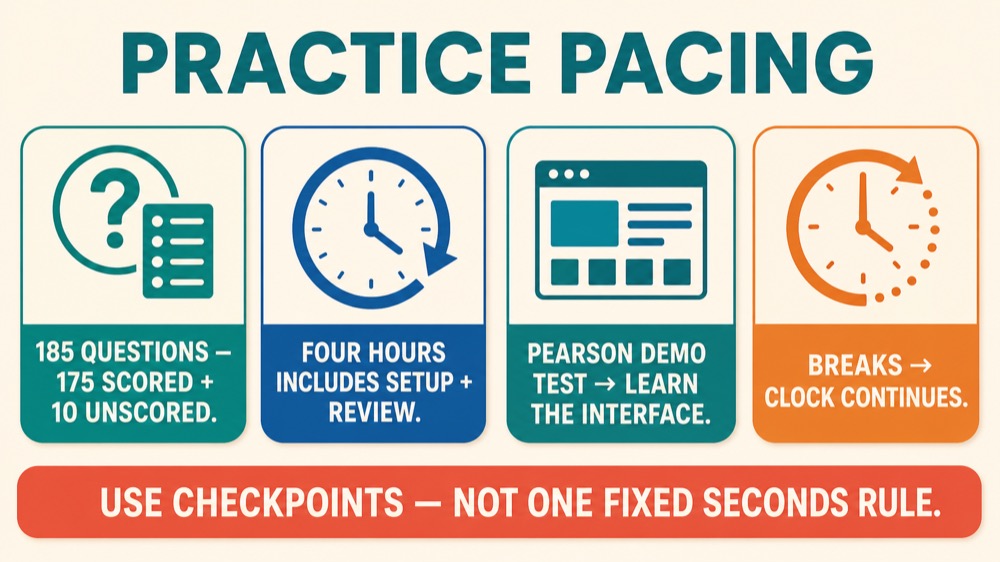
The current BCBA examination contains 185 multiple-choice questions: 175 scored and 10 unscored. The four-hour period includes the Terms and Conditions, navigation tutorial, load-time prompt, examination, and any review. Dividing 240 minutes by 185 gives roughly 78 seconds per question, but that calculation is only a planning average because the entire four hours is not available for answering items. Build a pacing plan with checkpoints that leave room for setup and review, then adjust to the timer and instructions displayed during the session.
The official Pearson demo test is useful for learning the computer-based environment before arriving at the center. Use it to locate navigation controls, understand how the screen advances, and practice returning attention to the task after a pause. It is an interface-orientation resource, not evidence about the secured examination form or a substitute for studying the Test Content Outline, Ethics Code, and training materials. Repeat the demo if operating the interface still consumes attention that could otherwise be used for reading and responding.
- Practice a full work period under realistic timing before exam day, using lawful study materials.
- Set broad pacing checkpoints rather than forcing the same number of seconds on every question.
- Remember that the Terms and Conditions, tutorial, load prompt, and review are inside the four-hour block.
- Use the provided dry-erase board only as permitted; do not bring a personal timing sheet.
- Monitor the on-screen clock and preserve a review buffer that fits your own practice data.
Pacing practice can identify a process problem: reading too quickly, rereading every sentence, spending too long after uncertainty, or failing to reserve review time. Change one process variable at a time in practice and compare the result. No sleep routine, breathing method, pacing rule, or checklist fixes the passing standard; these steps merely reduce avoidable friction so the candidate can apply existing knowledge.
Confidentiality and Content Boundaries
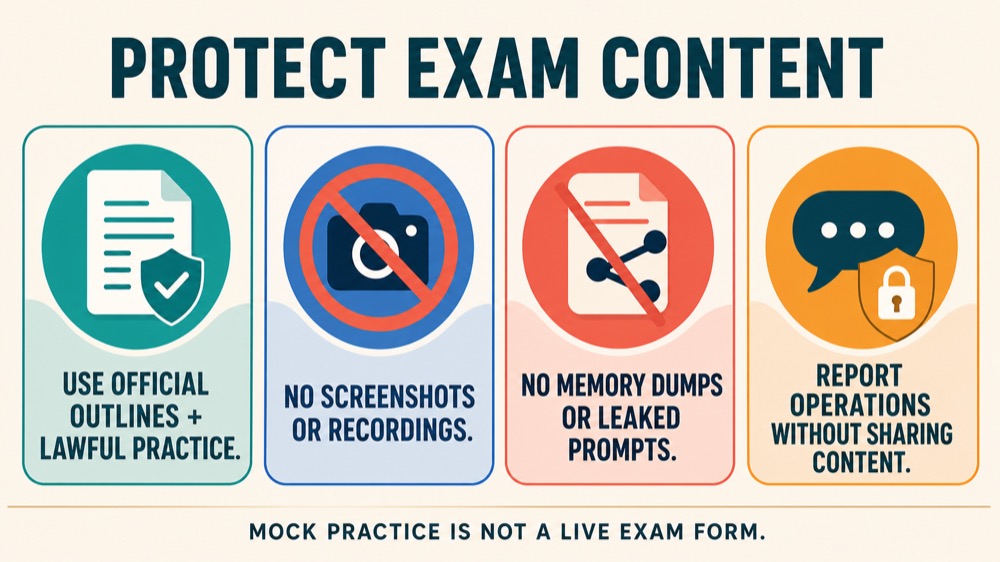
Exam-day preparation must stay separate from secured content. BACB examination questions are confidential, and candidates agree to the applicable Terms and Conditions before testing. Do not seek, reconstruct, record, transmit, discuss, or trade protected prompts or answer choices. A post claiming inside access is not a reliable study source and may expose the candidate to invalidation or disciplinary consequences. Use the current Test Content Outline to define the domains for lawful preparation instead of predicting a particular form.
- Use official outlines, ethical standards, training materials, and independently written practice.
- Treat screenshots, recordings, “memory dumps,” and claimed leaked prompts as prohibited material, not study shortcuts.
- Do not bring notes, recording devices, or communication tools into the examination room.
- Report an operational problem to testing-center staff without describing protected content to bystanders or online forums.
The current BCBA examination is delivered in person at authorized Pearson VUE sites. That delivery fact belongs to logistics; it does not reveal anything about the questions a candidate will see. Likewise, a mock exam can provide practice and feedback but cannot represent a live form, predict selection of topics, or promise an outcome.
Final Preparation Checklist
Complete this check while there is still time to correct a problem:
- Account and ID: verify the first-and-last-name match and the original ID’s expiration, photo, signature, and government issuer.
- Confirmation: verify the center address, date, local time, and current arrival instructions.
- Travel: map the route, parking or transit, building entrance, and a reasonable delay buffer.
- Arrival: plan around Pearson’s advice to arrive approximately 30 minutes before the appointment.
- Belongings: leave prohibited electronics, watches, notes, scratch paper, calculators, and reference materials out of the testing room.
- Break plan: remember that the clock continues and identify any food, drink, or medication need in advance.
- Interface: complete the Pearson demo test and review the Candidate Rules Agreement.
- Pacing: use practice data to set broad checkpoints and a realistic review buffer.
- Sources: recheck the handbook, BACB examination page, Pearson VUE page, and appointment email for updates.
A calm morning cannot compensate for a mismatched ID or a late arrival, and perfect logistics cannot substitute for content preparation. Treat the checklist as a way to protect the opportunity to test. Once check-in is complete, follow staff directions, use the permitted materials, watch the on-screen time, and respond based on the knowledge developed during training and study.
Conclusion
Strong BCBA exam-day preparation is concrete: verify government-issued identification and the name match, confirm travel details, arrive with time for test-center security, understand prohibited materials and break rules, and rehearse pacing with the Pearson demo test. Each step reduces a specific source of avoidable disruption while preserving the boundary between lawful preparation and secured content. Recheck official instructions close to the appointment, because a remembered rule may be outdated. For additional original practice and feedback—not a copy or prediction of a secured examination form—use the Free BCBA Mock Exam below.
Try Our Free BCBA Mock Exam — Practice & Feedback



