
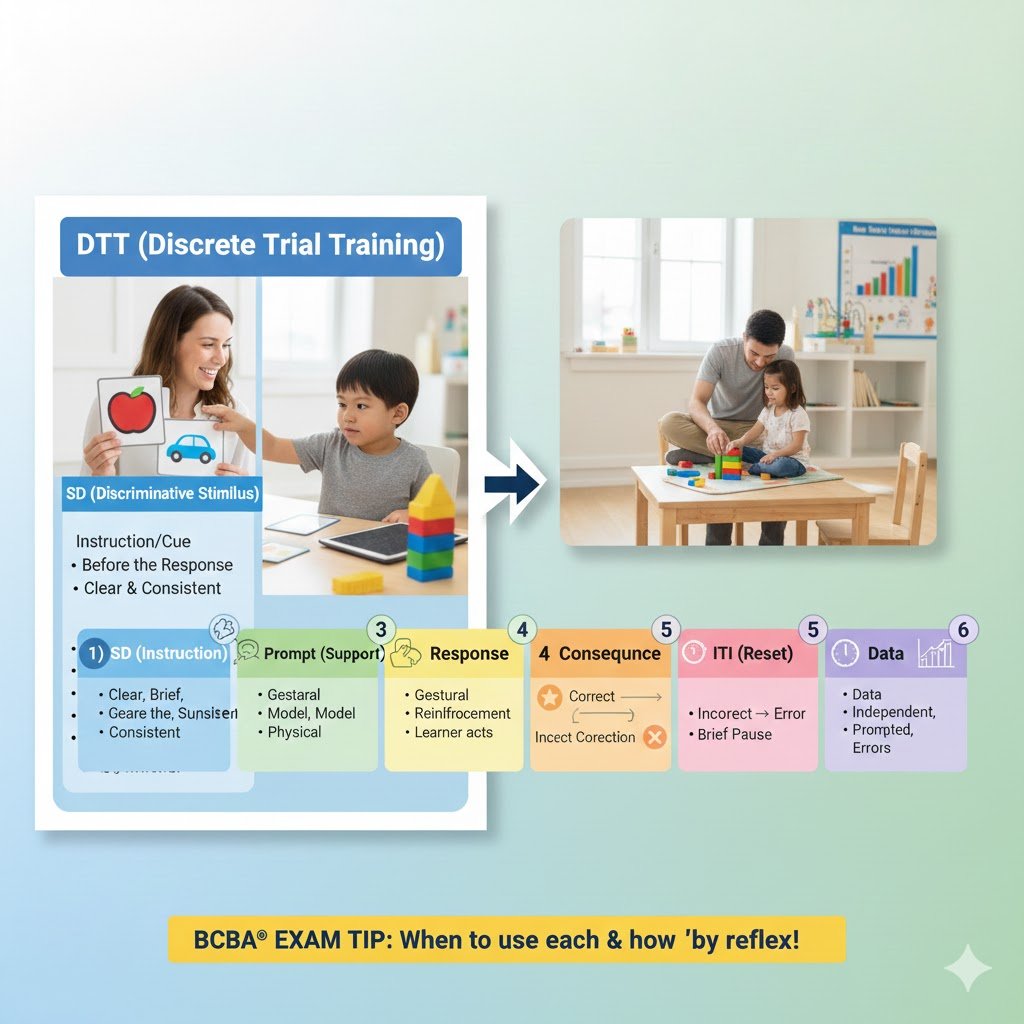
What is Discrete Trial Training?
By BCBA Mock Exam
Discrete Trial Training (DTT) is one of the most common teaching formats in ABA—and one of the easiest to oversimplify.
A lot of people hear “DTT” and picture table work or drilling. But for the BCBA® exam, DTT is better understood as a structured way to arrange learning opportunities so you can build skills, strengthen stimulus control, and make data-based decisions with clarity. (This article follows the same “simple definition + real examples + exam tips” structure as our reinforcement guides.)
Alt text: Discrete Trial Training (DTT) trial flow: SD, prompt, response, consequence, ITI, data.
What Is Discrete Trial Training (DTT)?
Definition (task-list style)
Discrete Trial Training is a teaching procedure where skills are taught through repeated, clearly defined “trials.” Each trial has a clear beginning and end, and the instructor controls the teaching conditions so learning is easier to shape and measure.
A “trial” is a short sequence:
-
you present a clear instruction (SD),
-
the learner responds,
-
you deliver a planned consequence,
-
you record data,
-
you reset and run the next trial.
If you can identify what happens before, what the learner does, and what happens after, you can analyze DTT questions quickly.
The basic DTT pattern (think: ABC + reset)
In DTT, the sequence usually looks like this:
-
SD (instruction / discriminative stimulus)
-
Prompt (if needed)
-
Response
-
Consequence (reinforcement or error correction)
-
Intertrial Interval (ITI) (brief pause/reset)
-
Data (trial-by-trial)
BCBA® exam tip: Many questions test whether you can tell the difference between an SD and a prompt, or whether the consequence is reinforcing, neutral, or accidentally strengthening errors.
The 6 core parts of a DTT trial (know these “by reflex”)
1) SD (the instruction)
The SD should be clear, brief, and consistent during early teaching.
Examples:
-
“Touch red.”
-
“Match.”
-
“What is it?” (while showing a picture card)
2) Prompt (support to help correct responding)
Prompts are not “cheating.” Prompts are how you prevent repeated errors and teach the correct response efficiently.
Common prompt types:
-
Gestural
-
Model
-
Positional
-
Partial physical / full physical
3) Response
The learner emits the target behavior (or does not).
4) Consequence
-
Correct (especially independent correct) → reinforcement
-
Incorrect / no response → error correction (not a “lecture”)
5) ITI (reset)
A short pause (often 1–3 seconds) before the next trial. This keeps trials “discrete” and reduces accidental chaining.
6) Data
DTT is designed to be measurable. Strong DTT data often separates:
-
Independent correct
-
Prompted correct (and prompt level)
-
Incorrect
-
No response
DTT vs NET (a classic exam contrast)
DTT (Discrete Trial Training)
-
Adult-led, structured
-
High number of teaching opportunities
-
Easier to measure precisely
-
Great for early acquisition, discrimination, and building clean stimulus control
NET (Natural Environment Teaching)
-
More natural, often learner-led
-
Teaching embedded in play/routines
-
Reinforcement is often naturally related to the behavior
-
Great for generalization, spontaneity, functional use
BCBA® exam tip: The best answer is often not “DTT or NET,” but when to use each and how to sequence them (DTT to build, NET to use).
Alt text: DTT vs NET comparison for the BCBA exam (structure, data, generalization).
Everyday DTT examples (simple, real, and test-friendly)
Here are examples you can reuse for studying and for explaining DTT to parents/staff.
1) Receptive ID (listener responding)
Target: “Touch spoon.”
-
SD: “Touch spoon.” (3 items on the table)
-
Prompt: gesture near spoon (if needed)
-
Response: learner touches spoon
-
Consequence: “Nice job!” + 10 seconds of a preferred toy
-
Data: mark independent vs prompted
2) Matching (visual discrimination)
Target: match identical pictures.
-
SD: “Match.”
-
Prompt: model placing one card (then fade)
-
Response: learner matches correctly
-
Consequence: token + praise
-
ITI: reset cards, run again
3) Motor imitation
Target: “Do this.” (tap cup)
- SD: “Do this.”
-
Prompt: physical guidance only if needed (fade quickly)
-
Response: learner taps cup
-
Consequence: access to a quick sensory item (or praise + token)
4) Tacting (labeling)
Target: label “dog” when shown a picture.
-
SD: show card + “What is it?”
-
Prompt: echoic prompt (“dog”) if needed (fade using time delay)
-
Response: “dog”
-
Consequence: praise + brief access to preferred item
Error correction (where most DTT questions hide traps)
If a learner makes errors in DTT, the goal is to teach the correct response and keep the trial moving—without accidentally reinforcing mistakes.
A common, clean error correction flow:
-
Incorrect response → neutral feedback (“Try again.”)
-
Represent SD
-
Increase prompt level (so a correct response happens)
-
Deliver smaller reinforcement than independent correct (or neutral praise)
-
Move on
What to avoid (exam traps):
-
Giving big attention after errors (can reinforce errors if attention is reinforcing)
-
Repeating SD over and over with no prompt change (teaches waiting/guessing)
-
Making error correction so long that the learner escapes the task (can strengthen avoidance patterns)
Alt text: DTT error correction steps: neutral feedback, re-present SD, increase prompt, smaller reinforcement, move on.
Prompting & fading (DTT is not just prompting—it’s transfer of control)
The point of prompting is stimulus control transfer: the learner responds to the SD, not the helper prompt.
Common fading strategies:
-
Most-to-least: start with high support, fade down (often reduces early errors)
-
Least-to-most: test independence first, then add support
-
Time delay: 0-second prompt → gradually delay prompts to build independent responding
BCBA® exam tip: If the stem says “only responds correctly when the therapist points/models,” that’s usually prompt dependence → the fix is a better fading plan and transfer trials.
DTT data and mastery (what BCBAs are expected to decide)
DTT is built for clean decision-making.
Common decisions you make from DTT data:
-
Is the learner acquiring the skill? (trend up in independent correct)
-
Are prompts fading successfully? (prompted correct decreases while independent increases)
-
Is discrimination getting tighter? (errors decrease across similar stimuli)
-
Is it time to generalize? (new materials/people/settings)
Example mastery criteria (you’ll see patterns like this in exam stems):
-
“≥ 90% independent correct across 2 consecutive sessions”
-
“≥ 80% across 3 sessions with 2 instructors and varied stimuli”
How DTT shows up on the BCBA® exam (what to look for)
Common question patterns:
-
The stem describes repeated trials with clear SDs, planned prompts, immediate consequences, and trial-by-trial data.
-
You’re asked to identify:
-
the SD vs prompt
-
whether the consequence is functioning as reinforcement
-
the best prompt fading plan
-
the most appropriate error correction
-
what data system is missing (e.g., no prompt-level recording)
-
Fast test strategy:
-
Ask: “What’s the SD?”
-
Ask: “What’s the prompt (if any)?”
-
Ask: “What consequence is delivered for correct vs incorrect?”
-
Ask: “What’s happening to behavior over time (increase/decrease)?”
-
Ask: “What should be changed—antecedent, prompting, consequence, or measurement?”
Quick Study Checklist
Before the exam, make sure you can:
-
Define DTT in one sentence without calling it “drill” or “table time”
-
Name the parts of a trial: SD → (prompt) → response → consequence → ITI → data
-
Identify SD vs prompt in a vignette
-
Select a prompting and fading strategy that matches the goal (fewer errors vs more independence)
-
Choose an error correction procedure that teaches, not punishes or reinforces errors
-
Describe what “good DTT data” includes (independent vs prompted, prompt level, errors)
Final Thoughts
Discrete Trial Training is not about making learners “sit and comply.” It’s a structured, measurable way to teach skills—especially early acquisition and discrimination—so you can build clean stimulus control and make confident, data-based decisions.
Once DTT feels simple, a huge chunk of BCBA® exam questions becomes easier: you stop guessing, and you start labeling the parts of the trial like a system.


