Variable Dependency and Experimental Control: Understanding IV, DV, and Confounds for the BCBA® Exam
By BCBA Mock Exam
Introduction
Independent variables (IVs), dependent variables (DVs), and confounding variables show up all over the BCBA® exam—especially in questions about experimental design, graphs, and functional relations.
But the exam doesn’t just ask you to define terms. It wants to know whether you can:
-
Tell which variable is being manipulated and which is being measured
-
Decide whether a change in the DV is really due to the IV
-
Spot confounds that weaken experimental control
In this article, we’ll walk through:
-
What “variable dependency” and “experimental control” mean in ABA
-
A quick review of IVs and DVs
-
What confounds are and how they affect your data
-
How single-subject designs help you rule out alternative explanations
-
Common BCBA® exam traps and mini practice questions.
1. Variable Dependency and Experimental Control: The Big Picture
In ABA, we care about whether changes in behavior (DV) are actually caused by our intervention (IV).
Variable dependency:
-
We want the DV to depend primarily on the IV (and not on a bunch of other things).
Experimental control:
-
We have experimental control when we can show that systematic changes in the IV are reliably followed by systematic changes in the DV, and alternative explanations are reasonable ruled out.
In single-subject designs, we use:
-
Baseline logic (prediction, verification, replication)
-
Repeated measurement
-
Carefully planned phases and comparisons
to show that behavior change is functionally related to the intervention, not just happening by coincidence.
2. Quick Review: Independent vs Dependent Variable
Before we talk about confounds, we need clean IV/DV discriminations.
Independent Variable (IV)
-
The intervention or environmental change you deliberately manipulate.
-
Examples: extinction, FCT, token economy, DRO, visual schedules, prompting procedures.
Dependent Variable (DV)
-
The behavior you measure to see whether the IV had an effect.
-
Examples: rate of aggression, duration of tantrums, percentage of correct responses, latency to compliance.
Exam shortcut:
-
Ask, “What did the BCBA change on purpose?” → IV.
-
Ask, “What did the BCBA record data on?” → DV.
Once you’ve pinned down IV and DV, you can ask the key question: 🤔 “Is there anything else that could reasonably explain this change besides the IV?”
3. Extraneous Variables and Confounds: What They Are
Not everything that changes in the environment is part of your IV.
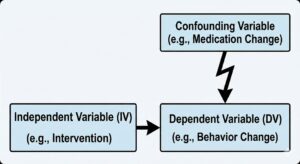
Extraneous variables
-
Any variables outside your planned IV that could influence the DV.
-
Example: change in medication, new teacher, major schedule change at home.
Confounding variables
-
Extraneous variables that co-vary with your IV in such a way that you cannot tell which one caused the behavior change.
-
Example: You start a new reinforcement program at the same time a client’s medication dose doubles. Behavior improves. Was it the reinforcement, the medication, or both?
If an extraneous variable:
-
Changes at the same time as your IV, and
-
Could plausibly affect the DV → it becomes a confound, weakening your experimental control.
4. Experimental Control and Functional Relations in Single-Subject Designs
In ABA, we usually demonstrate experimental control using baseline logic:
-
Prediction – Baseline data allow us to predict what would happen if we did nothing.
-
Verification – Returning to baseline or keeping other tiers in baseline shows that behavior would have stayed roughly the same without the IV.
-
Replication – Repeating the effect (e.g., across phases, tiers, or conditions) shows the pattern is reliable.
When these three pieces line up, we can say there is a functional relation between the IV and DV.
Examples:
-
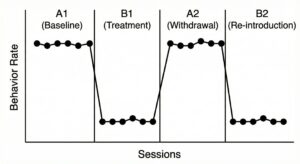
In a reversal (ABAB) design, the pattern “high → low → high → low” in response to A and B phases shows experimental control.
-
In a multiple baseline, each tier changes only when the IV is introduced, despite different start times.
Experimental control is strong when:
-
DV changes only when and only where the IV is applied.
-
Other plausible causes (confounds) are unlikely or ruled out.
5. Common Confounds and Threats to Internal Validity
The BCBA® exam often asks you to recognize threats to internal validity in scenarios or designs. Common ones include:

History
-
Events outside the intervention that occur during the study and affect behavior.
-
Example: A new school-wide behavior program starts the same week you introduce your classroom intervention.
Maturation
-
Natural changes in the client over time (fatigue, growth, developmental change).
-
Example: Over a semester, attention span improves simply because the child is getting older and more experienced with classroom routines.
Testing / practice effects
-
Behavior changes because of repeated exposure to the task, not the IV.
Instrumentation / observer drift
-
Changes in how data are recorded, or gradual drift in observer criteria.
-
Example: Rater becomes more lenient over time when scoring tantrums.
Procedural fidelity issues
-
The IV is not implemented consistently across sessions or staff.
Multiple treatment interference
-
In alternating treatments or complex packages, one condition affects responding in another condition.
When these are present and not controlled, it becomes harder to say the DV depends only on the IV.
6. Clean vs Confounded Examples (In Words)
Example 1 – Clean reversal pattern
-
Baseline (A): High, stable aggression.
-
Treatment (B: FCT + extinction): Aggression drops and stays low.
-
Return to A: Aggression rises again.
-
Return to B: Aggression drops again.
No major changes in meds, staff, or setting are described. 👉 Strong evidence that aggression depends on the IV.
Example 2 – Confounded reversal
-
Baseline (A): High aggression.
-
Treatment (B): Aggression drops.
-
Return to A: Aggression remains low.
-
At the same time, the client’s psychotropic medication dose was doubled.
Now:
-
The medication change is a confound that co-occurred with the change in phases.
-
You can’t cleanly say the IV caused the drop in aggression.
Example 3 – Confound in multiple baseline
-
You implement an intervention to increase homework completion across three students.
-
At the same time, the teacher changes the homework policy for the entire class (shorter assignments, more feedback).
-
Homework improves for all three students.
Is it your intervention or the new class policy? Both are plausible → threat to experimental control.
7. How Designs Help Control Confounds
Different single-subject designs help you rule out confounds in different ways:
Reversal (ABAB) design
-
By repeatedly turning the IV on and off, you check whether the DV changes systematically along with it.
-
If history or maturation were responsible, you would not expect behavior to flip back and forth in sync with the IV.
Multiple baseline design
-
Staggered introduction of the IV across behaviors, settings, or subjects.
-
If a history event occurs, it’s unlikely to line up perfectly with each staggered change.
Alternating treatments design
-
Rapidly alternates conditions (A vs B vs baseline) to compare their effects.
-
Because conditions are intermingled, general history and maturation affect all conditions similarly, making differential effects more likely due to the IVs.
Changing criterion design
-
Systematically shifts performance criteria over time.
-
If behavior reliably tracks these criterion changes, it’s less likely that a confound explains the pattern.
Key exam idea:
-
Designs use replication and structure to counter threats to internal validity.
8. Reading Exam Stems: Is There Experimental Control?
When you see a graph or design description on the exam, ask:
-
What is the IV? What is the DV?
-
You must answer this first.
-
-
Does the DV change in a predictable way when the IV changes?
-
Onset, withdrawal, staggered introduction, criterion shifts, or alternations.
-
-
Are changes replicated?
-
Across phases (A-B-A-B), tiers (multiple baseline), conditions (alternating treatments), or criterion steps.
-
-
Are there obvious confounds mentioned?
-
Medication changes, staffing changes, new school policies, major schedule changes.
-
-
Could those confounds alone account for the pattern?
-
If yes, experimental control is weaker.
-
On many questions, the best answer is the one that:
-
Recognizes when control is strong and a functional relation is likely, or
-
Recognizes when a confound must be addressed before drawing strong conclusions.
9. Common BCBA® Exam Traps About IV, DV, and Confounds
Watch for these traps:
Trap 1 – Ignoring obvious confounds
-
The stem clearly mentions a medication change or large schedule change, but answer choices pretend it’s only about the intervention.
Trap 2 – Treating any A–B design as strong evidence
-
A single A–B sequence (baseline then intervention) has no replication and poor control.
Trap 3 – Mislabeling variables
-
Calling the behavior plan the DV or calling client demographics the IV.
Trap 4 – Over-interpreting noisy data
-
High variability and overlapping data across phases make functional relations less clear, even if the design is correct.
Trap 5 – Assuming correlation = causation
-
Just because behavior changed after the IV started doesn’t mean the IV caused it, especially when confounds are present.
Ethical implication:
-
BCBAs should be cautious about claiming effectiveness when experimental control is weak or confounded.
10. Mini BCBA® Exam–Style Questions (With Explanations)
Question 1 – Identifying a Confound A BCBA implements a reinforcement-based intervention to increase on-task behavior in a classroom. During the same week, the school changes the seating arrangement and reduces class size. On-task behavior increases.
What is the BEST description of the situation? A. The data clearly demonstrate a functional relation between the intervention and on-task behavior B. The changes in class size and seating are potential confounds that weaken experimental control C. The seating and class size changes are irrelevant if the intervention is evidence-based D. The BCBA should ignore the environmental changes and continue as planned
Correct Answer: B Explanation: Because class size and seating changed at the same time as the IV, they are potential confounds that may also explain the behavior change.
Question 2 – Weak Experimental Control A BCBA collects five days of baseline data on tantrums, then implements a new FCT program. Tantrums decrease steadily over the next week. No additional phases or replications are conducted.
What is the BEST conclusion? A. A strong functional relation between FCT and tantrums has been demonstrated B. The design is A–B only and provides limited evidence of experimental control C. The data are invalid because extinction was not used D. The BCBA must immediately conduct an alternating treatments design
Correct Answer: B Explanation: An A–B design shows a correlation but lacks the replication needed to establish strong experimental control.
Question 3 – Reversal and Confound A BCBA uses an A–B–A–B design to evaluate a time-out procedure for aggression. Aggression is high in A1, low in B1, high again in A2, and low in B2. However, the stem notes that a new medication was started two days before B1 and discontinued two days before A2.
Which statement is MOST accurate? A. The pattern proves time-out alone is responsible for changes in aggression B. The medication changes are a serious confound that prevent clear attribution of effects to time-out C. The design automatically controls for medication changes D. The medication changes function as the dependent variable
Correct Answer: B Explanation: Because medication changes co-occurred with the phase changes, they are a confound and limit the ability to attribute changes solely to the IV.
Question 4 – Multiple Baseline Logic A BCBA implements a reading intervention across three students in a multiple baseline design. The start of the intervention is staggered across students. Only after the intervention is introduced for each student does that student’s reading fluency improve, while others remain at baseline until their turn.
What does this pattern MOST strongly suggest? A. History effects are responsible for the change B. The intervention is functionally related to improvements in reading fluency C. The data are inconclusive because there is no reversal D. The students matured at different rates
Correct Answer: B Explanation: Staggered change in the DV that occurs only when the IV is introduced in each tier is classic evidence of a functional relation in a multiple baseline design.
11. Key Takeaways
-
Variable dependency in ABA means we want changes in the DV to be primarily due to the IV, not to uncontrolled variables.
-
Experimental control is shown when systematic changes in the IV reliably produce changes in the DV, with replication and minimal alternative explanations.
-
Confounds are extraneous variables that co-vary with the IV and may also affect the DV, weakening internal validity.
-
Single-subject designs (reversal, multiple baseline, alternating treatments, changing criterion) use structure and replication to rule out confounds.
-
On the BCBA® exam, always ask:
-
What is the IV? What is the DV?
-
Does the DV change when and only when the IV changes?
-
Are there any confounds mentioned that could explain the change?
-
Using this lens will help you reason through design and graph questions and choose the best, most behavior-analytic answer.