

A practical family guide to finding UnitedHealthcare ABA providers, checking network status, confirming authorization, estimating cost share, and documenting the next call. If you searched for unitedhealthcare aba providers, you probably want a provider you can actually contact—not a generic list that may be outdated or tied to the wrong plan. The safest answer is that UnitedHealthcare ABA availability is plan- and location-specific. The provider directory attached to your member plan, the number on your insurance card, the provider’s own intake team, and any UnitedHealthcare Community Plan or Optum instructions for your state are more reliable than a search snippet alone.
Table of Contents
- UnitedHealthcare ABA Providers: Start With Your Plan
- How to Search for ABA Providers
- What to Verify Before You Schedule
- A Provider Verification Table
- Commercial Plans, Medicaid, and Optum Differences
- What to Ask on the Phone
- If You Cannot Find an In-Network Provider
- Your Next Practical Step
- Frequently Asked Questions
- Quick Review Checklist
- Take the Free BCBA Mock Exam
A provider appearing in a directory does not automatically mean that the provider can accept your exact member plan, has immediate openings, or can start without prior authorization. Treat the search as the first step in a verification process. You need to confirm the product, network, service type, authorization pathway, age range, location, and expected family cost before assuming that an appointment is covered.
Important: Insurance directories, benefits, contracts, state programs, and authorization rules change. This article is an access checklist, not a coverage determination. Use your current plan documents and contact UnitedHealthcare or the administrator identified on your card before scheduling services or relying on a cost estimate.
UnitedHealthcare ABA Providers: Start With Your Plan
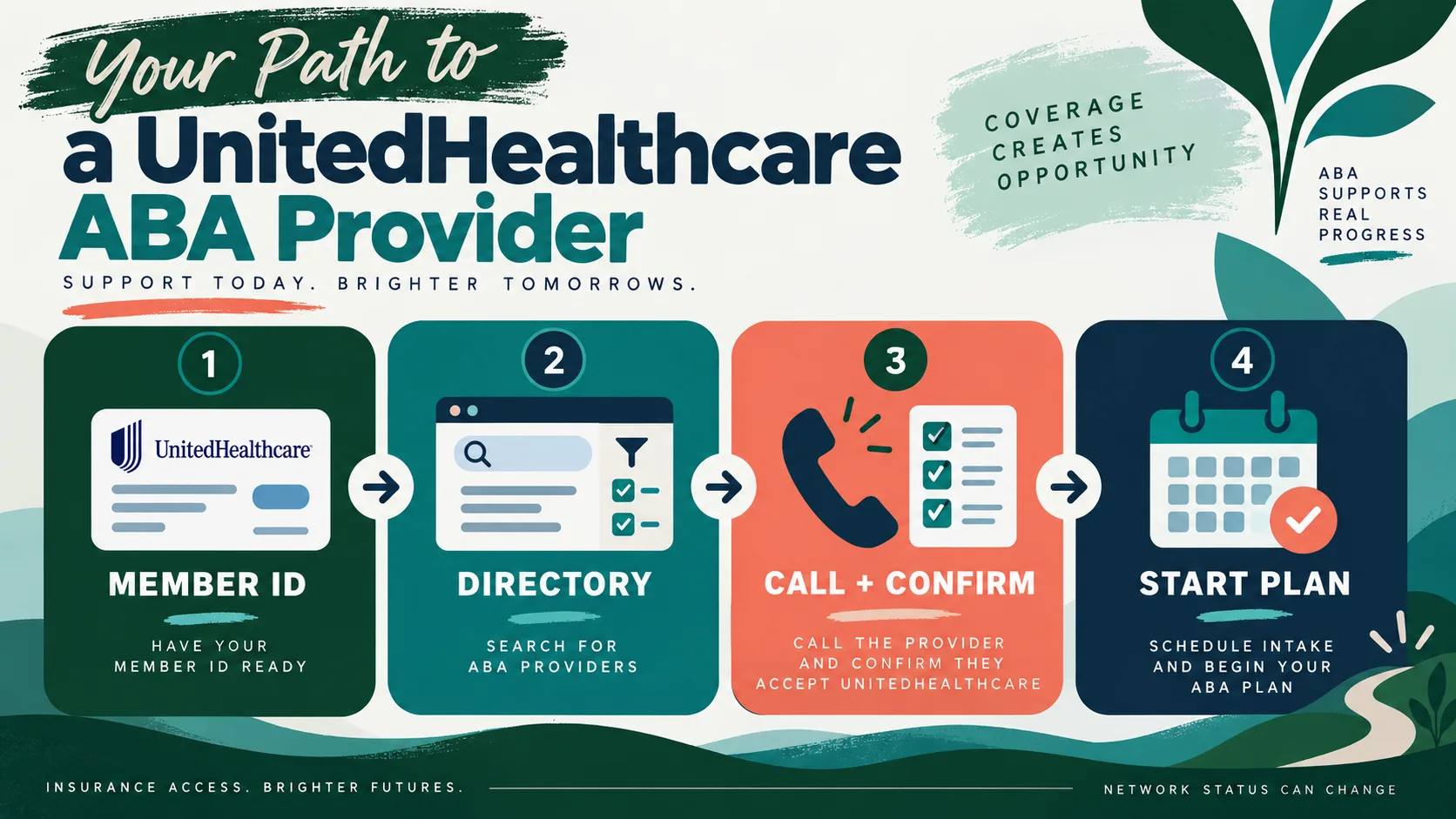
“UnitedHealthcare” is not one identical benefit design for every member. A commercial plan, an employer plan, a Marketplace plan, and a UnitedHealthcare Community Plan can use different directories, administrators, medical-necessity policies, and state instructions. Some ABA networks are managed through an affiliated behavioral-health administrator such as Optum. The name printed on a provider’s website is not enough to establish that the provider is in-network for your card.
Start by photographing or writing down the details on the front and back of the card. Keep the member ID, group number, plan name, customer-service number, and behavioral-health or autism-services number together. If the card directs you to a separate administrator, follow that route. If you are using Medicaid, identify the state and the exact managed-care plan rather than relying on a national UnitedHealthcare search result.
For public information, the UnitedHealthcare provider referral directory and state Community Plan pages may publish provider directories or autism-specific documents. Medicaid also explains autism-service coverage at the program level, but a federal or state overview cannot confirm your individual eligibility, network, authorization, or cost share. Use these resources to understand the route, then verify the member-specific answer with the plan.
How to Search for ABA Providers
Use the directory as a filter, not as the final answer. If your member portal provides a “find care” or behavioral-health search, enter your ZIP code, select autism or applied behavior analysis when available, and record the provider’s name, address, phone number, service setting, and directory date. Save a PDF or screenshot when the portal allows it, because a listing can change before you call.
- Search the plan first: use the member portal or the official provider-directory link connected to your plan.
- Search by service: choose ABA, applied behavior analysis, autism services, or the plan’s closest category rather than only searching “therapist.”
- Search by location: test the home ZIP code, school area, and any realistic travel radius if the plan permits broader results.
- Record the exact network label: note whether the result says in-network, participating, accepting new patients, or merely listed.
- Call the provider anyway: ask the intake team to verify the exact plan and member product before you submit records.
Third-party directories can help you discover names, but they should not replace the insurer’s own confirmation. A provider directory may show a clinician who has moved, stopped accepting a product, changed service age ranges, or is listed under a group contract that does not match your plan. The family’s goal is not to find the longest list; it is to find a current, reachable, appropriate option.
What to Verify Before You Schedule
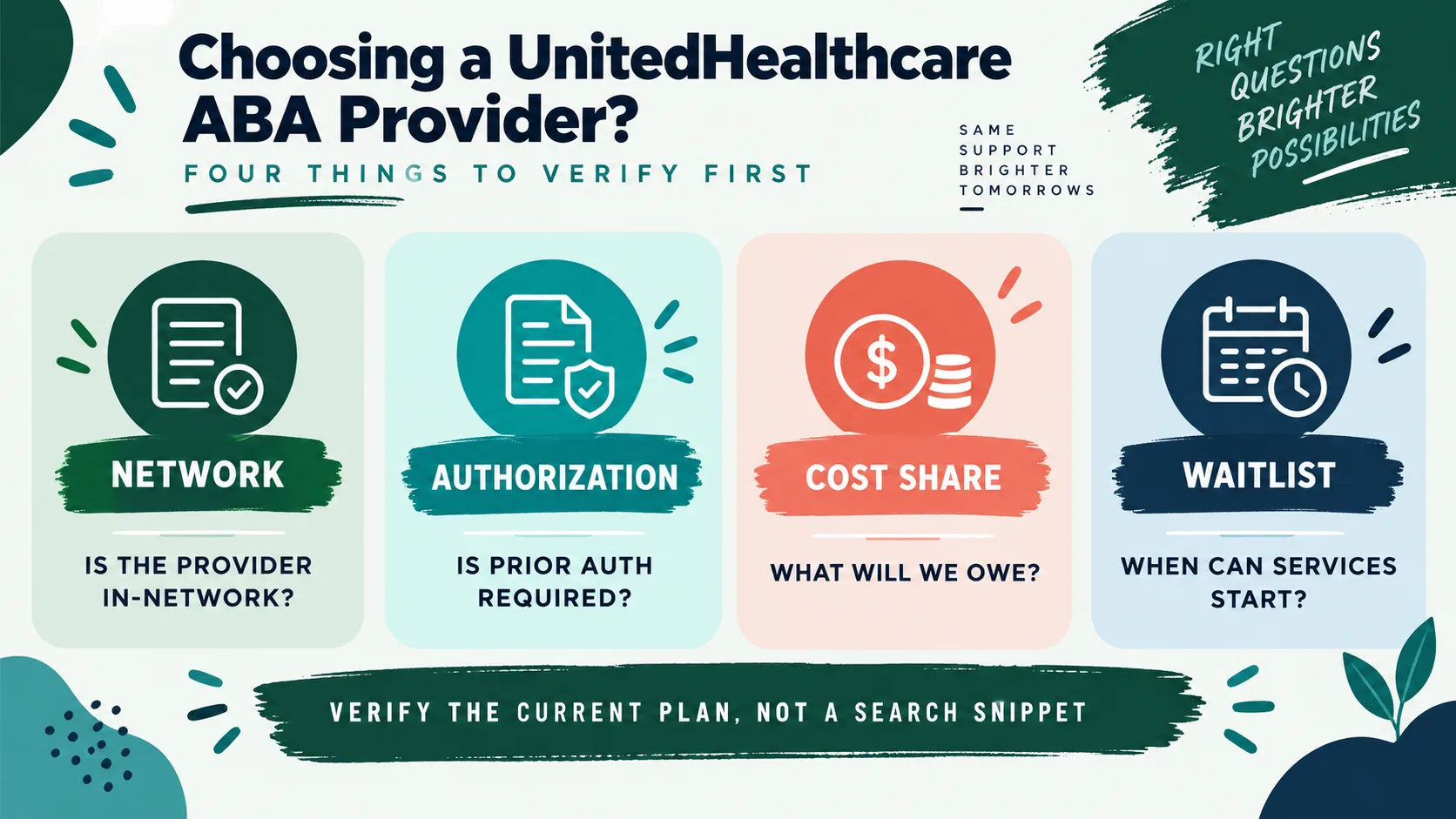
Before an intake appointment, verify six separate questions. Keeping them separate prevents a common mistake: hearing “we take UnitedHealthcare” and assuming that the answer covers every service, location, and authorization stage.
- Network: Is this provider or group in-network for the exact plan name and product on your card?
- Service: Does the network status apply to ABA assessment, direct treatment, caregiver training, and supervision—not only another behavioral-health service?
- Authorization: Is prior authorization required, who submits it, and what records or diagnostic documentation are needed?
- Cost: What deductible, copay, coinsurance, out-of-pocket maximum, and allowed-amount rules could apply?
- Availability: Is the provider accepting new clients, what is the waitlist, and where can sessions occur?
- Continuity: What happens if the provider leaves the network, the authorization period ends, or the family changes plans?
A Provider Verification Table
Use the table below during the same call with the insurer and the provider. It is intentionally practical: each row ends with evidence you can save instead of a verbal impression that is difficult to revisit.
| Check | Ask | Save |
|---|---|---|
| Network | Is the group and the rendering BCBA in-network for this exact plan? | Directory result, representative name, date, and reference number. |
| Authorization | What is required before assessment or treatment can begin? | Checklist of records, forms, diagnosis documentation, and deadlines. |
| Cost share | What is the member responsibility after benefits and allowed amounts? | Benefit quote, deductible status, and any written estimate. |
| Availability | Are you accepting new clients and when could services realistically start? | Waitlist position or intake timeline, including who will call next. |
Do not be discouraged if the provider and insurer give different answers on the first call. That disagreement is a reason to document the question, ask which department owns the answer, and request a written explanation—not a reason to assume that services are covered or excluded.
Commercial Plans, Medicaid, and Optum Differences
Commercial UnitedHealthcare plans can differ by employer, state, network, and benefit design. UnitedHealthcare Community Plan materials can differ by state and Medicaid program. A state provider PDF may be useful for a starting list, but its publication date, specialty labels, age ranges, and participating-provider status still need confirmation.
Some plans direct behavioral-health questions to Optum or another affiliated administrator. That does not mean every provider who appears in a general UnitedHealthcare search is available under every Optum-managed benefit. Ask the member-services representative to identify the administrator, directory, and authorization process that applies to your card.
Be especially careful with statements such as “all ABA is covered” or “there is no cost.” Coverage may still depend on medical necessity, diagnosis documentation, age or setting rules, network status, prior authorization, visit or unit limits, and the plan’s allowed amount. Self-funded employer plans can also follow different rules from fully insured state-regulated plans. The exact plan documents control.
What to Ask on the Phone
Use one short script so the conversation produces a usable record. You can say: “I am looking for applied behavior analysis services for a member on this exact plan. Can you confirm whether this provider or group is in-network, whether prior authorization is required, what documents are needed, and what the current estimated member responsibility is?” Then ask the representative to repeat the provider’s billing entity and the relevant service category.
- “Is the provider listed for my exact plan or only for UnitedHealthcare generally?”
- “Does the network status include the assessment, BCBA supervision, technician services, and caregiver training I am asking about?”
- “What diagnosis, referral, treatment plan, or clinical records are required for authorization?”
- “Which department handles authorization, and how can I follow up on the request?”
- “Can you give me a call reference number and the effective date of the information?”
Then ask the provider a matching set of questions. Confirm whether the provider is accepting new clients, which locations and ages they serve, how long the intake takes, whether they can help with authorization paperwork, and how they communicate changes in network status. If the provider says “we accept UHC,” ask them to verify the plan name and billing group rather than ending the call there.
If You Cannot Find an In-Network Provider
A thin directory or long waitlist does not automatically end the process. Ask UnitedHealthcare whether there is a network-adequacy or care-coordination process, whether an out-of-network exception or single-case agreement is possible, and what documentation is needed to show that an appropriate in-network option is not reasonably available. The answer depends on the plan and state; do not assume an exception will be approved.
Keep a simple access log with the date, phone number, representative, provider, plan answer, reference number, and next action. Save directory screenshots, denial letters, authorization requests, and provider emails. If you receive a denial, read the reason carefully: a denial for missing records, out-of-network status, medical necessity, coding, or authorization timing can require different follow-up.
For a deeper general process, see the site’s ABA health insurance verification guide and connect it to the plan-specific checklist here. The pages should support one another: this article is the UnitedHealthcare/provider-search entry point, while the hub covers broader benefits, authorization, cost sharing, and denial follow-up.
Your Next Practical Step
Before calling, gather the insurance card, member ZIP code, diagnosis or referral documents if available, preferred service setting, and a short description of the learner’s age and support needs. After each call, record the answer and the next action. That small paper trail turns a frustrating search into a sequence that can be checked and corrected.
If you are a BCBA candidate rather than a family member, the same topic can become an exam-reasoning exercise: separate the payer’s benefit decision, the provider’s network status, the BCBA’s clinical documentation, and the family’s access problem. You can practise those applied decisions with the Free BCBA Mock Exam, then review which questions required scope, documentation, ethics, or data-based reasoning.
Frequently Asked Questions
How do I find UnitedHealthcare ABA providers near me?: Start with the provider directory connected to your member plan or the number on your insurance card. Search for ABA or applied behavior analysis using your ZIP code, then call both the provider and UnitedHealthcare to confirm that the exact plan, billing group, service type, and location are current.
Does UnitedHealthcare cover ABA therapy?: Coverage depends on the plan, state, member eligibility, network, authorization, medical-necessity review, and service details. A general statement that UnitedHealthcare covers ABA cannot confirm your individual benefits. Use the current plan documents and request a member-specific answer with a reference number.
Is a provider listed online automatically in-network?: No. A directory entry may be outdated, may refer to a different UnitedHealthcare product, or may list a group without confirming every rendering provider or service. Verify the exact plan name, network status, service category, and effective date before assuming that the listing is usable.
What is the difference between UnitedHealthcare and Optum for ABA?: Some benefits route behavioral-health or ABA administration through Optum or another affiliated administrator. The administrator, directory, and authorization instructions depend on your plan. Follow the instructions on your member card and ask UnitedHealthcare which entity owns the coverage decision for ABA services.
What should I do if every provider has a long waitlist?: Record the providers you contacted, ask UnitedHealthcare about care coordination or network-adequacy options, and ask whether an out-of-network exception or single-case agreement is available. Keep written records and ask what documentation is needed; approval is plan-specific and never automatic.
Bottom line: Finding UnitedHealthcare ABA providers is a verification workflow, not a one-click directory search. Start with the exact plan, confirm network and authorization, estimate the real cost share, ask about availability, and save a dated record of every answer before services begin.
Quick Review Checklist
Use this final checklist to turn unitedhealthcare aba providers into exam-ready reasoning. The goal is not to memorize a label in isolation; it is to identify the relevant evidence and explain why the best answer fits the scenario. Key ideas to review:
- State the central definition or decision point for unitedhealthcare aba providers in your own words.
- Identify the detail that makes unitedhealthcare aba providers different from its closest related ABA term.
- Separate the observable facts in a scenario from assumptions that are not supported by the facts.
- Write one example and one nonexample so you can recognize the concept in a new setting.
Exam application checks:
- Ask what the question is actually requesting before comparing the answer choices.
- Mark the antecedent, response, consequence, or other evidence that supports the selected answer.
- Look for a distractor that describes a related process but does not answer the specific question.
Final self-check:
- Explain how you would verify the interpretation with clear observations or data.
- Change one detail in the scenario and decide whether your answer should change.
- Give a one-sentence rationale that a supervisor or study partner could evaluate.
Take the Free BCBA Mock Exam
When you are ready to apply the idea, use the free practice resource below for additional feedback. Take the Free BCBA Mock Exam



