Treatment Integrity and Social Validity: Subtle but Important Topics on the BCBA® Exam

Share the post

Treatment Integrity and Social Validity: Subtle but Important Topics on the BCBA® Exam

By BCBA Mock Exam

Introduction

Treatment integrity and social validity might feel like “side topics” compared to functions of behavior or measurement—but they show up on the BCBA® exam more often than many candidates expect. 

Treatment Integrity and Social Validity: Subtle but Important Topics on the BCBA® ExamGemini_Generated_Image_vbzfs3vbzfs3vbzf_compressed

The exam wants you to think like a practicing BCBA who can:

  • Check whether interventions are actually being implemented as designed (treatment integrity)

  • Evaluate whether goals, procedures, and outcomes are acceptable and meaningful to stakeholders (social validity)

  • Make ethical, data-based decisions when something is not working—not just blame the client

In this article, we’ll walk through:

  • What treatment integrity is and how it is measured

  • What social validity is and how to assess it

  • How these concepts interact in real practice

  • Common BCBA® exam traps

  • Mini exam-style questions with explanations so you can test yourself.

1. What Is Treatment Integrity?

Treatment integrity (also called procedural fidelity) refers to how accurately and consistently an intervention is implemented compared to its written plan.

In other words: 🔍 Are staff, parents, or therapists doing what the plan says—and doing it correctly?

Key pieces:

  • Accuracy – Are the steps completed as written?

  • Consistency – Are they completed on each opportunity or session?

  • Across implementers – Do multiple people implement the plan the same way?

Why it matters:

  • Without treatment integrity, you can’t be sure whether lack of progress is due to the intervention or the implementation.

  • Low integrity can compromise client outcomes and lead to incorrect clinical decisions.

2. Why Treatment Integrity Matters for Data-Based Decisions

From a decision-making standpoint, treatment integrity is critical because it affects how you interpret data.

Consider two scenarios:

  • Scenario A: Behavior isn’t improving and treatment integrity is high.

    • It’s more likely the intervention itself is ineffective or needs modification.

  • Scenario B: Behavior isn’t improving and treatment integrity is low or unknown.

    • You can’t conclude the intervention failed; it might not have been implemented correctly.

On the BCBA® exam, this often shows up as questions like:

  • “What should the BCBA check before deciding to change the intervention?”

  • “What additional data are needed to interpret these results?”

Treatment integrity is usually one of the best answers.

3. Measuring Treatment Integrity
Treatment Integrity and Social Validity: Subtle but Important Topics on the BCBA® ExamGemini_Generated_Image_vbzfs3vbzfs3vbzf (2)

To talk about treatment integrity, you need some way to measure it.

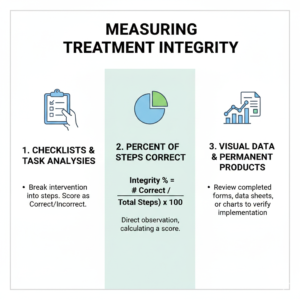
Common approaches:

  • Checklists or task analyses

    • Break the intervention into observable, measurable steps.

    • Example: For a token economy, list steps like “state rule,” “deliver tokens contingent on behavior,” “exchange tokens at set times,” etc.

  • Percent of steps implemented correctly

    • Observe a session and score each step as correct/incorrect.

    • Treatment integrity % = (number of correctly implemented steps ÷ total relevant steps) × 100.

  • Permanent products

    • Review completed work, data sheets, or completed checklists as evidence that steps were followed.

  • Frequency or occurrence measures of specific components

    • For example, the number of correct prompts, or frequency of delivering reinforcement as specified.

Exam tip: When a question asks how to verify implementation before changing a plan, an answer that includes direct observation with a fidelity checklist is usually stronger than relying only on verbal report.

4. Improving Treatment Integrity in Practice (and on the Exam)

Once you know integrity is low, you need strategies to improve it.

Effective methods often include:

  • Behavior Skills Training (BST)

    • Instructions, modeling, rehearsal, and feedback for staff or caregivers.

  • Simplifying procedures

    • Streamline the plan; remove unnecessary complexity.

    • Make steps easy to remember and feasible in context.

  • Visual supports and checklists

    • Provide quick-reference guides, flowcharts, or step cards.

  • Ongoing performance feedback

    • Regularly review implementation data; praise improvements, coach around errors.

  • Environmental supports

    • Ensure materials and time are available to implement the plan as written.

Exam tip: If staff are inconsistently implementing a plan, the BEST answer is rarely “write a new plan” or “discharge the client”—it’s often to train, support, and monitor implementation first.

5. What Is Social Validity?

Treatment Integrity and Social Validity: Subtle but Important Topics on the BCBA® ExamGemini_Generated_Image_vbzfs3vbzfs3vbzf (1)

Social validity refers to how acceptable and meaningful an intervention is to the people involved.

Traditionally, social validity covers three areas:

  • Goals – Are the target behaviors important and meaningful (e.g., independence, safety, quality of life)?

  • Procedures – Are the methods acceptable, feasible, and aligned with the values of the client and stakeholders?

  • Outcomes – Are the results clinically significant and meaningful, not just statistically different?

In simple terms: 🤔 Does this matter? Is it acceptable? And does it actually help in real life?

Social validity is an ethical issue—BCBAs should not run highly aversive or irrelevant interventions just because they “work” on a graph.

6. How to Assess Social Validity

The BCBA® exam won’t require you to memorize specific rating scales, but it will expect you to know basic methods for evaluating social validity.

Common approaches include:

  • Questionnaires and rating scales

    • Ask caregivers, clients (when appropriate), and staff to rate:

      • Importance of goals

      • Acceptability of procedures

      • Satisfaction with outcomes

  • Interviews

    • Open-ended or structured conversations about what matters to the client and family.

  • Direct measures of choice and preference

    • For example, observing whether a client chooses to participate in an activity or selects a particular intervention option.

  • Social comparison

    • Comparing the client’s behavior and outcomes to those of same-age peers or typical performance standards.

Exam tip: If a question asks how to determine whether an intervention is acceptable to families or teachers, look for options that mention rating scales, interviews, and preference/choice measures, not just behavior frequency data.

7. How Treatment Integrity and Social Validity Interact

Treatment integrity and social validity are related but distinct.

Examples of their interaction:

  • An intervention may have high integrity but low social validity:

    • Staff implement a highly intrusive procedure perfectly, but parents find it unacceptable and want it discontinued.

  • An intervention may have high social validity but low integrity:

    • Everyone likes the idea of the plan, but it’s so complex that no one actually follows it consistently.

For long-term success, you want:

  • Interventions that are acceptable and meaningful (social validity)

  • Interventions that are implemented accurately and consistently (treatment integrity)

On the BCBA® exam, you might be asked which factor to consider when:

  • A family is unhappy despite good data → check social validity.

  • Data show no improvement despite a well-designed plan → check treatment integrity.

8. How These Topics Show Up on the BCBA® Exam

Expect to see treatment integrity and social validity in scenarios involving:

  • Intervention evaluation

    • Deciding whether to continue, modify, or discontinue a program.

  • Ethical decision-making

    • Considering client dignity, acceptability of procedures, and collaboration with caregivers.

  • Supervision and staff training

    • Using BST and feedback to improve implementation fidelity.

  • Outcome evaluation questions

    • Recognizing that “statistically significant” or small changes may not be socially significant.

Common question types:

  • “Before changing the intervention, what should the BCBA check first?” (Often: treatment integrity.)

  • “How can the BCBA assess whether this intervention is acceptable to parents?” (Often: social validity measures.)

  • “Which of the following raises concerns about social validity?”

9. Common BCBA® Exam Traps About Treatment Integrity and Social Validity

Trap 1 – Blaming the client when treatment integrity is low If data are poor and integrity is questionable, you can’t conclude the client is “resistant” or the plan “doesn’t work.”

Trap 2 – Assuming an effective graph guarantees social validity An intervention can reduce behavior on a graph but still be unacceptable, too restrictive, or misaligned with client values.

Trap 3 – Using only informal comments as evidence of integrity Verbal statements like “Yeah, I’m doing it” are not strong evidence. The exam prefers direct observation and fidelity data.

Trap 4 – Ignoring stakeholder input If parents express serious concerns about an intervention, the BCBA should listen and assess social validity, not simply insist on continuing.

Trap 5 – Over-relying on social validity alone High caregiver satisfaction does not mean the intervention is effective. You still need behavioral data and integrity checks.

10. Mini BCBA® Exam–Style Questions (With Explanations)

Question 1 – Treatment Integrity Check A BCBA implements a differential reinforcement program to reduce elopement. After four weeks, data show no change in elopement rates. Teachers report that they “try to use the plan when they can,” but the classroom is busy and chaotic.

What is the BEST next step for the BCBA? A. Immediately design a completely new intervention B. Increase the schedule of reinforcement for staying in the classroom C. Assess and improve treatment integrity through observation, checklists, and staff training D. Conclude that reinforcement will not work for this client

Correct Answer: C Explanation: Before changing the intervention, the BCBA should verify whether it has been implemented as designed. Reports suggest integrity is likely low.


Question 2 – Social Validity Concern A school-based intervention decreases disruptive behavior from 10 episodes per day to 3 episodes per day. However, the teacher reports that the remaining behavior is still very disruptive and that the token system is too complicated to manage with 25 students.

Which statement BEST reflects the situation? A. The intervention has high social validity because behavior decreased B. The intervention may lack social validity in terms of procedures and outcomes C. Social validity is irrelevant because data show improvement D. Treatment integrity must be perfect because behavior decreased

Correct Answer: B Explanation: Although there is some improvement, the teacher finds the procedure difficult to implement and the remaining behavior still unacceptable—both are social validity concerns.


Question 3 – Measuring Treatment Integrity A BCBA wants to determine whether RBTs are implementing a token economy correctly. Which method is MOST appropriate?

A. Ask RBTs to rate their confidence in using the token system on a 1–10 scale B. Observe sessions using a checklist of key steps and calculate the percentage of correctly implemented components C. Compare the number of tokens delivered to the number of behaviors targeted D. Ask parents whether they think the token system is helpful

Correct Answer: B Explanation: Direct observation with a fidelity checklist and calculating percent correct is a standard way to measure treatment integrity.


Question 4 – Assessing Social Validity A clinic has implemented a social skills group. Parents report that their children enjoy the group, but the BCBA wants more systematic data on social validity of the goals and procedures.

What is the BEST step to take? A. Discontinue the group because only parent comments have been collected B. Conduct a functional analysis of social behavior during the group C. Administer structured social validity questionnaires to parents and, when appropriate, to clients D. Replace the group with 1:1 sessions for all clients

Correct Answer: C Explanation: Structured questionnaires provide more systematic social validity data about goals, procedures, and outcomes.

11. Key Takeaways

  • Treatment integrity (procedural fidelity) tells you whether an intervention is being implemented correctly and consistently.

  • Social validity addresses whether goals, procedures, and outcomes are important, acceptable, and meaningful to stakeholders.

  • Poor outcomes with unknown or low treatment integrity do not mean the intervention is ineffective—you must check fidelity first.

  • Positive data alone do not guarantee social validity; you still need stakeholder input and consideration of client values.

  • On the BCBA® exam, whenever an intervention seems ineffective or controversial, ask yourself:

    1. Do we know if the plan is being implemented correctly? (Treatment integrity)

    2. Do we know if the plan is acceptable and meaningful for this client and context? (Social validity)

Keeping these questions in mind will help you navigate subtle exam items—and make better, more ethical decisions in real practice.


Share the post