

What Are Behavioral Diagnostic Skills?
Behavioral diagnostic skills represent the core competencies needed to systematically identify, measure, and analyze behavior within an assessment context. These skills form the foundation of ethical and effective applied behavior analysis practice, enabling practitioners to move beyond surface-level observations to understand the underlying functions of behavior.
Table of Contents
- What Are Behavioral Diagnostic Skills?
- Applying Behavioral Diagnostic Skills: Worked ABA Examples
- Behavioral Diagnostic Skills on the BCBA Exam: Common Traps and Strategies
- BCBA Candidate Checklist for Behavioral Diagnostic Skills
- Summary and Key Takeaways
Within the BACB Task List, these skills primarily fall under Section F: Behavior Assessment, though they integrate across multiple domains. Mastery of these skills is essential for developing appropriate interventions that address the root causes of behavior rather than just its topography.
Core Definition and Exam Relevance
Behavioral diagnostic skills encompass the systematic processes used to understand why behaviors occur. This involves more than just describing what a behavior looks like—it requires analyzing the environmental variables that maintain it. On the BCBA exam, these skills are tested through scenarios that require you to select appropriate assessment methods, interpret data patterns, and develop accurate behavioral hypotheses.
The exam blueprint emphasizes practical application, so expect questions that present ABC data and ask you to identify the most likely function or determine the next logical assessment step. Understanding how to apply these skills in various contexts is crucial for exam success.
Key Components of Diagnostic Skills
Effective behavioral diagnosis requires proficiency in several interconnected areas:
- Operational definitions: Creating clear, objective, and measurable descriptions of target behaviors
- Measurement selection: Choosing appropriate data collection methods (frequency, duration, latency, etc.) based on behavior characteristics
- Data collection design: Implementing systematic observation procedures that yield valid and reliable information
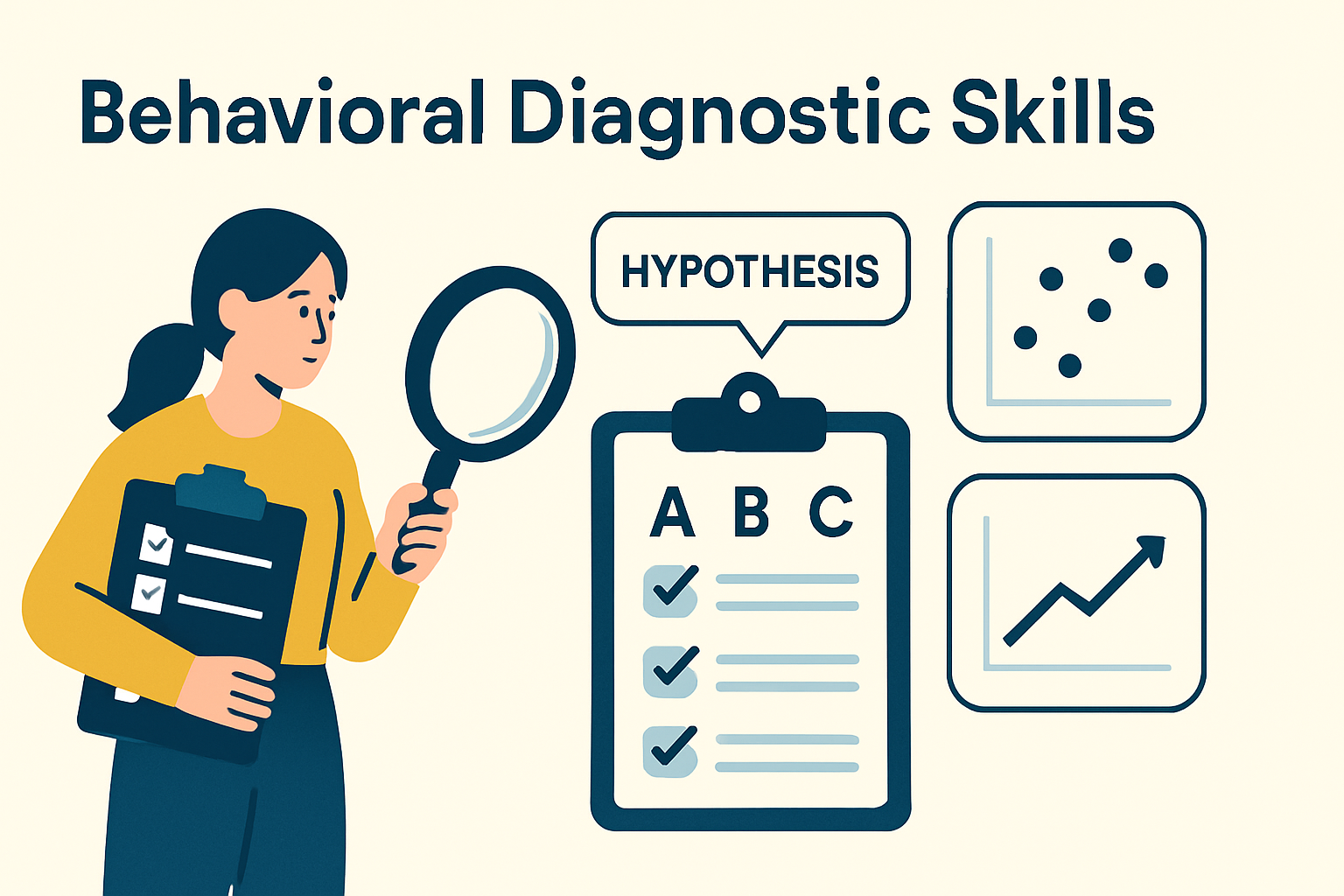
- ABC analysis: Identifying antecedents and consequences that reliably precede and follow target behaviors
- Hypothesis development: Formulating testable statements about behavioral function based on assessment data
Applying Behavioral Diagnostic Skills: Worked ABA Examples
Let’s examine three practical scenarios that demonstrate how behavioral diagnostic skills are applied in real-world settings. Each example follows the systematic process from initial observation to functional hypothesis.
Example 1: Elopement in a Classroom Setting
Consider a scenario where a child frequently leaves the instructional area during academic tasks. Through systematic observation, you collect the following ABC data:
- Antecedent: Teacher presents difficult math worksheet
- Behavior: Child stands up and walks out of classroom
- Consequence: Teacher does not follow, child avoids math work for 10+ minutes
The diagnostic analysis reveals a clear pattern: elopement consistently follows difficult demands and results in task removal. The hypothesized function is escape from aversive tasks. This conclusion is supported by the reliable relationship between the antecedent (difficult demand) and the maintaining consequence (task avoidance).
Example 2: Vocal Stereotypy During Free Play
In this scenario, a child engages in repetitive vocalizations during unstructured time. The collected data shows:
- Antecedent: Alone in play area, no toys available
- Behavior: Repetitive humming and vocal patterns
- Consequence: No observable social reaction from others
The diagnostic process must distinguish between potential functions. Since the behavior occurs when alone and doesn’t produce social consequences, the most likely hypothesis is automatic reinforcement. The behavior itself produces sensory stimulation that maintains its occurrence. This differs from socially-mediated functions where behavior produces attention or other external consequences.
Example 3: Aggression During Transitions
A student displays aggression when prompted to transition between activities. The assessment data indicates:
- Antecedent: Verbal prompt to clean up preferred activity
- Behavior: Hits peer standing nearby
- Consequence: Teacher provides immediate attention and delays transition
This example highlights the importance of consequence analysis. While the antecedent involves ending a preferred activity, the maintaining consequence is the teacher’s attention and delay of the transition. The hypothesized function is access to adult attention combined with tangible delay. This dual function requires careful intervention planning that addresses both maintaining variables.
Behavioral Diagnostic Skills on the BCBA Exam: Common Traps and Strategies
The BCBA exam tests your ability to apply diagnostic skills in various scenarios. Understanding common pitfalls can help you avoid costly mistakes.
Frequent Exam Question Traps
Several patterns consistently challenge candidates on diagnostic skill questions:
- Confusing topography with function: Selecting answers based on what the behavior looks like rather than why it occurs
- Premature intervention selection: Choosing treatment strategies before completing adequate assessment
- Measurement procedure errors: Selecting inappropriate data collection methods for the behavior characteristics
- Over-reliance on indirect assessment: Placing too much weight on interviews or checklists without direct observation data
- Function misidentification: Failing to distinguish between escape and attention functions when both are plausible
How to Approach Diagnostic Skill Questions
Develop a systematic approach for exam questions involving behavioral diagnosis:
- Identify the target behavior: Ensure you understand exactly what behavior is being assessed
- Review assessment data: Examine all provided information, including ABC patterns and measurement results
- Determine assessment phase: Identify whether the question addresses initial assessment, ongoing measurement, or hypothesis testing
- Select logical next step: Choose the most appropriate action based on current assessment phase and data patterns
- Verify function hypothesis: When asked about function, ensure your selection aligns with the maintaining consequences in the data
For more strategies on approaching complex exam questions, see our guide on BCBA test question strategies.
BCBA Candidate Checklist for Behavioral Diagnostic Skills
Use this quick self-assessment to gauge your readiness in this critical area:
- Define behaviors operationally for any given scenario
- Select appropriate measurement procedures based on behavior dimensions
- Design ABC data collection systems that capture relevant variables
- Analyze data patterns to identify potential functional relationships
- Develop testable hypotheses about behavioral function
- Distinguish between assessment types (descriptive vs. functional analysis)
- Identify common assessment pitfalls and how to avoid them
- Apply ethical considerations throughout the assessment process
For comprehensive assessment guidance, review our article on assessment in ABA.
Summary and Key Takeaways
Behavioral diagnostic skills form the essential foundation for effective ABA practice. These skills enable you to move beyond surface-level observations to understand the functional relationships that maintain behavior. Mastery requires systematic application of assessment principles across multiple domains.
Key points to remember include the importance of operational definitions, appropriate measurement selection, thorough ABC analysis, and accurate hypothesis development. On the BCBA exam, these skills are tested through practical scenarios that require careful data interpretation and logical decision-making.
Strong diagnostic skills directly contribute to ethical practice by ensuring interventions target the true causes of behavior rather than superficial characteristics. As you prepare for the exam, focus on applying these skills across diverse scenarios and avoiding common assessment pitfalls. For additional resources on behavior assessment, consult the BACB Task List and relevant research on functional assessment methodologies.
Remember that behavioral diagnostic skills are not just for exam success—they’re the cornerstone of effective, ethical, and client-centered ABA practice that produces meaningful behavior change.


