Stimulus Generalization and Response Generalization: Definitions, Examples, and BCBA® Question Patterns
By BCBA Mock Exam
Introduction
If you’re preparing for the BCBA® exam, you will see questions about generalization in many places—skill acquisition, maintenance, programming across settings, and more.
The tricky part is not memorizing the definitions. It’s quickly recognizing, in a scenario, whether the question is really about:
-
Stimulus generalization (same response, different stimuli),
-
Response generalization (different responses, same function or stimulus), or
-
A lack of generalization (stimulus control is too narrow).
In this article, we’ll:
-
Define stimulus and response generalization in plain language
-
Give clear, exam-style examples for each
-
Contrast them with stimulus discrimination
-
Show common BCBA® question patterns and traps
-
End with mini practice questions and explanations so you can test yourself.
1. Why Generalization Matters for Practice and the Exam
In real ABA work, training a skill that only occurs in one setting, with one person, using one set of materials, is rarely enough. We want behavior change that:
-
Shows up in new settings
-
Works with new people and materials
-
Includes flexible response forms that still meet the same goal
On the BCBA® exam, generalization is tested in questions about:
-
Program design (how to promote generalization)
-
Evaluating treatment success (did behavior generalize?)
-
Interpreting data from different settings or stimuli
-
Distinguishing stimulus control from stimulus generalization
Understanding stimulus vs response generalization helps you interpret what the exam is really asking when it describes new behaviors or new situations.
2. Stimulus Generalization: Same Response, New Stimuli
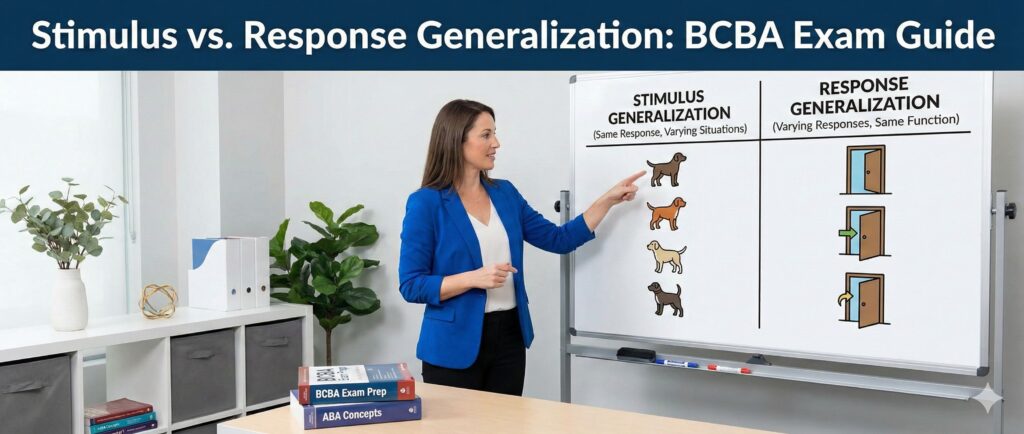
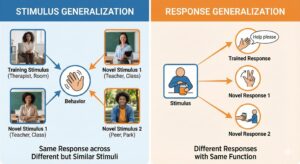
Stimulus generalization occurs when a learned response occurs in the presence of different but similar stimuli to those present during training.
Short definition:
-
Same response, different stimuli.
Examples:
-
A child learns to say “dog” when shown a picture of the family’s golden retriever. Later, they say “dog” when they see other breeds, cartoon dogs, or a neighbor’s dog.
-
A client is taught to use a picture card to request a break with one therapist in the therapy room. Later, they use the same card to request a break with a teacher in the classroom.
-
A teenager learns to stop at a red traffic light. They also stop when they see slightly different red lights in other cities or at slightly different intersections.
Exam tip: If the response stays basically the same but the antecedent stimuli vary, you’re most likely seeing stimulus generalization.
3. Response Generalization: New Forms of Behavior With the Same Function
Response generalization occurs when a learner emits different responses that serve the same function or meet the same class of reinforcement, after a particular response has been taught.
Short definition:
-
Different responses, same function (or same stimulus context).
Examples:
-
A child is taught to say “Help” when they cannot open a jar. Later, they also learn (without direct teaching) to say “Can you open this?” or hand the jar to an adult—all to access assistance.
-
A client is taught to greet peers by saying “Hi.” Over time, they begin saying “Hey,” “What’s up?” or waving, even though only “Hi” was directly trained.
-
A student is taught to write their name using a thick marker. Later, they can also sign their name with a pencil, pen, or digital stylus without specific training for each tool.
Exam tip: If new topographies (forms of behavior) appear that still contact the same kind of reinforcement, you’re looking at response generalization.
4. Stimulus Generalization vs Stimulus Discrimination
The BCBA® exam often contrasts stimulus generalization with stimulus discrimination.
Stimulus generalization
-
The response occurs in the presence of a range of similar stimuli.
-
Example: Saying “ball” when seeing many different types of balls.
Stimulus discrimination
-
The response occurs in the presence of specific stimuli and not in others.
-
Example: Saying “red” only when the card is truly red, not when it’s pink or orange.
Overly narrow stimulus control (too much discrimination, not enough generalization):
-
A child only says “hello” to one therapist, not to other adults.
-
A client only uses a communication device in the therapy room, never at home.
On the exam, when an item asks how to promote generalization, the best options often involve:
-
Teaching across multiple exemplars (different stimuli)
-
Varying people, settings, and materials
-
Programming common stimuli across environments
-
Training loosely (within reason) rather than only in a rigid context.
5. Programming and Assessing Generalization
To get full credit on exam questions about generalization, you need to recognize both:
-
How to program for generalization, and
-
How to determine if generalization has occurred.
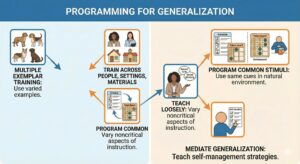
Common tactics to promote generalization:
-
Multiple exemplar training – Use a wide range of examples during instruction (many types of dogs, greetings, math problems).
-
Train across people, settings, and materials – Different therapists, teachers, rooms, and tools.
-
Program common stimuli – Use stimuli in teaching that will also be present in the natural environment (same visual schedules, same prompts).
-
Teach loosely – Vary noncritical aspects like tone of voice, wording, or seating arrangement.
-
Mediate generalization – Teach self-management, rules, or self-instructions that the learner can carry across contexts.
Assessing generalization:
-
Collect data in new settings or with new people/materials.
-
Use probe sessions outside of training conditions.
-
Compare baseline vs post-intervention performance across multiple contexts.
Exam tip: If an item describes strong performance in training sessions but no change at home, school, or community, the issue is likely a lack of generalization, and the best answer will add one of the strategies above.
6. BCBA® Question Patterns for Stimulus vs Response Generalization
Here are some common ways the exam tests these concepts:
1️⃣ Definition items
-
Straightforward: “Which example best illustrates stimulus generalization?” or “response generalization?”
2️⃣ Program design
-
“Which change would best promote generalization of this skill?” (e.g., adding multiple exemplars, programming common stimuli.)
3️⃣ Interpreting vignettes
-
A behavior occurs in many new settings → stimulus generalization.
-
New forms of a behavior appear with the same function → response generalization.
4️⃣ Error analysis
-
A child only uses a skill in a very narrow context: question asks what dimension of ABA or what programming component is missing (often generality or a generalization strategy).
5️⃣ Contrast with discrimination
-
Options may ask you to choose between tightening discrimination or promoting generalization, depending on the problem described.
7. Common BCBA® Exam Traps
Trap 1 – Calling any behavior change in a new setting “response generalization”
-
If the behavior topography is the same and the setting changes → stimulus generalization, not response generalization.
Trap 2 – Ignoring the function of behavior
-
For response generalization, different responses must still serve the same function (e.g., different mands to get help).
Trap 3 – Confusing generalization with maintenance
-
Maintenance = behavior continues over time.
-
Generalization = behavior occurs across stimuli, people, settings, or response forms.
-
Many exam questions combine both, but the wording will tell you which is being targeted.
Trap 4 – Over-focusing on noncritical details
-
Long vignettes may include diagnoses, preferences, or family history that are irrelevant to whether the example shows stimulus or response generalization.
-
Always return to: What changed? Stimuli or response topography?
Trap 5 – Forgetting that poor generalization can be a treatment integrity or programming issue
-
If behavior doesn’t generalize, the problem may be the plan, not the client.
8. Mini BCBA® Exam–Style Questions (With Explanations)
Question 1 – Stimulus or Response Generalization? A learner is taught to tact “spoon” when shown a metal spoon used during snack. Later, the learner correctly says “spoon” when shown a plastic spoon, a wooden spoon, and a cartoon picture of a spoon.
What is this an example of? A. Stimulus generalization B. Response generalization C. Stimulus discrimination D. Maintenance
Correct Answer: A – Stimulus generalization Explanation: The same response (saying “spoon”) occurs in the presence of different but similar stimuli.
Question 2 – Response Generalization A child is taught to request a break by saying “Break, please.” After training, the child also begins to say “I need a break,” “Can I rest?” and sometimes raises their hand and points to the break card, all to access the same break from work.
This pattern BEST illustrates: A. Stimulus generalization B. Response generalization C. Stimulus discrimination D. Extinction
Correct Answer: B – Response generalization Explanation: The child is emitting different response forms that all serve the same function (manding for a break).
Question 3 – Lack of Generalization A student learns to independently use a schedule to transition between activities in the resource room. However, in the general education classroom, the student does not use the schedule unless the resource-room teacher is present to prompt them.
Which of the following is the BEST next step for the BCBA? A. Conclude the skill is mastered because it occurs in at least one setting B. Add training sessions in the general education classroom and train the classroom teacher to use the same schedule system C. Increase the difficulty of tasks in the resource room D. Discontinue the schedule and focus only on token reinforcement
Correct Answer: B Explanation: The behavior has not generalized across settings and people. Programming common stimuli and training across settings/people will promote generalization.
Question 4 – Generalization vs Discrimination A learner is taught to sort pictures of animals vs non-animals. After training, the learner correctly places many different kinds of animals (dogs, birds, fish, elephants) in the “animal” bin and leaves household items in the “non-animal” bin.
This outcome MOST clearly reflects: A. Stimulus discrimination only B. Stimulus generalization within the “animal” category plus discrimination between categories C. Response generalization only D. Maintenance of behavior without generalization
Correct Answer: B Explanation: The learner discriminates animal vs non-animal, and within the “animal” category they show stimulus generalization across many examples.
9. Key Takeaways
-
Stimulus generalization: Same response, different stimuli (e.g., saying “dog” to many dog examples).
-
Response generalization: Different responses, same function or stimulus context (e.g., multiple ways of requesting help).
-
Generalization is different from maintenance (time) and from pure discrimination (tight responding to specific stimuli).
-
On the BCBA® exam, focus on what changed:
-
If stimuli changed → think stimulus generalization.
-
If response form changed but function stayed the same → think response generalization.
-
-
When generalization is missing, the best answers usually add:
-
Multiple exemplars
-
Training across people, settings, and materials
-
Common stimuli or loose training procedures.
-
With these distinctions clear, you’ll be better equipped to decode exam vignettes and design programs that lead to durable, flexible behavior change in real life.