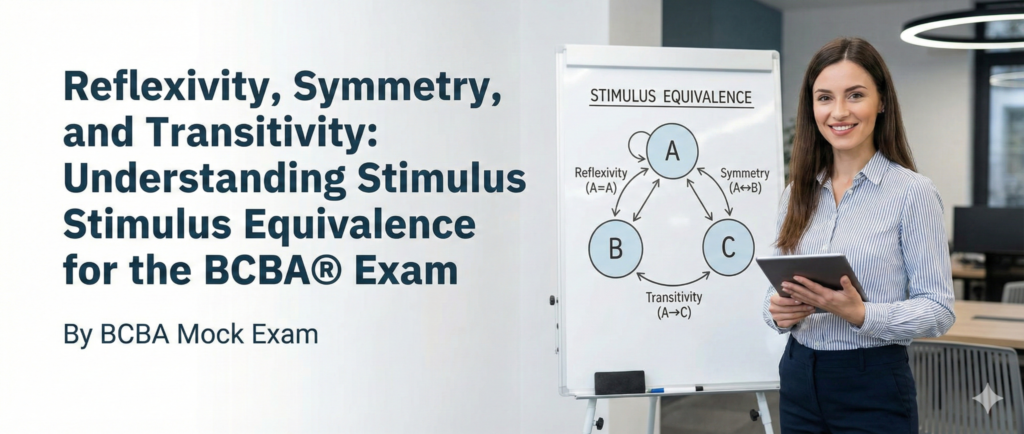
Reflexivity, Symmetry, and Transitivity: Understanding Stimulus Equivalence for the BCBA® Exam
By BCBA Mock Exam
“Stimulus equivalence” is one of those BCBA® exam topics that feels abstract at first — lots of A’s, B’s, C’s, arrows and matching tasks. But once you really understand reflexivity, symmetry, and transitivity, you’ll see that the exam is mainly asking:
-
Do you know what each relation means?
-
Can you tell when a relation is demonstrated vs trained?
-
Can you recognize a true equivalence class?
In this article, we’ll cover:
-
What stimulus equivalence is and why it matters
-
Clear definitions and examples of reflexivity, symmetry, and transitivity
-
How equivalence classes show up in reading, math, language
-
Common BCBA® exam traps
-
A few practice questions with explanations
1. What Is Stimulus Equivalence?
In applied behavior analysis, stimulus equivalence describes a situation where different stimuli become interchangeable in the learner’s behavior, even though they look or sound different.
Simple idea:
A set of stimuli forms an equivalence class when the learner treats them as the same in important ways, even if they are physically different.
Classic example:
-
Written word: “DOG”
-
Picture of a dog 🐕
-
Spoken word: “dog”
For a fluent reader, these three very different stimuli all “mean the same thing” and function similarly: they evoke the same response (thinking of a dog, saying “dog,” pointing to a dog, etc.). That’s stimulus equivalence.
Formally, we say a set of stimuli (A, B, C, etc.) forms an equivalence class when the learner shows:
-
Reflexivity
-
Symmetry
-
Transitivity
The BCBA® exam loves to test whether you can identify each relation correctly.
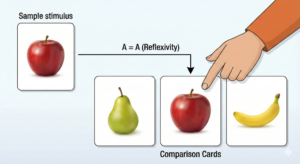
2. Reflexivity: “A = A” (Generalized Identity Matching)
Definition
Reflexivity is demonstrated when a learner matches a stimulus to itself, without specific training for that exact match, showing a generalized identity relation.
In formal notation:
-
If you present A as a sample and A as one of several comparison stimuli, the learner selects A.
-
A = A, B = B, C = C, etc.
Example
You put three pictures in front of a learner:
-
Picture A: 🍎 (red apple)
-
Picture B: 🍐 (pear)
-
Picture C: 🍌 (banana)
You present the apple picture as the sample and ask, “Match same.” The learner correctly picks the identical apple picture from the array — not because you trained that exact match, but because they understand “match identical.”
If they can do this across many stimuli, we say they show reflexivity (generalized identity matching).
On the exam
Look for:
-
“Match the picture to the identical picture”
-
“Select the same as the sample”
-
“Without prior direct training on that stimulus, the learner correctly matches it to itself”
That’s reflexivity.
The following image illustrates the concept of Reflexivity (A=A).
3. Symmetry: “If A = B, Then B = A”
Definition
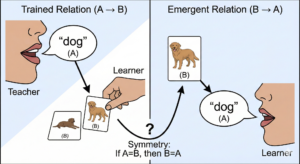
Symmetry is demonstrated when, after training the relation A → B, the learner can also show B → A without direct training.
If you train:
-
A = B (A relates to B),
and later test:
-
B = A (B relates to A),
and the learner responds correctly, that’s symmetry.
Example
Let’s say:
-
A = the spoken word “dog” (auditory stimulus)
-
B = a picture of a dog (visual stimulus)
Training phase (A → B):
-
You teach the learner: when you hear “dog” (A), select the dog picture (B).
-
This is a match-to-sample task: spoken word as sample, pictures as comparisons.
Test phase (B → A):
-
Now you do the reverse:
-
You show the dog picture (B) as the sample,
-
Provide several spoken-word options (or ask the learner to say the word),
-
Check whether they correctly respond with “dog” (A), without directly training that direction.
-
If the learner can do this, then symmetry is present: A = B and B = A.
On the exam
Watch for scenarios where:
-
The learner was only trained in one direction (A → B),
-
But then correctly responds in the reverse direction (B → A) without direct instruction,
-
The stem may highlight that no explicit training occurred for B → A.
That’s symmetry.
The following image illustrates the concept of Symmetry, showing the trained relation and the emergent reverse relation.
4. Transitivity: “If A = B and B = C, Then A = C”
Definition
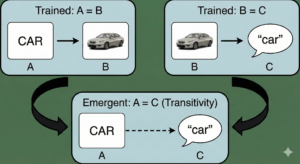
Transitivity is demonstrated when, after training A → B and B → C, the learner can respond correctly to A → C without direct training.
In notation:
-
Train: A = B
-
Train: B = C
-
Test: A = C (untaught)
If the learner shows A = C, that’s transitivity.
Example
Let’s extend the dog example:
-
A = written word “CAR”
-
B = picture of a car
-
C = spoken word “car”
Training:
-
Train A → B:
-
Show the written word “CAR” (A) as sample,
-
Present pictures as comparisons,
-
Teach the learner to choose the car picture (B).
-
-
Train B → C:
-
Show the car picture (B) as sample,
-
Provide spoken-word options or require a vocal response,
-
Teach the learner to say “car” (C).
-
Test: A → C (transitivity)
-
Now show “CAR” (A) as sample and require a spoken response (C).
-
If the learner says “car” without direct training of “CAR” → “car,”
-
Then they are showing transitivity: A = C, derived from A = B and B = C.
On the exam
Look for:
-
Two directly trained relations (A = B, B = C)
-
One new relation the learner demonstrates without direct training (A = C)
-
That’s transitivity.
The following image illustrates the concept of Transitivity, showing how two trained relations lead to an emergent third relation.
5. Stimulus Equivalence: When All Three Are Present
When a set of stimuli (A, B, C, etc.) shows:
-
Reflexivity (A = A, B = B, C = C)
-
Symmetry (If A = B, then B = A; if B = C, then C = B)
-
Transitivity (If A = B and B = C, then A = C)
…then we say the stimuli form an equivalence class.
In our dog example:
-
A (written “DOG”)
-
B (picture of a dog)
-
C (spoken “dog”)
If the learner:
-
Matches each to itself (reflexivity)
-
Goes both ways between each pair (symmetry)
-
Connects A to C via B (transitivity)
Then A, B, and C are equivalent for that learner.
Why this matters clinically
Stimulus equivalence explains how learners can suddenly show new, untrained relations once a few key relationships are taught — for example:
-
Learning to read new words once letter-sound relations are established
-
Understanding that “5,” “five,” and a set of ***** are all pointing to the same quantity
6. Arbitrary vs Non-Arbitrary Relations (A Subtle Exam Point)
Stimulus equivalence is often described in the context of arbitrary relations:
-
The stimuli in the equivalence class do not share physical similarity, but are related by convention or learning.
Examples:
-
“DOG” (text), 🐕 (picture), and “dog” (spoken word)
-
Flags and country names
-
Currency symbols and their spoken names
This contrasts with non-arbitrary (physical) relations, like:
-
Matching identical shapes or colors (these already have physical similarity; that’s more about reflexivity and simple discrimination than about equivalence classes).
On the BCBA® exam, stimulus equivalence usually refers to arbitrary matching (e.g., words, pictures, and spoken names linked through learning, not physical similarity).
7. How Reflexivity, Symmetry, and Transitivity Show Up on the BCBA® Exam
Common patterns:
-
Definition-matching questions
-
“Which term describes matching a stimulus to itself?” → reflexivity
-
“Which term describes demonstrating B = A after training A = B?” → symmetry
-
“Which term describes demonstrating A = C after training A = B and B = C?” → transitivity
-
-
Scenario-based questions
-
You’ll see descriptions of match-to-sample procedures
-
The stem will specify what was taught vs what was tested without direct training
-
Your task is to label the relation (reflexive, symmetric, transitive, or full equivalence)
-
-
Equivalence class questions
-
They may ask if a set of relations meets the criteria for an equivalence class
-
Or ask: “What additional test is needed to demonstrate stimulus equivalence?”
-
-
Generalization and derived relational responses
-
Sometimes equivalence is discussed as a way of explaining emergent behaviors (responses that appear without direct teaching).
-
8. Common Exam Traps
Trap 1 – Confusing “trained” vs “emergent” relations The exam cares about which relations were:
-
Explicitly taught, versus
-
Derived or emergent (not directly trained)
Symmetry and transitivity are usually about emergent relations. If the stem says the BCBA directly taught both directions (A → B and B → A), then:
-
B → A is not symmetry; it is just another trained relation.
Trap 2 – Calling any matching task “equivalence” Not every matching task is stimulus equivalence.
-
Simple “match identical pictures” tasks show reflexivity, but not necessarily full equivalence.
-
To claim equivalence, you must have evidence for reflexivity + symmetry + transitivity.
Trap 3 – Ignoring the “A = C” and “C = A” tests To fully demonstrate an equivalence class with three stimuli (A, B, C), you need:
-
Reflexivity (A = A, B = B, C = C)
-
Symmetry tests (A ↔ B, B ↔ C)
-
Transitivity (A = C)
-
Sometimes also combined relations (like C = A inferred via symmetry of A = C)
Exam stems may ask: “What additional probe is needed to show equivalence?” The answer often involves testing untaught relations like A = C or C = A.
9. Mini Practice Questions (With Explanations)
Question 1 – Identify the Relation
A BCBA teaches a learner to match the spoken word “apple” to a picture of an apple (A → B). Later, without direct teaching, the learner can select the spoken word “apple” when shown the apple picture as a sample (B → A).
Which relation has been demonstrated?
A. Reflexivity B. Symmetry C. Transitivity D. Generalization
Correct Answer: B – Symmetry
Why?
The BCBA trained A → B (spoken word to picture).
The learner later shows B → A (picture to spoken word) without direct training.
That’s the definition of symmetry: if A = B is trained, B = A emerges.
Question 2 – Reflexivity or Something Else?
A learner is presented with a sample picture of a cat and three comparison stimuli: an identical picture of a cat, a picture of a dog, and a picture of a car. The learner selects the identical cat picture without having been directly taught that specific match.
Which relation is MOST directly illustrated here?
A. Reflexivity B. Symmetry C. Transitivity D. Stimulus generalization
Correct Answer: A – Reflexivity
Why?
The learner is matching the stimulus to itself (same picture).
That’s reflexivity, or generalized identity matching.
No reversed or derived relation between different stimuli is being shown here.
Question 3 – Transitivity
A BCBA trains the following relations using match-to-sample:
-
Train 1: When shown the written word “CAR” (A1), select the picture of a car (B1).
-
Train 2: When shown the picture of a car (B1), select the spoken word “car” from an array of recorded words (C1).
Later, without direct training, when presented with the written word “CAR” (A1), the learner correctly selects the spoken word “car” (C1).
Which relation is demonstrated by this new performance?
A. Reflexivity B. Symmetry C. Transitivity D. Generalization across settings
Correct Answer: C – Transitivity
Why?
Two relations were trained: A1 = B1 and B1 = C1.
The learner now demonstrates A1 = C1 without direct teaching.
That is exactly transitivity: if A = B and B = C, then A = C.
10. Key Takeaways
-
Reflexivity – A = A (generalized identity matching).
-
Symmetry – If A = B is trained, B = A emerges without direct training.
-
Transitivity – If A = B and B = C are trained, A = C emerges without direct training.
-
When a set of stimuli shows reflexivity, symmetry, and transitivity, we say they form an equivalence class.
-
On the BCBA® exam, always note:
-
Which relations were trained vs tested
-
Whether the learner is matching a stimulus to itself (reflexivity)
-
Whether the learner is reversing a trained relation (symmetry)
-
Whether the learner is deriving a new third relation from two others (transitivity)
-