Stimulus Control ABA: The Complete Exam Guide
If you are studying for the BCBA® exam, you will inevitably encounter the phrase “stimulus control.” It appears constantly in questions regarding reinforcement, discrimination training, and verbal behavior. If you need a quick review of basic reinforcement before diving deeper into stimulus control in ABA, you can read our guide on positive reinforcement here:
https://bcbamockexam.com/positive-reinforcement-aba/
The good news? Once you understand stimulus control in concrete terms, a massive section of the exam becomes significantly easier to navigate.
In this guide, we will break down the definition of stimulus control, provide everyday and clinical examples, and clarify the confusing difference between an SD and an MO.
Table of Contents:
-
Simple Definition of Stimulus Control
-
The Building Blocks: SD, S-Delta, and Differential Reinforcement
-
3 Everyday Examples of Stimulus Control
-
Stimulus Control in ABA Therapy
-
The Big One: SD vs. MO
-
BCBA Exam Strategy & Practice Questions
What Is Stimulus Control ABA in Simple Language?
Let’s start with the simplest way to think about this concept.
Stimulus control occurs when a behavior happens (or doesn’t happen) because of a specific cue in the environment.
The Plain-English Explanation
-
A certain event or signal (stimulus) is present.
-
Because of your learning history, you know that performing a behavior in this situation “works.”
-
Therefore, you are more likely to do that behavior when that stimulus is present, and less likely when it is not.
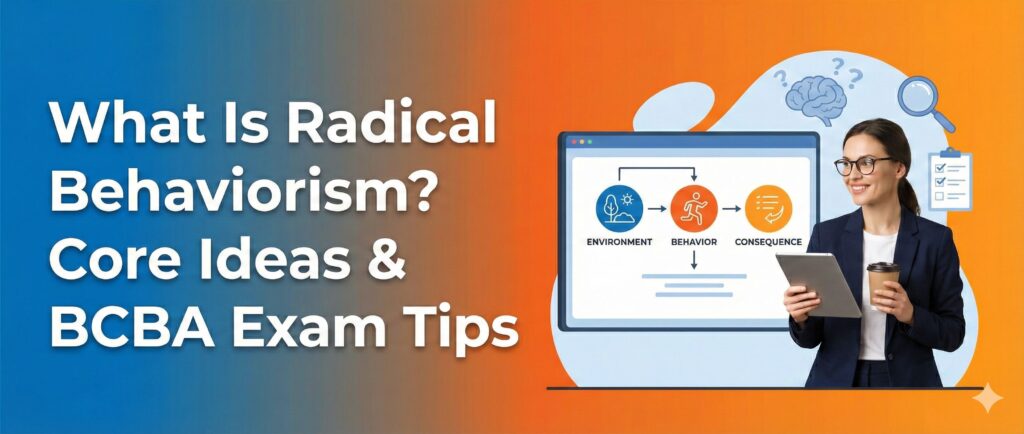
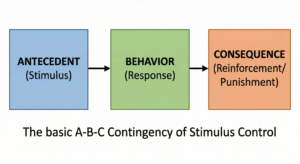
The following diagram illustrates the basic three-term contingency that forms the basis of stimulus control:
The Technical BCBA® Definition for Stimulus Control ABA
For the exam, you need to be precise. A behavior is under stimulus control when it occurs more often in the presence of a specific stimulus (the SD) and less often in its absence. This is caused by a history of differential reinforcement.
Exam Tip: Look for this key phrase in test questions: “In the presence of ___, the response has been reinforced in the past.” That blank is usually your Discriminative Stimulus (SD).
The Building Blocks: SD, S-Delta, and Differential Reinforcement
Stimulus control doesn’t happen by magic; it is built through a process called Differential Reinforcement. To understand this, you must know the difference between the SD and the S-Delta.
1. Discriminative Stimulus (SD)
The SD is a stimulus that signals reinforcement is available for a particular response.
-
Translation: “When you see this, that behavior will probably pay off.”
2. S-Delta (SΔ)
The S-Delta is a stimulus that signals reinforcement is NOT available for that response.
-
Translation: “When you see this, don’t bother doing that behavior; it won’t work.”
How Differential Reinforcement Works
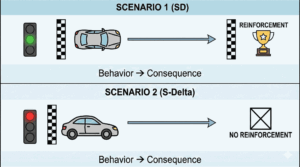
To create stimulus control, you reinforce the behavior in the presence of the SD and do not reinforce it (extinction) in the presence of the SΔ. Over time, the organism learns: “In Situation A, this works. In Situation B, it doesn’t.” This process is depicted below:
Everyday Examples of Stimulus Control ABA
You experience stimulus control all day without realizing it. Here are three common scenarios to help you visualize the concept.
Example 1: The Traffic Light
-
Stimulus (SD): Green light.
-
Behavior: You press the gas pedal.
-
Consequence: You move forward safely (Reinforcement).
-
Why it works: Green lights have a long history of reinforcement (arriving faster). Red lights are an S-Delta for pressing the gas because that behavior is punished or not reinforced.
Example 2: The “Open” Sign
-
Stimulus (SD): The neon “OPEN” sign is lit.
-
Behavior: You pull the door handle.
-
Consequence: You enter and buy what you need.
-
Why it works: When the sign says “CLOSED” (SΔ), pulling the door doesn’t work. Your door-pulling behavior is under the stimulus control of the “OPEN” sign.
Example 3: Phone Notifications
-
Stimulus (SD): That specific “ding” sound.
-
Behavior: You check your phone.
-
Consequence: You see a meme or text (Reinforcement).
-
Why it works: Over many pairings, the sound has become an SD because checking your phone in the presence of that sound leads to reinforcement.
Stimulus Control ABA Teaching Situations
Now let’s move closer to what you will see in clinical practice and on the BCBA® exam.
Clinical Example 1: Receptive Labeling
In a discrete-trial teaching (DTT) session:
-
SD: Therapist puts out three cards and says, “Touch dog.”
-
Behavior: Learner touches the picture of the dog.
-
Consequence: Therapist gives a token or praise.
-
Result: The verbal SD “Touch dog” gains control over the response. If the therapist said “Touch cat” (SΔ for touching the dog), the learner would not be reinforced for touching the dog.
Clinical Example 2: Classroom Hand-Raising
-
SD: Teacher says, “If you have an answer, raise your hand.”
-
Behavior: Student raises hand.
-
Consequence: Teacher calls on them (Positive Attention).
-
Result: Through consistent reinforcement, students learn that in the presence of the teacher’s cue, hand-raising works. Calling out answers without the cue is not reinforced.
The Big One: SD vs. Motivating Operations (MOs)
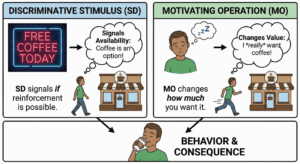
This is perhaps the most “testable” distinction on the BCBA® exam. Both SDs and MOs are antecedents (they happen before behavior), but they serve different functions. This diagram helps clarify the difference:
| Feature | Discriminative Stimulus (SD) | Motivating Operation (MO) |
| Function | Signals reinforcement is available. | Changes how valuable a reinforcer is. |
| Question it answers | “Is this behavior likely to work right now?” | “How much do I want this reward right now?” |
| Exam Keywords | “In the presence of…”, “Signals availability” | Deprivation, Satiation, “Hungry,” “Thirsty” |
The “Free Coffee” Analogy (Stimulus Control ABA)
-
The SD: A sign outside a shop that says “FREE COFFEE.” This signals that if you walk in, you will get coffee.
-
The MO: You haven’t slept in 24 hours. This makes the coffee valuable to you.
Warning: On the exam, if the question stem mentions deprivation, pain, salt ingestion, or temperature changes, think MO. If it mentions a history of reinforcement in a specific context, think SD.
For additional reading on MOs and related concepts, the Cooper, Heron, and Heward textbook is widely recommended in the ABA field. You can find publisher information here:
https://www.pearson.com
BCBA® Exam Strategy & Practice Questions for Stimulus Control ABA
When answering stimulus control aba questions, use this 3-step check:
-
Identify the Consequence: What is maintaining the behavior?
-
Look Backward: What stimulus is present when that behavior gets reinforced?
-
Decide: Does the stimulus signal availability (SD) or change the value (MO)?
Mini Practice Questions
Question 1
A teacher consistently praises students for hand-raising. Eventually, students only speak out after the teacher says, “Who has an idea?” Which stimulus is functioning as the SD?
-
A. The classroom rules poster
-
B. The teacher’s question “Who has an idea?”
-
C. The student’s desire to share
-
Correct Answer: B. The teacher’s question is the antecedent that has been paired with reinforcement.
Question 2
A learner receives tokens for saying “cookie” only when a picture of a cookie is visible. When the picture is hidden, saying “cookie” results in no tokens. What is the picture?
-
A. Establishing Operation
-
B. S-Delta
-
C. Discriminative Stimulus (SD)
-
Correct Answer: C. The picture signals that reinforcement (tokens) is available.
Question 3
A child greets peers on the playground (where they are praised) but ignores them in the library (where they are shushed). This pattern is best described as:
-
A. Stimulus Control
-
B. Behavioral Momentum
-
C. Negative Reinforcement
-
Correct Answer: A. The behavior occurs in one setting (SD) but not the other (SΔ) due to history of reinforcement.
Key Takeaways
-
Stimulus control aba means a behavior is triggered by a specific cue due to past reinforcement.
-
SDs signal availability; S-Deltas signal non-availability.
-
MOs change the value of a reinforcer; SDs signal the chance of getting it.