

What is Socially Mediated Reinforcement?
In applied behavior analysis, socially mediated reinforcement refers to reinforcement that requires the action of another person to be delivered. This concept is fundamental to understanding how behaviors are maintained in social environments.
Table of Contents
- What is Socially Mediated Reinforcement?
- Identifying Socially Mediated Reinforcement: Practical ABA Examples
- Socially Mediated Reinforcement on the BCBA Exam
- Study Checklist and Summary
- References
The social mediator serves as the crucial link between behavior and consequence, distinguishing this process from automatic reinforcement where consequences occur without social intervention.
The Core Definition and Key Components
Socially mediated reinforcement occurs when a behavior produces a consequence through the actions of another person. The three-term contingency (antecedent-behavior-consequence) remains central, but with an essential social component.
- Social mediator: Another person who delivers the consequence
- Behavior: The operant response that produces the consequence
- Consequence: The stimulus change delivered by the mediator
- Reinforcement effect: Future probability of the behavior increases
Why This Concept is Central to ABA Practice
Understanding socially mediated reinforcement is critical for effective functional behavior assessment and intervention planning. Most behaviors targeted in ABA involve social consequences, making this concept indispensable.
This knowledge directly informs behavior intervention plans and skill acquisition programs, particularly when teaching communication skills like manding for socially mediated reinforcement.
Identifying Socially Mediated Reinforcement: Practical ABA Examples
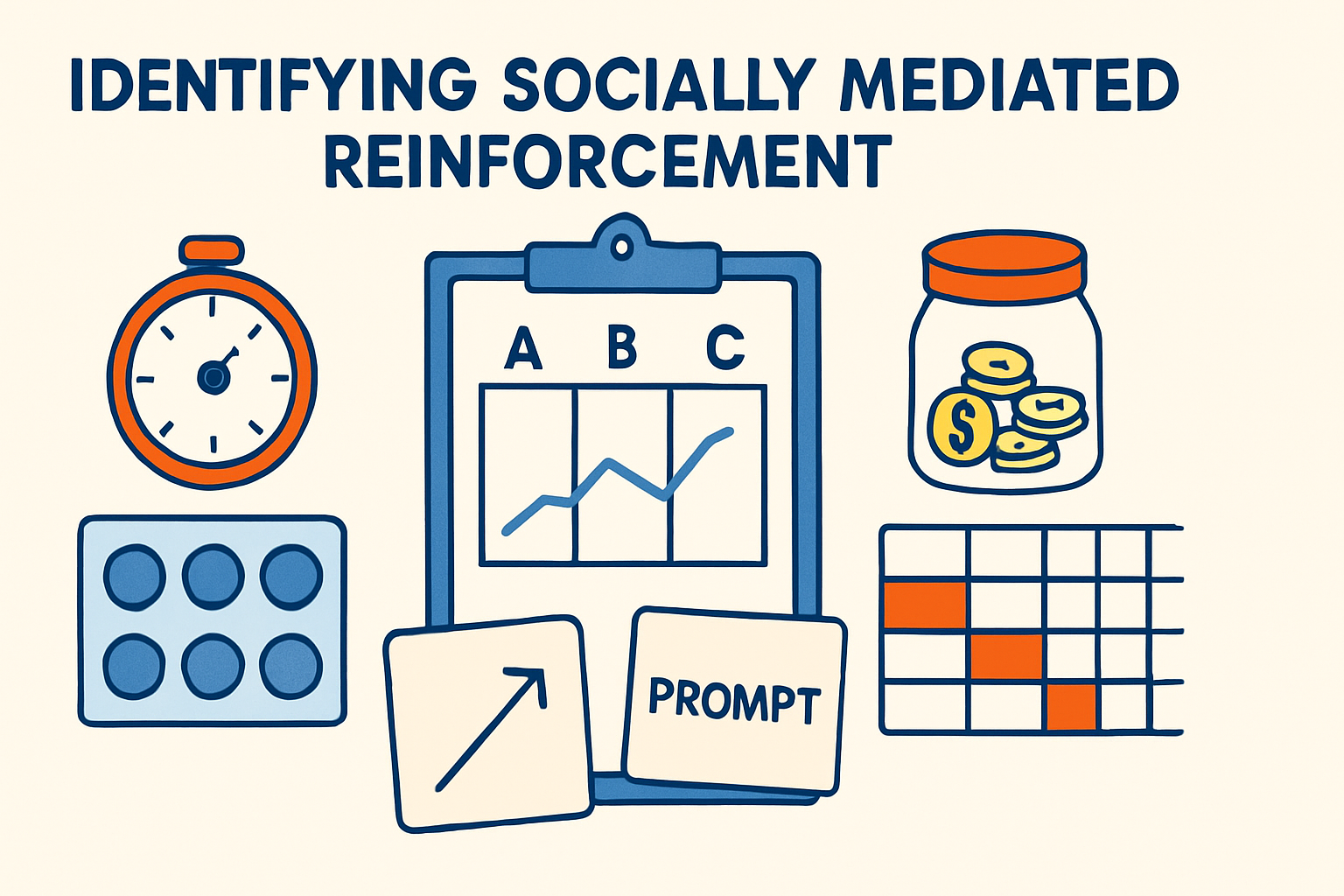
Let’s examine concrete scenarios that demonstrate how socially mediated reinforcement operates in real-world settings. Each example follows the ABC analysis framework.
Example 1: Attention-Maintained Behavior in a Classroom
A student repeatedly taps their pencil loudly during independent work time. The teacher approaches and says, ‘Please stop tapping your pencil.’ The tapping behavior increases in future work sessions.
- Antecedent: Independent work, low teacher attention
- Behavior: Pencil tapping
- Consequence: Teacher verbal attention (reprimand)
- Function: Socially mediated positive reinforcement (attention)
Example 2: Escape-Maintained Behavior During Demands
During a therapy session, when presented with a difficult math worksheet, a client engages in aggression. The therapist removes the worksheet and ends the demand. Aggression increases when similar demands are presented later.
- Antecedent: Difficult academic demand presented
- Behavior: Aggression
- Consequence: Demand removal by therapist
- Function: Socially mediated negative reinforcement (escape)
Example 3: Tangible-Seeking Behavior at Home
At the grocery store checkout, a child begins crying and screaming when denied candy. The parent purchases the candy to stop the tantrum. Future shopping trips see increased tantrum behavior at checkout.
- Antecedent: Candy visible at checkout, previous denial
- Behavior: Tantrum (crying, screaming)
- Consequence: Access to candy provided by parent
- Function: Socially mediated positive reinforcement (tangible)
Socially Mediated Reinforcement on the BCBA Exam
Exam questions often test your ability to distinguish socially mediated reinforcement from other reinforcement types and identify the specific function of behavior.
Common Exam Traps and How to Avoid Them
Several patterns consistently challenge candidates. Recognizing these traps can improve your exam performance significantly.
- Confusing with automatic reinforcement: Remember that automatic reinforcement doesn’t require a social mediator. Look for the presence of another person delivering consequences.
- Overlooking negative reinforcement forms: Escape and avoidance behaviors are still socially mediated if someone removes the aversive stimulus.
- Misidentifying the mediator: Ensure you correctly identify who delivers the consequence, as this defines the ‘social’ component.
- Focusing only on positive reinforcement: Socially mediated reinforcement includes both positive and negative reinforcement categories.
Practice Applying the Concept
Test your understanding with these exam-style scenarios. Consider the function and whether reinforcement is socially mediated.
Scenario A: During group instruction, a student makes inappropriate comments. Peers laugh each time. The behavior increases during future group sessions.
Scenario B: A client engages in hand flapping when alone in their room. The behavior persists even when no one is present to observe it.
For more practice with behavior function identification, review our guide on the four functions of behavior.
Study Checklist and Summary
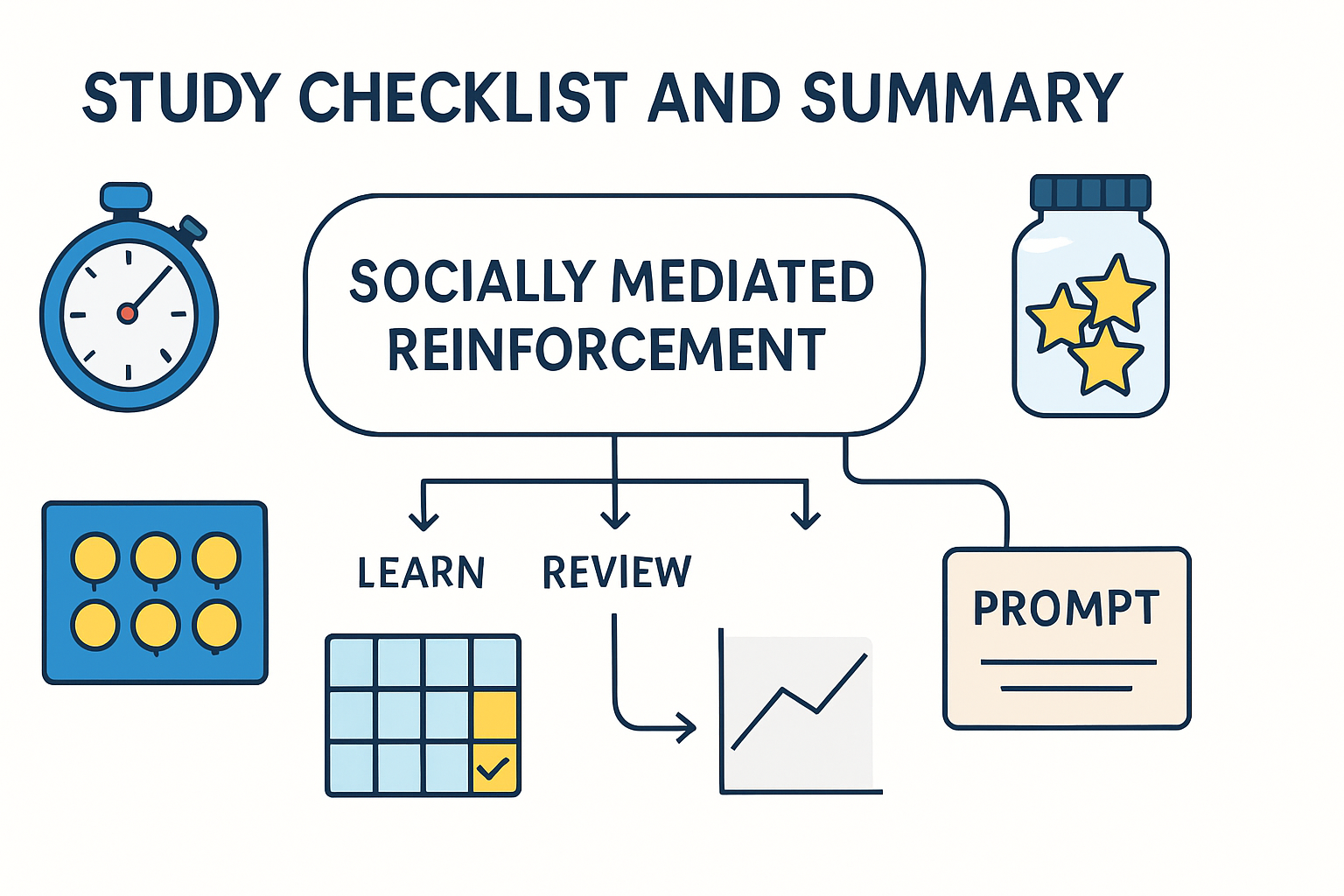
Use this checklist to ensure you’ve mastered socially mediated reinforcement concepts for the BCBA exam.
- Define socially mediated reinforcement accurately, emphasizing the social mediator requirement
- Distinguish from automatic reinforcement in various scenarios
- Identify all four functions when they involve social mediation
- Conduct ABC analyses that correctly identify social mediators
- Apply to intervention planning for behavior reduction and skill acquisition
- Recognize exam traps and select correct answers under time pressure
Key Takeaways for Clinical Practice
Socially mediated reinforcement is the most common type of reinforcement encountered in ABA practice. Accurate identification is essential for developing effective behavior intervention plans.
When conducting functional behavior assessments, always consider whether consequences are delivered socially or automatically. This distinction guides appropriate intervention selection, such as functional communication training for socially mediated functions.
Final Exam Preparation Tips
For comprehensive exam preparation, integrate this concept with related topics like automatic reinforcement and motivating operations. Practice with varied scenarios to build fluency in function identification.
Remember that socially mediated reinforcement concepts are tested across multiple BCBA exam domains, particularly in assessment and intervention sections. Consistent practice with ABC analysis will build the pattern recognition skills needed for exam success.


