Single-Subject Experimental Designs: Reversal, Multiple Baseline, Alternating Treatments & Changing Criterion
By BCBA Mock Exam
Introduction
Single-subject experimental designs are a core part of ABA—and a favorite topic on the BCBA® exam.

These designs let you:
-
Demonstrate a functional relation between your intervention and behavior change
-
Make data-based decisions for individual clients
-
Show that changes are unlikely due to chance, maturation, or other variables
But on the exam, you’re not just asked to memorize design names. You’ll be expected to:
-
Recognize different designs from brief descriptions or graphs
-
Decide which design is most appropriate for a given clinical situation
-
Spot threats to internal validity and design limitations
In this article, we’ll walk through:
-
Core features common to single-subject experimental designs
-
Reversal (ABAB) designs
-
Multiple baseline designs
-
Alternating treatments designs
-
Changing criterion designs
-
Common exam traps and mini practice questions to test your understanding.
1. Core Features of Single-Subject Experimental Designs
All of the classic single-subject designs share some key characteristics:
-
Repeated measurement
-
You collect ongoing data on the target behavior over time.
-
-
Baseline logic
-
You compare behavior under at least two conditions (e.g., baseline vs intervention).
-
You look for prediction, verification, and replication of effects.
-
-
Individual focus
-
Designs are built around one or a few individuals (or units) rather than large group averages.
-
-
Visual analysis
-
Decisions are based on patterns in graphs: level, trend, variability, and overlap.
-
For the BCBA® exam, you need to know how each design uses these elements differently to demonstrate functional control.
2. Reversal Design (ABAB and Variants)
Reversal designs (also called withdrawal designs) introduce and remove an intervention to see whether behavior changes systematically.
Typical format:
-
A1 (Baseline) – Measure target behavior with no intervention.
-
B1 (Intervention) – Introduce treatment; measure behavior.
-
A2 (Return to Baseline / Withdrawal) – Remove treatment; see if behavior returns toward baseline levels.
-
B2 (Reintroduction) – Reintroduce treatment; see if behavior again changes in the same direction.
Logic:
-
If behavior changes systematically only when the intervention is present (B phases), and reverses when it is withdrawn (A phases), this provides strong evidence of a functional relation.
Strengths:
-
Powerful demonstration of experimental control.
-
Allows you to see whether behavior change is reversible.
Limitations:
-
Ethical concerns: It may be inappropriate to withdraw effective treatment (e.g., life-threatening self-injury).
-
Irreversibility: Some behaviors or skills may not reverse when treatment is withdrawn (e.g., learning to read).
Common BCBA® exam cues:
-
Descriptions of “introducing and then withdrawing” treatment.
-
Graphs with clear A–B–A–B sequences.
-
Questions asking when it is not appropriate to use a reversal design (e.g., dangerous behavior, skill acquisition that is unlikely to reverse).
3. Multiple Baseline Designs (Across Behaviors, Settings, Subjects)
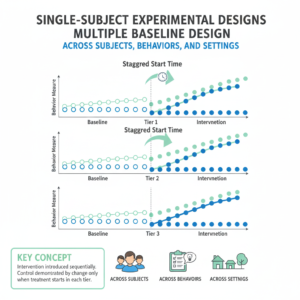
Multiple baseline designs are used when reversal is unethical, impossible, or not preferred.
General idea:
-
You stagger the start of an intervention across different baselines:
-
Across behaviors – Same person, different behaviors.
-
Across settings – Same behavior, different environments.
-
Across subjects – Same behavior, different individuals.
-
Structure:
-
Collect baseline data on all tiers (behaviors, settings, or subjects).
-
Introduce intervention in Tier 1 while Tiers 2 and 3 remain in baseline.
-
Once behavior changes in Tier 1, introduce intervention in Tier 2, and so on.
Logic:
-
If behavior changes only when the intervention is introduced in each tier and not before, this suggests a functional relation.
Strengths:
-
No need to withdraw effective treatment.
-
Useful when behavior change is unlikely to reverse.
Limitations:
-
Requires behavior to be independent across tiers (e.g., one setting’s intervention shouldn’t automatically affect others).
-
Requires extended baseline for later tiers, which may be impractical.
Exam cues:
-
Phrases like “staggered introduction,” “across three students,” “across home, school, and community,” or “across three target behaviors.”
4. Alternating Treatments Design (Multi-Element)
An alternating treatments design (also called multi-element design) rapidly compares two or more interventions.
General idea:
-
Different conditions (e.g., Treatment A, Treatment B, baseline) are alternated quickly—often session by session or within sessions.
Structure:
-
Introduce conditions in a rapid, typically randomized order.
-
Each session is associated with one condition.
-
Compare performance under each condition on the same graph.
Logic:
-
If behavior is consistently different under one condition compared to others, you can infer relative effectiveness.
Strengths:
-
Fast comparison of interventions.
-
Requires no formal baseline phase before introducing treatments.
Limitations:
-
Multiple treatment interference: Frequent switching might cause carryover effects.
-
Requires behaviors that can quickly change and stabilize under different conditions.
Exam cues:
-
Rapidly alternating conditions described in the stem (e.g., “on some days,” “in randomly ordered sessions,” “Condition A vs Condition B vs no treatment”).
-
Questions about comparing two interventions (e.g., praise vs tokens) efficiently.
5. Changing Criterion Design
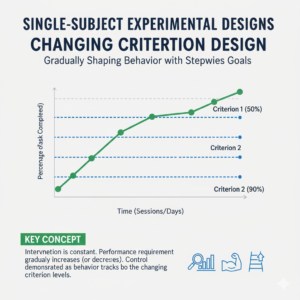
Changing criterion designs evaluate the effects of an intervention by gradually changing the performance requirement (criterion) over time.
General idea:
-
You set a series of successive criteria for behavior (e.g., 2 cigarettes per day, then 1, then 0).
-
Intervention stays in place, but the required level of performance shifts.
Structure:
-
Baseline: Measure natural level of behavior.
-
Phase 1: Implement intervention with an initial criterion.
-
Phase 2+: Systematically increase or decrease the criterion (e.g., gradually increase number of math problems, gradually reduce number of prompts).
Logic:
-
If behavior reliably tracks the changing criteria (in the predicted direction), this suggests the intervention is controlling behavior.
Strengths:
-
Useful for behaviors that need gradual shaping (e.g., increasing exercise duration, decreasing soda intake).
-
Does not require withdrawal of treatment.
Limitations:
-
Behavior must be able to change in small steps.
-
Requires careful planning of criterion magnitudes and phase lengths.
Exam cues:
-
Words like “stepwise,” “gradually increasing/decreasing the required amount,” “successive criteria,” or “target changed from X to Y over time.”
6. Choosing a Design: When to Use What
On the BCBA® exam, you’ll often be asked to choose the most appropriate design for a described scenario.
Quick matching guide:
-
Reversal (ABAB) design
-
Use when: Behavior is reversible, and it is ethical to withdraw treatment.
-
Great for: Demonstrating strong experimental control with clear on/off effects.
-
-
Multiple baseline design
-
Use when: Withdrawal is unethical or impractical, or behavior is unlikely to reverse.
-
Great for: Applied settings, multiple clients, behaviors, or contexts.
-
-
Alternating treatments design
-
Use when: You need to compare two or more interventions quickly.
-
Great for: Selecting the better of two treatments for ongoing use.
-
-
Changing criterion design
-
Use when: Gradually shaping behavior toward a final goal with stepwise changes.
-
Great for: Behaviors like increasing study time, reducing caffeine, or building endurance.
-
Exam tip:
-
Always consider ethics, reversibility, the need for comparison, and whether behavior can change in small steps when choosing a design.
7. Common Internal Validity Concerns Across Designs
The exam may ask about threats to internal validity or limitations of these designs.
Key threats include:
-
History – Events outside the intervention that affect behavior over time.
-
Maturation – Natural changes in behavior due to growth, fatigue, etc.
-
Testing/Practice effects – Behavior changes due to repeated exposure to the task.
-
Instrumentation – Changes in how data are recorded or in measurement tools.
-
Multiple treatment interference – Especially in alternating treatments designs.
How designs address threats:
-
Reversal and multiple baseline designs rely on replication across phases or tiers.
-
Alternating treatments uses rapid alternation and randomization to control for extraneous variables.
-
Changing criterion design shows control through behavior tracking systematic criterion shifts.
Exam tip:
-
When in doubt, ask: “Does the described pattern support a functional relation, or could something else reasonably explain the change?”
8. Common BCBA® Exam Traps with Single-Subject Designs
Watch out for these patterns on the exam:
Trap 1 – Calling any A–B design experimental
-
A simple A–B design (baseline then treatment once) has no replication and weak experimental control.
Trap 2 – Ignoring ethical issues with withdrawal
-
Reversal designs are not always appropriate for dangerous or irreversible behaviors.
Trap 3 – Overlooking independence in multiple baseline designs
-
If behavior in one tier affects others automatically, it’s not a clean multiple baseline.
Trap 4 – Mislabeling designs
-
Rapid alternation with different treatments → alternating treatments.
-
Staggered start times → multiple baseline.
-
Stepwise goal shifts under one intervention → changing criterion.
Trap 5 – Confusing visual analysis patterns
-
Overlap and high variability may weaken evidence, even when a design is technically correct.
9. Mini BCBA® Exam–Style Questions (With Explanations)
Question 1 – Choosing a Design A BCBA is working with a child who engages in severe self-injury. An effective intervention has been identified, but the team feels it would be unethical to withdraw treatment once it is introduced. The BCBA also wants to show experimental control.
Which design is MOST appropriate? A. Reversal (ABAB) design B. Multiple baseline design C. Alternating treatments design D. Changing criterion design
Correct Answer: B – Multiple baseline design Explanation: Withdrawing treatment is unethical for severe self-injury. A multiple baseline allows demonstration of control without withdrawal.
Question 2 – Identifying a Reversal Design A graph shows high rates of problem behavior in baseline, followed by reduced behavior during treatment, then a return to high rates when treatment is removed, and again reduced rates when treatment is reintroduced.
This pattern BEST represents which design? A. Changing criterion B. Alternating treatments C. Reversal (ABAB) D. Multiple baseline
Correct Answer: C – Reversal (ABAB) Explanation: The sequence A–B–A–B with systematic behavior changes across conditions is characteristic of a reversal design.
Question 3 – Alternating Treatments A BCBA wants to compare two reading interventions. On some days, Intervention A is used; on other days, Intervention B is used. The order of conditions is randomized, and data are graphed with separate lines for each intervention.
Which design is being used? A. Multiple baseline B. Reversal (ABAB) C. Alternating treatments D. Changing criterion
Correct Answer: C – Alternating treatments Explanation: Rapid alternation of conditions with separate data paths for each is characteristic of an alternating treatments (multi-element) design.
Question 4 – Changing Criterion A BCBA designs an intervention to increase the number of math problems a student completes during independent work. The initial criterion is set at 5 problems, then raised to 8, 10, and finally 12 problems over successive phases. The student’s performance closely matches each new criterion.
Which design is being used? A. Reversal (ABAB) B. Changing criterion C. Multiple baseline D. Alternating treatments
Correct Answer: B – Changing criterion Explanation: Gradually shifting performance goals under a single intervention while behavior tracks the changing criteria is exactly what defines a changing criterion design.
10. Key Takeaways
-
Single-subject designs are essential tools for demonstrating functional relations in ABA.
-
Reversal designs show strong on/off control but may be unethical or impractical for some behaviors.
-
Multiple baseline designs stagger treatment across behaviors, settings, or subjects without requiring withdrawal.
-
Alternating treatments designs rapidly compare two or more interventions.
-
Changing criterion designs shape behavior through gradually shifting performance requirements.
On the BCBA® exam, always ask:
-
What is the goal (comparison, demonstration of control, shaping)?
-
Is it ethical and practical to withdraw treatment?
-
Can the behavior change in small steps, or do we need rapid comparisons?
Answering those questions will guide you toward the correct design—and the correct answer choice.