Discriminative Stimuli (SD) and S-Delta: How Stimuli Signal Reinforcement, Punishment, and Extinction
By BCBA Mock Exam
Introduction
Discriminative stimuli and S-Delta in ABA work show up everywhere—SDs and S-deltas (SΔs) are all over practice and the BCBA® exam.
You’re expected to be able to:
-
Define SD and SΔ in clear, behavior-analytic terms
-
Recognize how stimuli signal reinforcement, punishment, or extinction
-
Tell SDs apart from motivating operations (MOs)
-
Analyze exam scenarios where behavior happens in some conditions but not others
In this article, we’ll walk through:
-
Simple definitions of SDs and SΔs
-
How they signal different consequences
-
Everyday and ABA program examples
-
Common exam traps
-
Mini BCBA®-style practice questions with explanations.
1. Big Picture: Why Discriminative Stimuli and S-Delta Matter in ABA
On the BCBA® exam, SDs and SΔs show up in questions about:
-
Stimulus control and discrimination
-
Differential reinforcement procedures
-
Functional communication training
-
Extinction and punishment
-
MOs vs SDs
If you clearly understand what an SD signals, you can:
-
Explain why behavior occurs in some conditions and not others
-
Design better interventions
-
Avoid common exam mistakes (like calling every antecedent an SD).
2. Core Definitions: Discriminative Stimuli and S-Delta in ABA Consequences
Let’s start with clean, exam-ready definitions of what discriminative stimulus in ABA actually means.
Discriminative Stimulus (SD)
-
A stimulus in the presence of which a particular response has been reinforced (or punished) in the past.
-
It “signals” that a certain consequence is available if the behavior occurs.
-
Example: “Line open” on a vending machine signals that putting in money will likely produce a snack.
- In simple terms, a discriminative stimulus in ABA is any antecedent that signals that a specific response is likely to contact a particular consequence.
S-Delta (SΔ)
-
A stimulus in the presence of which a particular response has not been reinforced (or has been put on extinction) in the past.
-
It “signals” that a certain consequence is not available for that response.
-
Example: “Out of order” sign on a vending machine signals that money will not produce a snack.
Note: SDs and SΔs are defined functionally—by their history with specific responses and consequences, not just by how they look or sound. Across all these examples, discriminative stimuli and S-Delta define when a response is likely to contact a consequence and when it will not.
3. How SDs Signal Reinforcement (and S-Delta Signals No Reinforcement)
In classic operant terms:
-
An SD for reinforcement (SD^SR) signals: “If you emit this response now, reinforcement is available.”
-
An SΔ for reinforcement signals: “If you emit this response now, that reinforcement is not available.”
Examples:
Example 1 – Asking for help in class
-
SD: Teacher looking at the student and saying, “Do you need help?” → Asking for help is reinforced with assistance.
-
SΔ: Teacher busy talking to another student and explicitly says, “Wait a moment.” → Asking repeatedly is not reinforced.
Example 2 – Vending machine
-
SD: “Exact change only” light on + machine working → Inserting coins and pressing a button produces a snack.
-
SΔ: “Out of service” sign → Same response (coins + button) will not produce a snack.
Over time, behavior comes under stimulus control:
-
The behavior is more likely in the presence of the SD.
-
The behavior is less likely in the presence of the SΔ.
Below is a flowchart illustrating how an SD signals reinforcement and an S-Delta signals extinction for the same behavior.
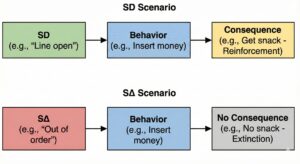
A visual comparison of an SD scenario versus an S-Delta scenario.
4. SDs and S-Deltas for Punishment and Extinction
While we often talk about SDs for reinforcement, SDs can also signal punishment or extinction.
SD for punishment (SD^SP)
-
A stimulus correlated with the availability of punishment for a particular response.
-
Example: A supervisor enters the room and is known for reprimanding employees for using their phones. The supervisor’s presence becomes an SD for punishment of phone-use behavior.
SΔ for punishment
-
A stimulus correlated with the non-availability of punishment for a response.
-
Example: Same employees may use phones freely when they are in the break room with no supervisor present.
SD for extinction (or signaling extinction)
-
A stimulus correlated with no reinforcement for a behavior that was previously reinforced.
-
Example: A “No candy today” sign on a desk signals that asking for candy will not be reinforced today.
Exam tip: SDs and SΔs can be defined with respect to any consequence class (reinforcement, punishment, extinction). Always ask: “What consequence is being signaled?”
5. SD vs MO vs S-Delta: Critical Discriminations
This is a classic BCBA® exam area: SD vs MO vs SΔ.
SD (for reinforcement)
-
Signals that reinforcement is available for a particular response.
-
Does not change how valuable the reinforcer is.
Motivating Operation (MO)
-
Alters the value of a reinforcer (value-altering effect).
-
Alters the current frequency of behavior that has produced that reinforcer in the past (behavior-altering effect).
-
Does not signal whether reinforcement is currently available.
SΔ
-
Signals that reinforcement is not available (or is much less likely) for a particular response.
Example:
-
Hunger → MO (makes food more valuable).
-
“Open” sign at a restaurant → SD for ordering food (reinforcement available).
-
“Closed” sign → SΔ for ordering food (that response will not be reinforced with food right now).
- This example shows how discriminative stimuli and S-Delta work together with motivating operations to control when a behavior is likely to occur.
Exam shortcut:
-
MO = “How bad do I want it?”
-
SD = “Can I get it if I respond now?”
-
SΔ = “It won’t work right now.”
6. Everyday Examples of SD and S-Delta
Example 1 – Sales and coupons
-
SD: “Buy one, get one free” sign → Increases the likelihood you’ll purchase.
-
SΔ: “Full price” sign → The same purchase behavior is less likely if you are only reinforced by discounts.
Example 2 – Door signs
-
SD: “Push” sign → Pushing the door results in it opening.
-
SΔ: “Pull” sign on the same door → Pushing will not open it; pushing is effectively on extinction here.
Example 3 – Wi-Fi availability
-
SD: Wi-Fi icon with full bars → Refreshing your feed produces new content (reinforcement).
-
SΔ: No service icon → Same response does not contact reinforcement.
Everyday life is full of stimuli that tell us when behavior will and will not be effective. This photo of a vending machine is a perfect example.

The “Out of Order” sign is a clear S-Delta, signaling that putting money in will not be reinforced with a snack.
7. ABA Program Examples: SDs, S-Deltas, and Differential Reinforcement
In ABA interventions, we often create discriminative stimuli and S-Delta via differential reinforcement.
Example 1 – Teaching color discrimination
-
SD: Red card presented with SD “Touch red.” Touching red is reinforced.
-
SΔ: Blue and yellow cards are present; touching them is not reinforced for that SD.
-
Result: Touching occurs in the presence of the SD (red) and not the SΔs.
Example 2 – Functional communication for break requests
-
SD: Therapist presents a difficult task and says, “Let’s work.” Using a break card produces a short break (reinforcement).
-
SΔ: During free play, using the break card produces no additional break (no reinforcement/possibly gentle redirection).
Example 3 – Differential reinforcement of alternative behavior (DRA)
-
SD: Adult’s instruction, “If you want the toy, you can ask nicely.” Asking nicely is reinforced with access.
-
SΔ: Grabbing the toy from peers is placed on extinction; no access.
In each case, SDs and SΔs help shape and maintain more appropriate behavior.
8. SDs, S-Deltas, and Extinction in Practice
Extinction is closely tied to SDs and SΔs.
Before extinction
-
A certain antecedent reliably precedes reinforcement for a response → functions as an SD.
During extinction
-
The same antecedent no longer signals reinforcement for that response.
-
That stimulus may become an SΔ for that response, as the contingency has changed.
Example:
-
A parent used to give attention whenever a child screamed in the grocery store.
-
Grocery store environment and parent’s presence functioned as SDs for screaming (attention available).
-
When the parent consistently implements extinction (no attention for screaming), the same stimuli now signal that screaming will not contact reinforcement → they move toward functioning as SΔs for screaming.
Exam tip: When the exam stem mentions a contingency change (reinforcement → no reinforcement), think about how SD and SΔ functions may shift.
9. Common BCBA® Exam Traps with SD and S-Delta
Be ready for these pitfalls:
Trap 1 – Calling any antecedent an SD
-
A stimulus is only an SD if it has a history of signaling a consequence for a specific response.
Trap 2 – Ignoring the consequence class
-
Ask: “Is this an SD for reinforcement, for punishment, or for extinction?” The exam may be subtle about which consequence is in play.
Trap 3 – Confusing SD with MO
-
MO changes how much the person cares about a consequence; SD signals whether the consequence is available.
Trap 4 – Forgetting SΔ
-
Differential reinforcement requires both: reinforcing in the presence of some stimuli and not reinforcing in the presence of others.
Trap 5 – Over-focusing on labels vs function
-
The exam may not use the words “SD” or “SΔ” in the stem; you have to infer function from the history of reinforcement.
10. Mini BCBA® Exam–Style Questions (With Explanations)
Question 1 – SD for Reinforcement
In a classroom, a student’s jokes are consistently laughed at when the teacher is out of the room, but are ignored when the teacher is present. Over time, the student tells more jokes only when the teacher is absent.
Which statement BEST describes the function of the teacher’s absence?
A. It is an MO for attention B. It is an SD for punishment C. It is an SD for reinforcement of joking behavior D. It is an SΔ for reinforcement of joking behavior
Correct Answer: C – It is an SD for reinforcement of joking behavior Explanation: The teacher’s absence signals that joking will be reinforced with peer attention. The teacher’s presence likely functions as an SΔ or SD for punishment.
Question 2 – S-Delta for Reinforcement
A vending machine dispensed snacks reliably when a green light was on but stopped dispensing when a red “out of order” light appeared. After a few failed attempts during the red light, people stopped inserting money.
In this scenario, the red “out of order” light is BEST described as:
A. An SD for reinforcement B. An SD for punishment C. An SΔ for reinforcement D. An MO for food
Correct Answer: C – An SΔ for reinforcement Explanation: The red light signals that reinforcement (snacks) is not available for the usual response.
Question 3 – SD vs MO
A child has not eaten in several hours and is very hungry. When the parent opens the fridge and says, “Do you want a snack?”, the child immediately asks for crackers and receives them.
Which option BEST identifies the MO and SD for asking for crackers?
A. MO = parent’s question; SD = hunger B. MO = hunger; SD = parent’s question “Do you want a snack?” C. MO = crackers; SD = fridge door D. MO = asking for crackers; SD = getting crackers
Correct Answer: B – MO = hunger; SD = parent’s question Explanation: Hunger increases the value of food (MO). The parent’s question signals that asking now will be reinforced with access to food (SD).
Question 4 – SD and S-Delta in Discrimination Training
During a discrimination training program, a therapist presents a red card and a blue card. When the red card is presented with the instruction “Touch red,” touching the red card produces praise and a token. When the blue card is presented with the same instruction, touching the blue card produces no praise or token.
Which statement BEST identifies the SD and SΔ for the “touch” response in this program?
A. SD = red card; SΔ = blue card B. SD = blue card; SΔ = red card C. SD = instruction; SΔ = therapist presence D. SD = therapist’s praise; SΔ = token board
Correct Answer: A – SD = red card; SΔ = blue card Explanation: Touching is reinforced in the presence of the red card (SD) and not reinforced in the presence of the blue card (SΔ).
The diagram below provides a visual representation of this discrimination training scenario.
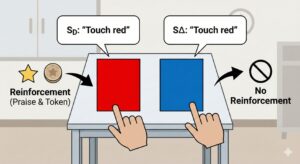
An illustration of discrimination training where a red card is an SD and a blue card is an S-Delta for touching behavior.
11. Key Takeaways
Discriminative stimuli and S-Delta in ABA are defined by their history with specific responses and consequences, just like S-deltas (SΔs).
-
SDs signal that a consequence (reinforcement, punishment, or extinction) is available if the behavior occurs.
-
SΔs signal that the consequence is not available (or less likely) for that response.
-
MOs change how much the person values a consequence; SDs/SΔs signal whether that consequence can be obtained by a particular response right now.
-
On the BCBA® exam, always ask:
-
What response are we talking about?
-
What consequence is historically available (or not) in the presence of this stimulus?
-
Is this stimulus functioning as an SD, SΔ, MO, or something else?
-
Clear SD/SΔ/MO discriminations will help you solve many exam questions about antecedents, stimulus control, and behavior change procedures.