
In the testing room, SD ABA can feel like a “blink-and-you-miss-it” detail: a tiny cue that changes the whole answer. I still remember reviewing mock exams late at night and realizing I was labeling prompts and motivating operations as SDs because the scenarios “felt” similar. Once you learn what SD ABA actually signals (and what it does not), your accuracy on stimulus control, skill acquisition, and ethics questions jumps fast. This guide breaks it down in plain language with exam-ready examples.

What “SD” Means in SD ABA (The Definition You Need)
In SD ABA, SD stands for discriminative stimulus: an environmental event or cue that signals reinforcement is available for a specific response because of a learning history. In other words, the SD doesn’t “make” the behavior happen; it sets the occasion for behavior because responding in its presence has paid off before.
A tight, exam-friendly definition:
- SD = stimulus correlated with reinforcement availability for a response
- The response becomes more likely in the presence of the SD due to past differential reinforcement
For foundational terminology aligned with behavior analysis standards and credentialing context, see the Behavior Analyst Certification Board.
SD ABA in One Sentence: “When This Is Present, That Works”
A quick way to spot SD ABA in a vignette is to translate it into a contingency prediction:
- In the presence of X (SD), doing Y is more likely to contact reinforcement Z.
Examples (everyday + clinical):
- Seeing a “OPEN” sign (SD) increases the likelihood you pull the door (response) because that’s historically worked (reinforcement = entry).
- Therapist says, “Touch your head” (SD). Learner touches head (response). Reinforcement follows (praise/token), because this has been reinforced in this context before.
When a stimulus reliably predicts reinforcement for a response, it earns the SD label.
SD vs. MO vs. Prompt (The Most Common SD ABA Confusion)
Many BCBA candidates lose points because they confuse SDs with motivating operations (MOs) or prompts. Here’s the clean distinction.
- SD (discriminative stimulus): signals availability of reinforcement for a response (due to learning history).
- MO (motivating operation): changes the value of reinforcement and momentarily changes the frequency of behavior that has produced it.
- Prompt: helps evoke the response without necessarily signaling that reinforcement is available; prompts are assistance, not “availability signals.”
If this is a recurring weak area, this deeper breakdown is worth reading: SD vs MO BCBA exam differences.
| Concept | What it changes | What it signals | Quick test question | Example |
|---|---|---|---|---|
| SD (Discriminative Stimulus) | Availability of reinforcement for a behavior (given current contingency) | “If you do the behavior now, reinforcement is available.” | If the behavior occurs now, will it be reinforced (more than in its absence)? | “OPEN” sign lit: ordering food will be reinforced (you get food) vs sign off |
| MO (Motivating Operation) | Reinforcer value and the current likelihood of behavior that has produced that reinforcer | “This reinforcer matters more/less right now.” | Did something change how much the person wants/needs the reinforcer? | Food deprivation increases the value of snacks and increases requesting/working for food |
| Prompt | Momentary probability/accuracy of a specific response (assistance to respond) | “Do this response now (here’s how).” | If I remove the help, does the behavior drop even though the SD/MO remain? | Therapist models “say ‘water’” or gives a gestural prompt pointing to the cup to evoke requesting |
SD vs. SΔ (S-Delta): Same Stimulus Class, Opposite Message
On exam items, you’ll often see SD paired with SΔ (S-delta):
- SD: responding is reinforced (in this context)
- SΔ: responding is not reinforced (in this context)
Think of it as a discrimination: when the SD is present, responding “works”; when SΔ is present, it doesn’t. This is why SD ABA is fundamentally about stimulus control and differential reinforcement across conditions.
The SD ABA Checklist: How to Identify the SD in Any Scenario
When you’re stuck between two answer choices, run this 4-step check:
- What behavior is the question targeting? (Pin down the response.)
- What consequence has followed that response in the past? (Identify reinforcement.)
- What cue reliably preceded reinforcement for that response? (That’s your SD.)
- Is the cue about availability (SD) or value (MO) or assistance (prompt)? (Label correctly.)
This is also why strong operant conditioning fluency pays off. If you want a quick refresher that connects directly to SD ABA, review operant conditioning ABA therapy.
SD ABA in Skill Acquisition: Why SDs Build Independence (or Dependence)
In practice, SD ABA is how we teach learners when to use skills:
- SDs can be verbal (“What’s your name?”), visual (signs, icons), gestural (a teacher holding up a worksheet), or contextual (standing at a crosswalk).
- Well-designed SDs support generalization because they resemble cues in the natural environment.
- Poorly designed SDs can create prompt dependency if prompts replace SDs instead of being faded.
In my own exam-prep work, the turning point was recognizing that a “therapist points to the correct answer” is usually a prompt, not the SD. The SD is often the instruction (e.g., “Show me the cat”)—the pointing is just extra help.
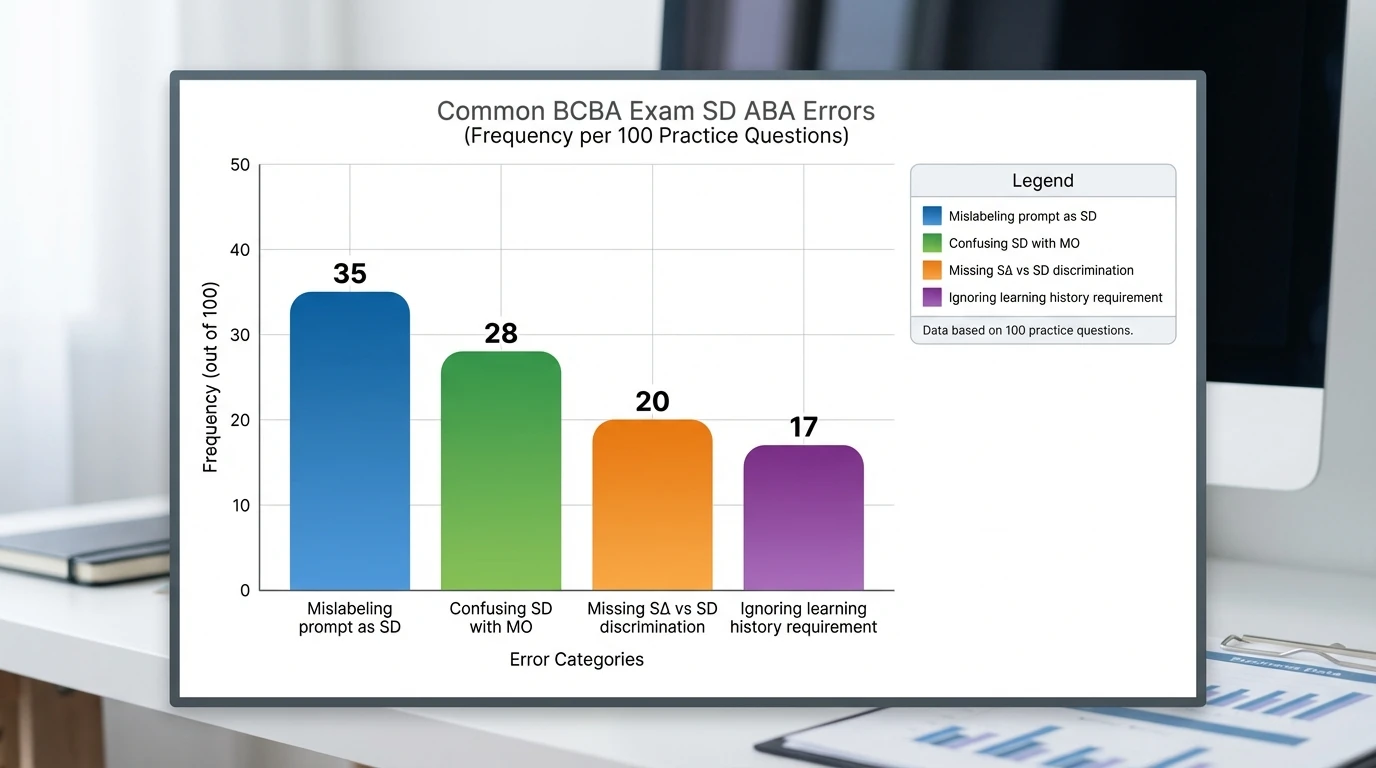
Common SD ABA Exam Traps (and How to Beat Them)
These patterns show up repeatedly in mock exams and real exam-style items:
-
Trap 1: “It’s a cue, so it must be an SD.”
Not all cues are SDs. In SD ABA, the cue must be correlated with reinforcement availability for a response due to past reinforcement. -
Trap 2: Confusing “wants it” with SD.
“Wants it” is usually MO territory (value). SD is about which behavior will be reinforced right now in the presence of the stimulus. -
Trap 3: Treating prompts like SDs.
Prompts are response aids. SDs are discriminative signals tied to reinforcement contingencies. -
Trap 4: Ignoring the “because of history” clause.
If there’s no learning history described or implied, be cautious. SD ABA is built on differential reinforcement across conditions.
To strengthen your discrimination in research-style vignettes, it helps to be crisp on variables and control: independent dependent variables aba.
Practical SD ABA Examples You Can Reuse in Study Notes
Use these as templates when building flashcards:
- Instructional SD: “Clap your hands.” → Clap → Reinforced (praise/token)
- Environmental SD: “Checkout open” light → Join line → Reinforced (faster checkout)
- Social SD: Teacher stands at front + asks question → Raise hand → Reinforced (called on/praise)
- Safety SD: Crosswalk “WALK” sign → Walk → Reinforced (safe crossing / rule-following outcomes)
When you practice, always label:
- SD
- Response
- Reinforcer
- SΔ contrast condition (when relevant)
Discriminative Stimulus vs. Motivating Operations (SD vs MO) ReadySetABA
How to Study SD ABA Efficiently (Using Exam-Style Practice)
The fastest path I’ve seen (and used) is to practice SD identification under timed conditions, then review explanations until you can justify each label in one sentence. Look for resources that:
- mirror real exam wording and difficulty,
- force you to discriminate SD vs MO vs prompt vs SΔ,
- provide in-depth rationales (not just correct letters).
That’s exactly why candidates use BCBA Mock Exam: realistic vignettes, unlimited attempts, and explanations that pinpoint why a stimulus is an SD (or not), especially in commonly confusing areas like stimulus control and motivating operations.
Conclusion: Treat SD ABA Like a Signal, Not a Guess
SD ABA becomes simple when you stop hunting for “any cue” and start asking, “What stimulus signals reinforcement is available for this response—based on history?” When you study that way, your answers get consistent, your justifications get shorter, and your confidence rises the way it should.
If you’re prepping now, share in the comments: what SD ABA scenario keeps tricking you—MO vs SD, prompt vs SD, or SD vs SΔ? And if you want structured, exam-style SD practice with full explanations, explore BCBA Mock Exam resources and build your stimulus control accuracy before test day.
FAQ: SD ABA (Discriminative Stimulus) Questions Candidates Search
1) What does SD mean in ABA?
SD means discriminative stimulus—a cue that signals reinforcement is available for a specific behavior due to past reinforcement.
2) What is an example of SD in ABA therapy?
A therapist saying “Touch your nose” can function as an SD if touching the nose has been reinforced following that instruction in the past.
3) How is SD different from a prompt?
An SD signals reinforcement availability; a prompt helps the learner perform the response (e.g., pointing, modeling), even if reinforcement isn’t the reason the response occurs.
4) What is the difference between SD and MO in ABA?
SD relates to availability of reinforcement for a response; an MO changes the value of a reinforcer and momentarily changes behavior that has produced it.
5) What is SΔ and how does it relate to SD ABA?
SΔ (S-delta) signals that reinforcement is not available for the response in that context, the opposite of an SD.
6) Can an SD be internal (like thoughts or feelings)?
On most BCBA exam items, SDs are treated as observable environmental events. Private events can be discussed behaviorally, but exam vignettes typically frame SDs as external stimuli.
7) Why do SD ABA questions feel tricky on the BCBA exam?
They often embed prompts, MOs, and contextual cues together. The trick is isolating which stimulus signals reinforcement availability for the target response.
Authoritative References (for Further Reading)
- Behavior Analyst Certification Board
- South Dakota Department of Social Services: Applied Behavior Analyst Advisory Committee
- National Institutes of Health (NIH)


