Schedules of Reinforcement ABA: Compound Schedules
If you’re preparing for the BCBA® exam, you’ll see schedules of reinforcement ABA concepts everywhere: task-list items, mock exam vignettes, and real clinical decision-making in applied behavior analysis (ABA).
But the moment the exam starts talking about multiple, mixed, chained, tandem, concurrent, alternative, or conjunctive schedules of reinforcement, things get fuzzy.
The reality: compound schedules of reinforcement ABA questions are just combinations of basic schedules with a few key features:
-
Are the components happening one after another or at the same time?
-
Are there discriminative stimuli (SDs) that signal which schedule is in effect?
-
Does reinforcement depend on one requirement, either of two, or both?
In this article, we’ll:
-
Review what a compound schedule of reinforcement is
-
Break down multiple, mixed, concurrent, chained, tandem, alternative, and conjunctive schedules
-
Give simple examples you can actually remember
-
Show you how these schedules show up on the BCBA® exam
-
End with a few practice questions with explanations
If you want to review basic schedules first, you can check out our guide on basic schedules of reinforcement and positive reinforcement in ABA. For broader punishment vs reinforcement comparisons, see Punishment in ABA: Ethical Use, Side Effects, and BCBA® Exam Tips.
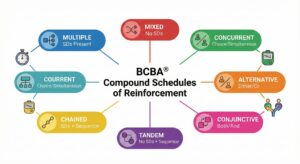
Image 1: An overview of the different types of compound schedules of reinforcement and their key features.
1. Simple vs Compound Schedules of Reinforcement ABA
Basic reinforcement schedules include:
-
Fixed Ratio (FR) – reinforce after a fixed number of responses
-
Variable Ratio (VR) – reinforce after a varying number of responses around an average
-
Fixed Interval (FI) – reinforce the first response after a fixed time period
-
Variable Interval (VI) – reinforce the first response after varying time periods around an average
These are single schedules – only one schedule of reinforcement is in effect.
If you need a quick refresh of simple schedules before tackling more complex schedules of reinforcement ABA questions, start with a basic reinforcement review.
What Are Schedules of Reinforcement ABA?
A compound schedule of reinforcement combines two or more basic schedules of reinforcement for a single response or multiple responses.
Key dimensions:
-
Successive vs simultaneous – components happen one after another or at the same time
-
With or without SDs – are there correlated stimuli signaling which schedule is in effect?
-
One response or multiple responses – are we choosing between options (like in concurrent schedules)?
-
One requirement, either requirement, or both – as in alternative and conjunctive schedules
Understanding these features helps you decode exam questions quickly, even if the schedule name is not explicitly given.
For more practice with how reinforcement interacts with other procedures, see our article on differential reinforcement in ABA and how it shapes behavior.
2. Multiple Schedules of Reinforcement in ABA (mult)
Definition
A multiple schedule (mult) is:
Two or more basic schedules of reinforcement, presented successively, for the same response, with each component having its own discriminative stimulus (SD).
Key points:
-
Components alternate (e.g., FR 10, then VI 2-min, then back to FR 10, etc.)
-
Only one component is in effect at a time
-
Each component has a correlated SD (e.g., different colors, tones, or contexts)
Example
A child answers intraverbal questions:
-
When the card on the table is green → correct answers are reinforced on FR 3 (every 3rd correct response gets a token)
-
When the card is blue → correct answers are reinforced on VI 2-min (first correct answer after an average of 2 minutes gets a token)
The child learns different response patterns in each condition because each SD (green vs blue) signals a different schedule.
Exam Clues for Multiple Schedules of Reinforcement in ABA
Look for:
-
“The therapist alternated between two different conditions…”
-
“Each condition had its own visual cue…”
-
“In the presence of the red card…, in the presence of the blue card…”
Same response, successive components, distinct SDs → multiple schedule.
3. Mixed Schedules of Reinforcement in ABA (mix)
Definition
A mixed schedule (mix) is:
Two or more basic schedules of reinforcement, presented successively, for the same response, but without correlated discriminative stimuli.
Key points:
-
Just like a multiple schedule, components alternate
-
No SDs to signal which schedule is currently in effect
-
The learner cannot tell which component is active except through the pattern of reinforcement
Example
A learner is working on a matching task:
-
Sometimes the behavior is reinforced on FR 5
-
Sometimes on VI 2-min
The therapist switches between these components according to a plan, but no cards, colors, or signals change between components.
The learner experiences different reinforcement patterns, but there is no correlated SD.
Exam Clues for Mixed Schedules of Reinforcement in ABA
Look for:
-
Successive presentation of different schedules
-
Same response
-
No mention of SDs or distinct cues
If it sounds like a multiple schedule but the question explicitly says there are no correlated stimuli, that’s mixed.
4. Multiple vs Mixed: One Simple Memory Hook
Both involve successive schedules on the same response.
-
Multiple (mult) – Marked by SDs
-
Mixed (mix) – No signals (no SDs)
“Mult = Marked; Mix = Mystery”
This is a helpful way to remember: in mixed schedules of reinforcement, it’s a mystery which component is in effect.
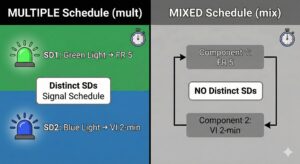
Image 2: A visual comparison of Multiple vs Mixed schedules. Note how the Multiple schedule has distinct SDs (green and blue lights) signaling the active component, while the Mixed schedule alternates components with no external cues.
5. Concurrent Schedules of Reinforcement ABA (conc)
Definition
A concurrent schedule (conc) is:
Two or more basic schedules of reinforcement available simultaneously, usually on different response options, allowing for choice.
Key points:
-
Multiple response options are available at the same time
-
Each option is on its own independent schedule
-
The learner’s allocation of responding across options is of interest (think matching law)
Example
A learner can:
-
Work on Task A (answering math problems) to earn tokens on a VI 2-min schedule
-
Or work on Task B (sorting pictures) to earn tokens on a FR 5 schedule
Both tasks are available simultaneously. The learner chooses where to respond.
Exam Clues for Concurrent Schedules of Reinforcement ABA
Look for:
-
“Two tasks available at the same time…”
-
“The learner can choose between…”
-
“Each response option has its own schedule…”
The idea of choice and allocation of responding suggests a concurrent schedule.
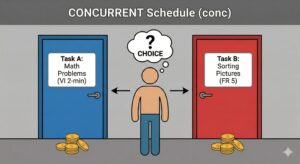
Image 3: A simple illustration of a Concurrent Schedule, highlighting the element of choice between two different reinforcement contingencies available at the same time.
6. Chained Schedules of Reinforcement in ABA (chain)
Definition
A chained schedule (chain) is:
Two or more basic schedules, presented successively, each with its own SD, and reinforcement delivered only at the end of the final component.
Key points:
-
Each component has its own SD
-
Completion of one component leads to the next component
-
Only the last component produces the terminal reinforcer
-
Often used for behavior chains or multi-step tasks
Example
A three-step chained schedule to earn a break:
-
Component 1 (SD1: blue card) → FR 5 math problems
-
Component 2 (SD2: yellow card) → FI 2-min of quiet reading
-
Component 3 (SD3: green card) → FR 1: complete one writing sentence
Only after Component 3 is completed does the learner earn a 5-minute preferred activity.
Exam Clues for Chained Schedule
Look for:
-
“The learner must complete one step before moving to the next…”
-
Each step has different cues (cards, contexts, signals)
-
Reinforcement is delivered after the sequence, not after each mini-component
That’s a chained schedule.
7. Tandem Schedules of Reinforcement in ABA (tand)
Definition
A tandem schedule (tand) is:
Like a chained schedule, but without correlated discriminative stimuli for each component.
Key points:
-
Two or more successive components
-
No distinct SDs for each component
-
Only the final component produces the reinforcer
-
The “chain” is internal to the schedule, not signaled externally
Example
A learner must:
-
Emit 10 correct responses (FR 10), and
-
Then continue responding for 2 minutes (FI 2-min)
Only after both are completed is the reinforcer delivered, but the learner does not get a new SD when the interval component starts.
Chained vs Tandem Memory Aid
-
Chained – Clear cues for each component
-
Tandem – No cues
8. Alternative Schedules of Reinforcement in ABA (alt)
Definition
An alternative schedule (alt) is:
Reinforcement is delivered when the requirement of any one of two (or more) basic schedules is met.
Key points:
-
Two schedules operate simultaneously for the same response
-
When either requirement is met, reinforcement is delivered
-
Often an “either/or” situation
Example
A learner receives a reinforcer when:
-
Either they emit 50 responses (FR 50),
-
OR 5 minutes elapse with at least one response (FI 5-min).
Whichever requirement is met first produces reinforcement.
9. Conjunctive Schedules of Reinforcement in ABA (conj)
Definition
A conjunctive schedule (conj) is:
Reinforcement is delivered only when both of two (or more) basic schedule requirements have been met.
Key points:
-
Two schedules operate simultaneously for the same response
-
All requirements must be met before reinforcement is given
-
Think “AND” instead of “either/or”
Example
A learner gets reinforcement only when:
-
They emit at least 30 correct responses (FR 30),
-
AND at least 5 minutes have passed (FI 5-min).
Both the ratio and the interval criteria must be satisfied.
Alternative vs Conjunctive Memory Aid
-
Alternative = “OR” (either requirement is enough)
-
Conjunctive = “AND” (all requirements must be met)
10. How Schedules of Reinforcement ABA Show Up on the BCBA® Exam
You’ll typically see compound schedules of reinforcement ABA questions in:
-
Definition-matching questions (easier)
-
Scenario-based questions where the name is missing, but the features are described (harder)
Common Exam Patterns
Multiple vs Mixed
-
Are there distinct SDs for each component? → multiple
-
No SDs, but components alternate → mixed
Chained vs Tandem
-
Are there different SDs for each step? → chained
-
Steps with no new SDs → tandem
Concurrent
-
Two or more response options available at the same time
-
Focus on choice and allocation of responding
Alternative vs Conjunctive
-
Reinforce when either requirement is met → alternative
-
Reinforce when both requirements are met → conjunctive
On test day, don’t panic about the labels first. Instead, ask:
-
Are schedules in effect one at a time or simultaneously?
-
Is there one response or multiple response options?
-
Are there SDs for each component or not?
-
Is reinforcement given when any condition is met, or only when all are met?
Once you answer those questions, the schedule of reinforcement in ABA usually becomes clear.
For official exam and task list updates, always cross-check with the BACB® website.
If you want to practice these ideas in full-exam format, you can try our free BCBA® mock exam.
11. Mini Practice Questions (With Explanations)
Question 1 – Multiple vs Mixed
A therapist alternates between two schedules for the same response. When a red card is on the table, correct responses are reinforced on a VR 5 schedule. When a blue card is on the table, correct responses are reinforced on a VI 2-min schedule. The red and blue cards are always present and signal which schedule is active.
Which schedule arrangement is this?
A. Multiple schedule
B. Mixed schedule
C. Concurrent schedule
D. Chained schedule
Correct Answer: A – Multiple schedule
Why?
-
Two basic schedules (VR 5 and VI 2-min)
-
Successively in effect for the same response
-
Each with its own correlated SD (red vs blue card)
That fits a multiple (mult) schedule.
Question 2 – Chained vs Tandem
A learner must complete 10 math problems and then read quietly for 3 minutes before earning a token. Each component has its own visual cue: a math worksheet is presented during the first component, and a reading card is displayed during the second component. The reinforcer is delivered only after both components are completed.
Which compound schedule is this?
A. Tandem schedule
B. Chained schedule
C. Alternative schedule
D. Conjunctive schedule
Correct Answer: B – Chained schedule
Why?
-
Two components presented successively
-
Each has its own SD (math vs reading cue)
-
Reinforcement is delivered only after the final component
That matches a chained schedule. Tandem schedules would not include distinct SDs for each component.
Question 3 – Alternative vs Conjunctive
A BCBA sets up a schedule where a client earns access to a preferred activity when either:
-
they complete 40 responses,
-
or 10 minutes have passed, as long as at least one response occurred in that time.
Which type of compound schedule is this?
A. Concurrent schedule
B. Conjunctive schedule
C. Alternative schedule
D. Mixed schedule
Correct Answer: C – Alternative schedule
Why?
-
Two schedules (a ratio and an interval) are operating
-
Reinforcement is given when either requirement is met
That is an alternative (alt) schedule. Conjunctive schedules would require both criteria to be met.
12. Key Takeaways: Schedules of Reinforcement ABA
Compound schedules of reinforcement ABA questions are much easier when you focus on structure instead of names.
They combine basic schedules in different ways. Focus on:
-
Successive vs simultaneous components
-
Presence or absence of SDs
-
Single vs multiple responses
-
“Either condition” vs “both conditions” for reinforcement
On the BCBA® exam, use these questions to guide your thinking:
-
Are there correlated stimuli?
-
Are components alternating or available at the same time?
-
Is the learner choosing between responses?
-
Does reinforcement require one requirement or multiple requirements?
When you understand how schedules of reinforcement in ABA are built, compound schedules like multiple, mixed, concurrent, chained, tandem, alternative, and conjunctive stop feeling mysterious and start feeling predictable.
To apply these concepts under exam-style pressure, try a free full-length BCBA® mock exam or browse more BCBA® exam prep resources on our site.