

Mastering fluency-based instruction is essential for both BCBA exam success and effective clinical practice. The SAFMEDS protocol represents a powerful approach to building rapid, accurate responding across various skills. This comprehensive guide explores how this method works, provides practical implementation examples, and addresses both exam relevance and ethical considerations.
Table of Contents
- SAFMEDS ABA: What Are SAFMEDS? Defining the Protocol and Its Purpose
- Implementing SAFMEDS: A Step-by-Step Guide with ABA Examples
- SAFMEDS and the BCBA Exam: Relevance, Traps, and Application
- Ethical and Effective Use of SAFMEDS in Practice
SAFMEDS ABA: What Are SAFMEDS? Defining the Protocol and Its Purpose
SAFMEDS stands for Say All Fast Minute Every Day Shuffled, a fluency-building procedure rooted in Precision Teaching and Direct Instruction methodologies. Unlike traditional study methods that focus on accuracy alone, this approach emphasizes speed and automaticity of responding.
The SAFMEDS Acronym and Core Principles
Each component of the acronym serves a specific purpose in the learning process. Say All refers to the requirement that learners respond to every item in the deck. Fast emphasizes the importance of response speed, while Minute establishes the standard timing interval. Every Day ensures consistent practice, and Shuffled prevents rote memorization through predictable sequences.
The protocol measures performance using frequency counts (correct responses per minute) rather than percentage correct. Practitioners typically chart daily performance on Standard Celeration Charts to visualize learning progress over time. This approach originated from the work of Ogden Lindsley and represents a key component of Precision Teaching methodology.
SAFMEDS vs. Traditional Flashcards: Key Differentiators
- Purpose: SAFMEDS targets fluency and automaticity, while traditional flashcards often focus on accuracy and mastery alone
- Procedure: SAFMEDS requires timed, shuffled, daily practice with specific measurement protocols
- Measurement: SAFMEDS uses frequency counts (corrects per minute) rather than percentage correct
- Data tracking: SAFMEDS employs celeration charting to monitor learning progress systematically
- Application: SAFMEDS is designed for skill maintenance and response generalization beyond initial acquisition
Implementing SAFMEDS: A Step-by-Step Guide with ABA Examples
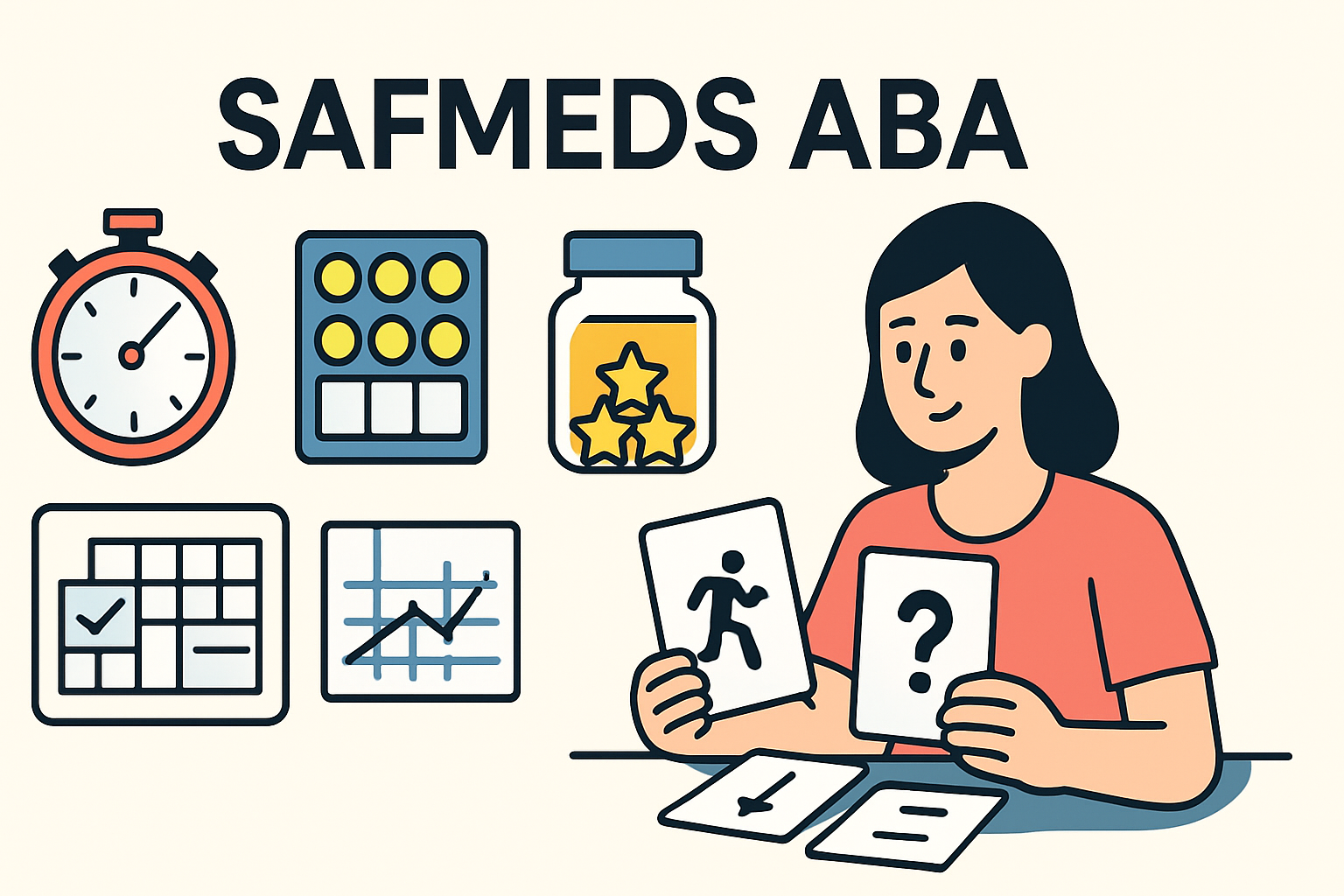
Effective implementation requires careful preparation and consistent procedures. Following standardized steps ensures the protocol delivers its intended benefits for both exam preparation and clinical skill development.
The Standard SAFMEDS Procedure
- Step 1: Create cards with terms on front and definitions/examples on back
- Step 2: Shuffle the deck thoroughly to prevent sequence learning
- Step 3: Set a one-minute timer and prepare recording materials
- Step 4: Go through the deck, saying answers aloud for each card
- Step 5: Count correct responses and errors separately
- Step 6: Chart daily performance on a Standard Celeration Chart
- Step 7: Review errors and practice challenging items separately
Worked Example 1: Building Fluency with ABA Terminology
Consider a BCBA candidate practicing behavior analytic concepts. The antecedent is seeing ‘MO’ on a card. The behavior involves saying ‘Motivating Operation‘ aloud. The consequence includes moving the card to the correct pile and recording the response. The hypothesized function is access to positive reinforcement through mastery and visible progress on the celeration chart.
This example demonstrates how SAFMEDS can build automaticity with foundational terminology. The timed practice helps candidates respond quickly during exam situations where time pressure exists. The shuffled presentation prevents rote memorization of sequences, ensuring true concept mastery.
Worked Example 2: SAFMEDS for Staff Training on Ethical Codes
In clinical settings, staff might practice ethical decision-making scenarios. A card presents: ‘Client requests to discontinue service.’ The staff member responds: ‘Respect client autonomy, discuss implications, document the conversation.’ The consequence includes peer feedback and moving to the correct pile.
The hypothesized function here is avoidance of negative reinforcement by preventing ethical missteps. This application shows how SAFMEDS supports staff training and competency development. The daily practice builds automatic ethical responding in complex situations.
SAFMEDS and the BCBA Exam: Relevance, Traps, and Application
Understanding how this protocol appears on the BCBA exam helps candidates prepare effectively. The method is tested across multiple content areas with specific emphasis on measurement and application principles.
How SAFMEDS is Tested: Knowledge and Application Questions
Exam questions may appear in several domains. Under Measurement, questions might address frequency recording and celeration charting. In Interventions, questions could cover Precision Teaching components and fluency-building procedures. For Ethics, questions might examine evidence-based training methods and effective supervision practices.
Candidates should recognize that SAFMEDS represents a specific implementation of broader fluency-based instruction principles. Understanding its relationship to Direct Instruction and Precision Teaching provides context for application questions.
Common Exam Traps and Misconceptions to Avoid
- Confusing fluency with mastery: Remember that fluency requires both accuracy and speed, not just correct responding
- Age limitations: SAFMEDS is effective for learners of all ages, not just children
- Missing components: All acronym elements (shuffled, every day) are essential for protocol integrity
- Historical connections: Always link SAFMEDS to Ogden Lindsley and Precision Teaching origins
- Measurement errors: Use frequency counts, not percentage correct, for proper implementation
- Application scope: Recognize that SAFMEDS works for both academic content and clinical skills
Ethical and Effective Use of SAFMEDS in Practice
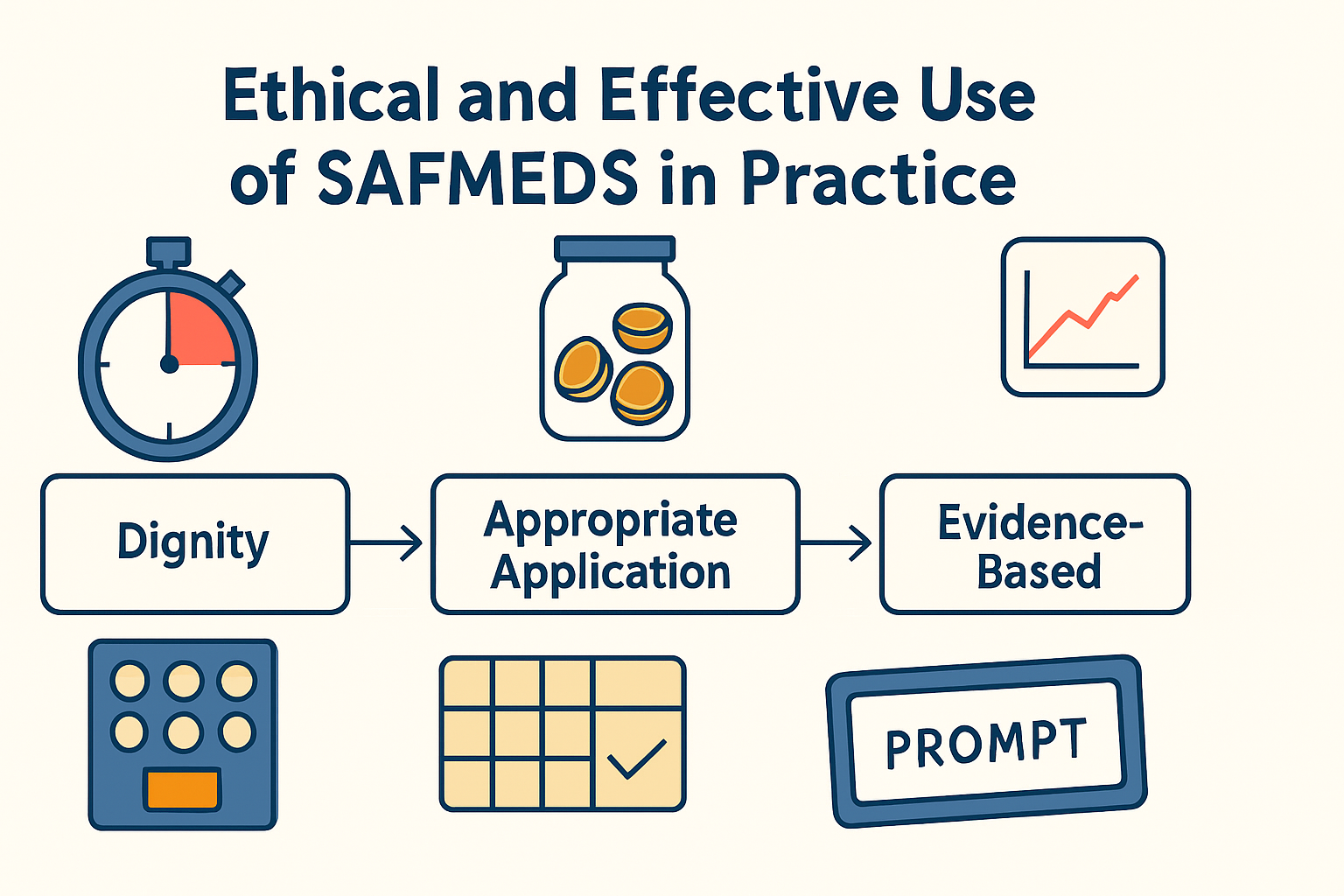
Implementing SAFMEDS ethically requires consideration of client dignity, appropriate application, and evidence-based decision making. Practitioners must ensure the method serves client needs rather than becoming an end in itself.
Aligning SAFMEDS with the BACB Ethics Code
The BACB Ethics Code provides essential guidance for ethical implementation. Code 2.0 emphasizes responsibility to clients and requires using effective, evidence-based procedures. Code 4.0 addresses responsibility to supervisees and mandates effective training methods.
Practitioners should ensure SAFMEDS is used appropriately for skill acquisition and fluency building, not as a punitive measure. Client assent and consent should be obtained, and the method should be individualized based on learner characteristics. For comprehensive ethical guidance, review the BACB Ethics Code directly.
Quick Checklist for Implementing SAFMEDS
- Assess skill appropriateness: Is the target skill suitable for fluency building?
- Prepare materials correctly: Are cards created with clear terms and definitions?
- Provide clear instructions: Does the learner understand the procedure and timing?
- Ensure proper environment: Is the setting free from unnecessary distractions?
- Implement data tracking: Are correct responses and errors being charted daily?
- Set mastery criteria: Have appropriate fluency aims been established?
- Obtain consent/assent: Has appropriate permission been obtained from all stakeholders?
- Monitor progress: Is performance being reviewed and adjustments made as needed?
The SAFMEDS protocol offers a powerful tool for building fluency and automaticity across various skills. When implemented ethically and systematically, it supports both exam preparation and clinical competency development. By understanding its principles, avoiding common misconceptions, and applying it within ethical guidelines, practitioners can leverage this method effectively in their professional practice.
Complete BCBA Exam Prep
Turn this topic into exam-day practice
Practice concepts in context with five full-length 6th Edition mock exams, two bonus practice exams, a 6th Edition study guide, and key-term flashcards—all in one $120 USD package.
Get the $120 All-in-One Prep Pack
Review everything included on the product page before ordering. No pass guarantee is implied.



