Response Generalization ABA: How Behaviors Spread and Change
If you are studying for the BCBA® exam, you’ll see response generalization ABA questions sprinkled across sections on reinforcement, generalization, and treatment design. Understanding how one learned response can lead to new, related responses is critical both for the exam and for real-life ABA programming.
Before diving in, you may want to refresh basic reinforcement concepts in our guides on Positive Reinforcement in ABA (https://bcbamockexam.com/positive-reinforcement-aba/) and Negative Reinforcement in ABA (https://bcbamockexam.com/negative-reinforcement-aba/). These articles provide the foundation for why new responses are reinforced and maintained over time.
For official task-list language and updates on exam content, always cross-check with the BACB® website (https://www.bacb.com) while you study.
In this guide, we’ll define response generalization in ABA, compare it to stimulus generalization, give everyday and clinical examples, and walk through exam-style questions that show up on BCBA® mock exams and the real test.
What Is Response Generalization in ABA?
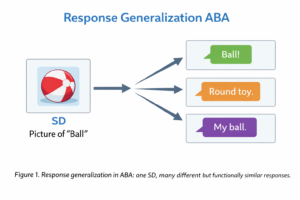
In response generalization ABA, the learner starts to use new, untrained responses that serve the same function as a reinforced response.
Simple definition
Response generalization occurs when a behavior change spreads to different topographies of behavior that were not directly trained, but produce the same outcome or contact the same reinforcement.
Key points:
- You directly teach one response (e.g., saying “Break, please”).
- Over time, the learner emits new, similar responses (e.g., “Can I rest?”, “I need a break”) that you never explicitly trained.
- These new responses still access the same reinforcer (break from work).
In other words, response generalization ABA means same function, different forms of behavior.
For BCBA® language, response generalization reflects a spread of effect within a response class (functionally equivalent behaviors).
Response Generalization vs Stimulus Generalization
These two show up together a lot, but they’re not the same.
Stimulus generalization
Same response, different stimuli.
- Example: Saying “dog” when you see many different dogs.
Response generalization
Different responses, same stimulus or function.
- Example: When presented with a tough math worksheet, a student might say “I need help,” raise a hand, or use a help card — all to get assistance.
You can remember it this way:
- Stimulus generalization = behavior spreads across stimuli.
- Response generalization ABA = behavior spreads across responses.
On the exam, ask: “Are they describing new forms of behavior (response generalization) or the same behavior in new situations (stimulus generalization)?” If they emphasize topography changes (new ways of responding) with the same reinforcer, that’s response generalization.
Everyday Examples of Response Generalization ABA
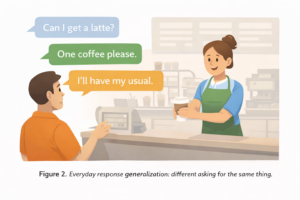
You see response generalization in daily life all the time.
Example 1 – Asking for help in different ways
You first learn to say “Help, please.”
- Say “Can you give me a hand?”
- Say “I’m stuck, can you help?”
- Send a text: “Can you call me?”
These different responses all access the same outcome: help. That’s response generalization.
Example 2 – Greeting others
You were reinforced for saying “Hi” to people. Over time you also start to:
- Wave
- Say “Hey!” or “Good morning”
- Smile and nod
All of these different greeting behaviors contact similar social reinforcement — a perfect everyday example of response generalization ABA.
Example 3 – Coping skills
You’re taught to take deep breaths when stressed. Later, you also:
- Go for a walk
- Put on calming music
- Do a short stretch
All were not directly trained together, but they reduce stress and contact similar relief — response generalization within a coping response class.
Response Generalization in ABA Programs
In ABA, we plan for response generalization, especially in communication, social skills, and replacement behavior programs.
Functional Communication Training (FCT)
You directly teach a client to request a break using a “Break” card.
- SD: Difficult task presented
- Taught response: Hand over “Break” card
- Consequence: Short break from demands
Later, you notice the learner also says “Break please,” pushes the card toward you while saying “Stop,” or signs “break” in sign language. These new responses weren’t directly prompted or reinforced at first, but they now access the same break. That is response generalization ABA in action.
Social skills and play
You teach “Can I play?” as an initiation with peers. Over time, the learner also:
- Says “Can I join?”
- Stands near peers and says “What are you playing?”
- Brings a toy over and says “Let’s play together.”
All these responses can lead to peer interaction and access to social play — response generalization inside a social initiation response class.
Problem behavior response classes
Response generalization can also occur with problem behavior:
- You see mild whining reinforced (e.g., task removed).
- Over time, you start seeing crying, yelling, or throwing materials.
These different topographies all serve the same function (for example, escape), forming a response class maintained by the same reinforcer. This is why identifying the function of behavior is crucial; you’re not just treating one topography, you’re addressing the whole response class.
For a deeper review of functions, see our guide on the four functions of behavior in ABA: https://bcbamockexam.com/four-functions-of-behavior-aba/
How to Program Response Generalization ABA in Treatment
Good ABA programs don’t stop at “one correct response.” They intentionally build flexible response classes.
Reinforce multiple response topographies
Don’t only reinforce one correct response.
- Accept and reinforce variations that serve the same function, such as “Break please,” “I need a break,” or “Can I rest?”
For exam questions, the best answer is often the one that reinforces a range of appropriate responses, not just a single scripted phrase.
Teach response classes, not one rigid script
When planning skill acquisition, define the functional goal (for example, “requesting help appropriately”). Allow multiple topographies to be reinforced (gestures, speech, AAC, etc.) and use shaping to gradually accept more advanced or clearer responses.
Example: Start reinforcing any approximation of “help” (for example, “hep”). Later, different full phrases (“Can you help me?”, “I need help”) are also reinforced.
Use differential reinforcement wisely
You can use differential reinforcement to guide which response variations you want more of:
- At first, reinforce many functionally equivalent responses.
- Later, differentially reinforce the most appropriate or most efficient forms (for example, a full verbal sentence instead of screaming).
This combines response generalization ABA with response refinement.
Contact natural reinforcement
Encourage responses that work in natural settings and contact natural social reinforcement (peer approval, teacher attention, successful problem solving). Teaching several polite ways to ask for help will generalize better than a single, scripted phrase.
Common BCBA® Exam Traps about Response Generalization
Expect the exam to mix response generalization ABA with related concepts. Watch for these traps:
Trap 1 – Calling stimulus generalization “response generalization”
If the same response (“dog”) occurs in the presence of many stimuli (different dogs), that’s stimulus generalization. Response generalization requires new response forms that produce the same outcome.
Trap 2 – Confusing response generalization with response maintenance
Maintenance is when the same response continues over time after treatment ends. Response generalization is when new, untrained responses emerge that are functionally similar.
Trap 3 – Ignoring function
A set of behaviors only form a response class if they produce similar consequences. If hand-flapping and shouting sometimes get attention and sometimes get escape, and the stem emphasizes escape as the consistent consequence, label them as an escape-maintained response class. Response generalization ABA is about new members joining that function-based response class.
Trap 4 – Over-focusing on topography
Exam stems may show very different topographies (for example, asking for a break, dropping to the floor, or walking to the calm corner). If they all reliably contact the same reinforcer (break from demands), they belong to the same response class, and the emergence of new ones can be response generalization.
Mini BCBA® Exam–Style Questions (With Explanations)
Question 1 – Response or Stimulus Generalization?
A learner is taught to say “help” when stuck on a worksheet. Over time, without direct teaching, the learner also begins to say “I need help,” “Can you help me?” and “I’m stuck” to access assistance from staff.
What process is BEST illustrated?
- Stimulus generalization
- Response generalization
- Response maintenance
- Extinction
Correct Answer: B – Response generalization
Why? Different responses (new phrases) are appearing, and they all serve the same function: accessing help. That matches response generalization ABA.
Question 2 – Identifying a Response Class
A child was originally reinforced for saying “More juice.” Later, they start signing “more,” pointing to the cup, or saying “Juice, please,” all of which consistently produce more juice from caregivers.
These different behaviors are BEST described as:
- Members of the same response class
- Members of different stimulus classes
- An example of stimulus generalization only
- An extinction burst
Correct Answer: A – Members of the same response class
Why? Different topographies (sign, point, vocal) all lead to the same reinforcer (more juice). The emergence of these new responses shows response generalization within a function-based response class.
Question 3 – Programming for Response Generalization
A BCBA teaches a client to greet peers by saying, “Hi.” After the client consistently uses “Hi,” the BCBA decides to reinforce other spontaneous greetings such as “Hey,” “What’s up?” and waving. What is the BCBA MOST likely trying to promote?
- Stronger stimulus control across settings
- Response generalization within the greeting repertoire
- Extinction of informal greetings
- Maintenance of a single greeting response
Correct Answer: B – Response generalization within the greeting repertoire
Why? The BCBA is reinforcing new greeting topographies that all serve the same social function. That is textbook response generalization ABA.
Key Takeaways
Response generalization ABA happens when a learner starts to use new, untrained behaviors that achieve the same outcome as a taught behavior.
- Think: same function, different forms — new members of a response class.
- It differs from stimulus generalization, which is the same response occurring in the presence of different stimuli.
- In treatment, you can strengthen response generalization by reinforcing multiple topographies, teaching response classes, using differential reinforcement and shaping, and making sure responses contact natural reinforcement.
For a stronger foundation before test day, you may also want to review:
Positive reinforcement in ABA: https://bcbamockexam.com/positive-reinforcement-aba/
Negative reinforcement in ABA: https://bcbamockexam.com/negative-reinforcement-aba/
Mastering response generalization ABA will help you design more flexible, functional interventions — and decode a whole class of BCBA® exam questions with confidence.