

Understanding respondent conditioning is essential for any ABA practitioner preparing for certification. This foundational concept explains how involuntary responses become associated with previously neutral stimuli through pairing. Unlike operant conditioning, which focuses on consequences, respondent conditioning centers on antecedents and their ability to elicit reflexive behaviors.
Table of Contents
- What is Respondent Conditioning? A Foundational Definition
- Respondent Conditioning in ABA Practice: Worked Examples
- Respondent Conditioning on the BCBA® Exam: What to Expect
- Summary and Key Takeaways
What is Respondent Conditioning? A Foundational Definition
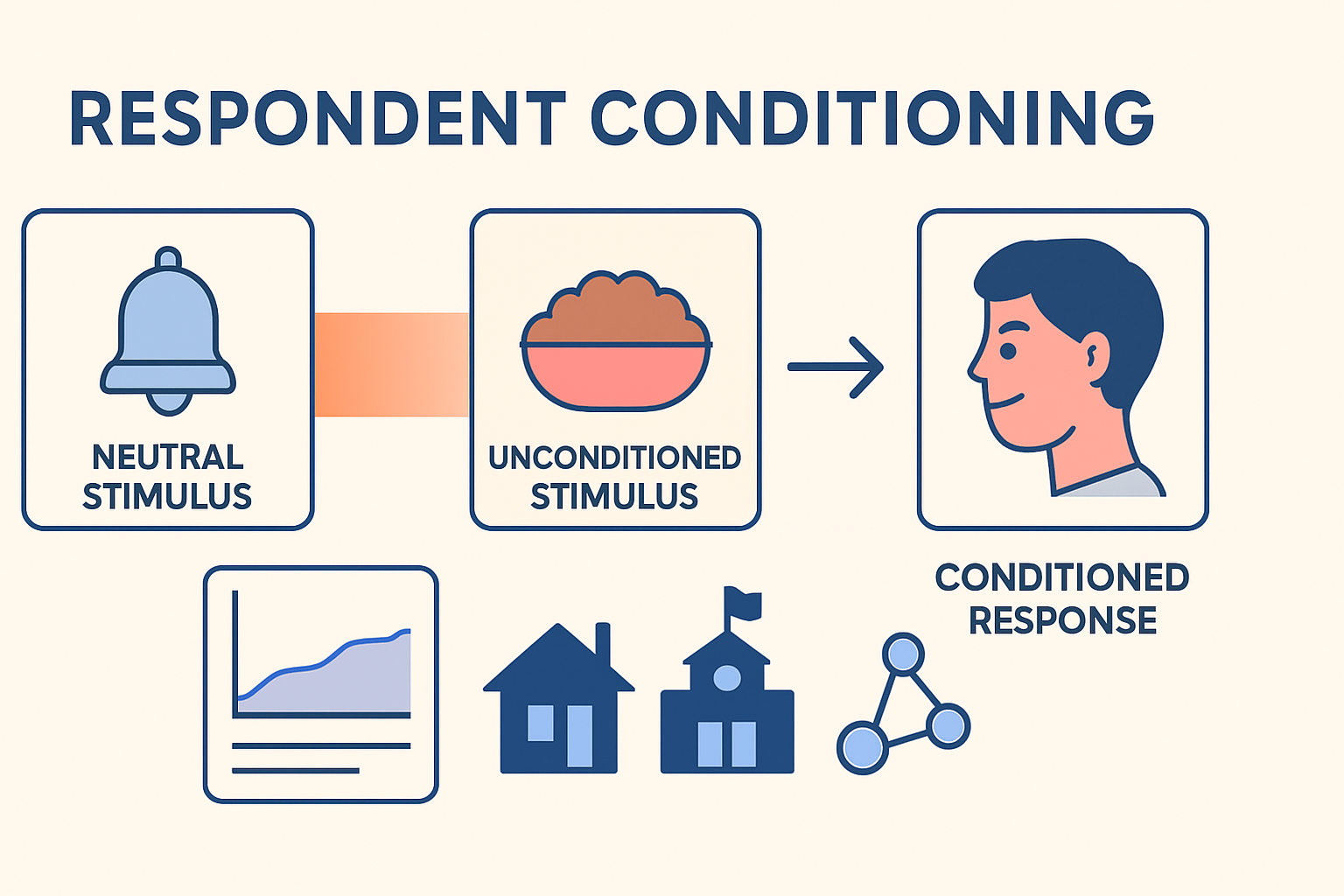
Respondent conditioning, also known as classical conditioning, involves learning through stimulus association. When a neutral stimulus is repeatedly paired with an unconditioned stimulus, it eventually elicits a conditioned response. This process explains many emotional and physiological reactions in clinical practice.
Key Components: US, UR, CS, CR
Master these four critical terms to analyze respondent conditioning scenarios effectively:
- Unconditioned Stimulus (US): A stimulus that naturally and automatically triggers a response without prior learning. Examples include food causing salivation or pain causing withdrawal.
- Unconditioned Response (UR): The natural, unlearned reaction to an unconditioned stimulus. This is a reflexive behavior that occurs automatically.
- Conditioned Stimulus (CS): A previously neutral stimulus that, after repeated pairing with an unconditioned stimulus, comes to elicit a conditioned response.
- Conditioned Response (CR): The learned reaction to a conditioned stimulus. It typically resembles the unconditioned response but occurs in response to the conditioned stimulus.
Respondent vs. Operant: The Critical Distinction
This distinction is a major exam trap area. Respondent conditioning focuses on antecedent events and involuntary responses, while operant conditioning centers on consequences and voluntary behaviors. Respondent behaviors are elicited by stimuli, whereas operant behaviors are emitted by the organism.
For a deeper understanding of how these concepts fit within behavior analysis, see our guide on philosophical assumptions underlying behavior analysis.
Respondent Conditioning in ABA Practice: Worked Examples
These practical examples demonstrate how respondent conditioning appears in clinical settings and how to analyze them using ABC frameworks.
Example 1: Medical Setting Anxiety (Fear Response)
A child develops anxiety when entering the doctor’s office after receiving painful injections. The neutral stimulus (doctor’s office) becomes a conditioned stimulus through pairing with the unconditioned stimulus (painful injection).
- Antecedent: Entering the doctor’s office (CS)
- Behavior: Crying, clinging to parent (CR)
- Consequence: Automatic negative reinforcement through anxiety reduction when leaving
- Function: Automatic negative reinforcement (escape from conditioned anxiety)
Example 2: Food Preference and Satiety Cues
A client salivates when seeing the packaging of their favorite snack. The sight of the package (NS) becomes a CS through pairing with the taste of the food (US).
- Antecedent: Seeing snack packaging (CS)
- Behavior: Salivation (CR)
- Consequence: Automatic positive reinforcement through physiological preparation
- Function: Automatic positive reinforcement (biological preparation for consumption)
Example 3: Emotional Response to a Specific Tone of Voice
A student flinches when hearing a teacher’s stern tone, developed after repeated pairing with reprimands. The tone (NS) becomes a CS through association with yelling (US).
- Antecedent: Hearing stern tone (CS)
- Behavior: Flinching, anxiety (CR)
- Consequence: Socially-mediated conditioned emotional response
- Function: Conditioned emotional response affecting social interactions
For more on how environmental variables influence behavior, explore our article on motivating operations in ABA.
Respondent Conditioning on the BCBA® Exam: What to Expect
The exam tests your ability to identify, analyze, and apply respondent conditioning concepts in complex scenarios.
Common Question Formats and Traps
Be prepared for these question types that often confuse candidates:
- Identification questions: Label US, UR, CS, CR in clinical vignettes
- Differentiation questions: Distinguish respondent from operant processes in mixed scenarios
- Procedure selection: Choose between pairing procedures and reinforcement contingencies
- Trap alert: Questions may describe operant behaviors that appear reflexive but are actually maintained by consequences
Quick-Study Checklist for Test Day
Use this checklist to reinforce key concepts before your exam:
- Remember that respondent behaviors are involuntary and reflexive
- Focus on antecedent pairing rather than consequences
- Common domains include emotional responses and physiological reactions
- The conditioned response typically resembles the unconditioned response
- Pairing must occur repeatedly and consistently for conditioning to develop
- Extinction occurs when the CS is presented without the US
For additional exam preparation strategies, check our comprehensive BCBA exam prep guide.
Summary and Key Takeaways
Respondent conditioning remains a foundational concept in behavior analysis with direct clinical applications. Master these essential points:
- Respondent conditioning explains involuntary learned responses through stimulus association
- The four key components (US, UR, CS, CR) form the basis for analysis
- Differentiate respondent from operant by focusing on antecedent elicitation versus consequence control
- Clinical examples often involve emotional responses, physiological reactions, and conditioned preferences
- Exam questions test identification, differentiation, and application in complex scenarios
- Common traps include confusing respondent processes with operant contingencies
For authoritative information on behavior analysis standards, refer to the Behavior Analyst Certification Board official resources.


