Respondent Conditioning (Classical Conditioning): Key Terms, Examples, and Common BCBA® Question Types By BCBA Mock Exam
Introduction
Respondent (classical) conditioning doesn’t get as much attention as operant behavior in everyday ABA practice—but it still shows up on the BCBA® exam.
Even if you don’t run Pavlov-style bell-and-salivation experiments, you’re expected to:
-
Know the key terms (US, UR, CS, CR, neutral stimulus)
-
Recognize respondent conditioning in real-life scenarios (anxiety, phobias, automatic reactions)
-
Distinguish respondent from operant conditioning
-
Answer questions about extinction, generalization, and discrimination in respondent behavior
In this article, we’ll walk through:
-
Simple, exam-ready definitions
-
Step-by-step examples of how classical conditioning works
-
Respondent vs operant distinctions
-
Common BCBA® exam traps and practice questions with explanations.
1. Why Respondent Conditioning Still Matters for the BCBA® Exam
ABA focuses heavily on operant behavior (behavior affected by its consequences). But the exam also expects you to understand respondent behavior, which is:
-
Elicited by antecedent stimuli (not emitted for consequences)
-
Often related to reflexes, emotions, and physiological responses
Respondent conditioning helps explain:
-
Why clients may have automatic fear or anxiety responses in certain contexts
-
How neutral stimuli become triggers for emotional reactions
-
How some patterns of behavior involve both respondent and operant components
On the BCBA® exam, questions may ask you to:
-
Label the US, UR, CS, and CR in a scenario
-
Identify whether a situation describes respondent or operant conditioning
-
Recognize respondent extinction or generalization.
2. Key Terms: US, UR, NS, CS, CR
Here are the core respondent conditioning terms in simple language:
Unconditioned Stimulus (US)
-
A stimulus that automatically elicits a response without prior learning.
-
Example: Bright light to the eye, food in the mouth, sudden loud noise.
Unconditioned Response (UR)
-
The automatic, reflexive response elicited by a US.
-
Example: Pupil constriction, salivation, startle response.
Neutral Stimulus (NS)
-
A stimulus that does not initially elicit the target response.
-
Example: A specific tone, a particular room, a toy—before pairing.
Conditioned Stimulus (CS)
-
A previously neutral stimulus that, after being paired with a US, comes to elicit a similar response.
-
Example: The tone that has been paired with food.
Conditioned Response (CR)
-
The learned response that the CS elicits after conditioning.
-
Example: Salivation to the tone alone.
Shortcut for the exam:
-
US/UR = unlearned, reflexive
-
CS/CR = learned, after pairing
-
NS becomes a CS only after repeated pairings with a US.
3. How Classical Conditioning Works Step by Step
Think of respondent conditioning as a before–during–after process. The image below illustrates this pairing process.
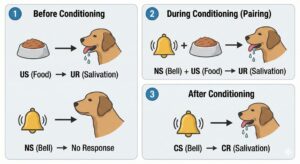
Before conditioning
-
US → UR
-
Food (US) → salivation (UR)
-
-
NS → no relevant response
-
Bell (NS) → no salivation (for now)
-
During conditioning (pairing)
-
NS + US → UR
-
Bell (NS) + food (US) → salivation (UR)
-
-
This happens repeatedly: NS is consistently paired with US.
After conditioning
-
CS → CR
-
Bell (now CS) → salivation (CR) even without food
-
Key idea:
-
The relationship changes: a previously neutral stimulus now elicits a respondent response because of its history of pairing with a US.
4. Everyday Examples Relevant to ABA Practice
You may see respondent conditioning in many real-life situations.
Example 1 – Medical setting anxiety
-
US: Painful injection
-
UR: Crying, increased heart rate
-
NS: The sight of a white lab coat or exam room
-
Result: After repeated pairings, the lab coat/exam room becomes a CS that elicits anxiety (CR) even before any injection.
The image below provides a visual representation of this common scenario.

Example 2 – Fear of dogs
-
US: Being bitten or barked at aggressively
-
UR: Startle, fear response
-
NS: Sight of a dog
-
Result: After pairing, the sight of any dog (CS) may elicit fear (CR).
Example 3 – Positive emotional response
-
US: Warm attention, praise from a caregiver
-
UR: Feelings of pleasure, smiling
-
NS: A specific song that always plays during positive moments
-
Result: Over time, the song (CS) may elicit a positive emotional response (CR) even when played alone.
These types of learning histories can influence how clients respond to settings, materials, or people before any operant contingencies are considered.
5. Respondent vs Operant Conditioning: Big Differences
The BCBA® exam loves comparing respondent and operant conditioning. The infographic below summarizes the key differences.
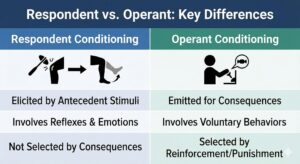
Respondent conditioning
-
Behavior is elicited by antecedent stimuli.
-
Involves reflexes, physiological responses, emotions.
-
Response is not selected by its consequences.
Operant conditioning
-
Behavior is emitted and then strengthened or weakened by its consequences.
-
Involves voluntary, controllable responses (pressing a lever, answering a question, asking for help).
-
Behavior is selected by reinforcement or punishment.
Example comparison:
-
Respondent: A child’s heart rate increases (CR) when entering the dentist’s office (CS) due to past pairings with painful procedures (US).
-
Operant: The child screams and escapes from the chair; escape is reinforced (negative reinforcement) if the procedure stops.
Exam tip: Many real-life situations include both respondent and operant components. Be clear which one the question is asking about.
6. Respondent Extinction, Generalization, and Discrimination
Once a CS–CR relationship is established, several other principles apply.
Respondent extinction
-
Present the CS repeatedly without the US.
-
Over time, the CR weakens or stops.
-
Example: Visiting the doctor many times with no painful procedures; fear response gradually decreases.
Spontaneous recovery
-
After respondent extinction, the CR may reappear temporarily when the CS is presented again following a rest period.
Generalization
-
Stimuli similar to the CS also evoke the CR.
-
Example: Fear response generalizes from one barking dog to many different dogs.
Discrimination
-
The CR occurs only in the presence of a specific CS, not similar stimuli.
-
Example: Fear only in the presence of a particular dentist’s office, not all medical offices.
Know these terms: the exam may ask you to identify which process a scenario illustrates.
7. Common BCBA® Question Types on Respondent Conditioning
Expect questions such as:
-
“Identify the US, UR, CS, and CR in this scenario.”
-
“Which of the following is an example of respondent conditioning?”
-
“Which process is illustrated by the reduction in response when the CS is repeatedly presented without the US?”
-
“Which statement BEST describes the difference between respondent and operant conditioning in this example?”
You may see:
-
Graph-free, story-based vignettes
-
Mixed items that mention both respondent and operant components
-
Questions about fear, phobias, or emotional reactions tied to specific antecedents.
8. Common BCBA® Exam Traps with Respondent Conditioning
Watch out for these traps:
Trap 1 – Calling an operant consequence a US
-
Reinforcement or punishment after behavior is operant, not respondent.
Trap 2 – Ignoring the timeline
-
For respondent conditioning, the CS precedes the CR and has been paired with a US.
-
If a stimulus occurs after behavior and changes future responding, that’s operant, not respondent.
Trap 3 – Mislabeling NS, CS, and CR
-
Remember: a neutral stimulus becomes a CS only after pairing.
-
The response to the CS after conditioning is the CR.
Trap 4 – Confusing extinction types
-
Respondent extinction = CS presented repeatedly without US.
-
Operant extinction = behavior no longer produces reinforcement.
Trap 5 – Overlooking respondent–operant interactions
-
Some stems mix physiological/emotional responses (respondent) with escape or avoidance behavior (operant). Identify which part the question is targeting.
9. Mini BCBA® Exam–Style Questions (With Explanations)
Question 1 – Labeling US, UR, CS, and CR
A child receives several painful injections at a pediatric clinic. At first, only the injection itself produces crying. After several visits, the child begins to cry as soon as they see the clinic waiting room.
Which option correctly identifies the US and CS?
A. US = clinic waiting room; CS = injection B. US = injection; CS = clinic waiting room C. US = crying; CS = injection D. US = caregiver; CS = crying
Correct Answer: B – US = injection; CS = clinic waiting room Explanation: The injection (US) automatically elicits crying (UR). The waiting room was initially neutral, then paired with the US and now elicits crying (CR), so it is the CS.
Question 2 – Respondent vs Operant
A teenager’s heart rate increases when they hear the sound of a dental drill, due to past painful dental procedures. They then ask to leave the room, and the parent agrees, removing them from the situation.
Which statement is MOST accurate?
A. The increased heart rate is operant behavior controlled by escape B. Asking to leave is a respondent behavior elicited by the drill sound C. The increased heart rate is a respondent response, and asking to leave is operant behavior maintained by escape D. Both increased heart rate and asking to leave are respondent behaviors
Correct Answer: C Explanation: The increased heart rate is an automatic physiological response (respondent). Asking to leave is an operant behavior that is negatively reinforced by escape from the aversive situation.
Question 3 – Respondent Extinction
A client previously developed a fear response (sweaty palms, elevated heart rate) to a particular elevator after it got stuck once. Their therapist now has them ride the same elevator repeatedly without any problems occurring. Over time, their fear response decreases.
Which process BEST describes this decrease in fear?
A. Respondent generalization B. Respondent extinction C. Operant extinction D. Higher-order conditioning
Correct Answer: B – Respondent extinction Explanation: The CS (elevator) is repeatedly presented without the US (getting stuck/aversive event), leading to a reduction in the CR (fear response).
Question 4 – Generalization vs Discrimination
A child was bitten by a large black dog and developed a fear response to that dog. Soon after, the child shows similar fear responses to many different dogs of various sizes and colors. Later, with therapy, the child’s fear is limited mainly to large dogs that closely resemble the original biting dog.
Which of the following BEST describes these two phases?
A. First: discrimination; later: generalization B. First: generalization; later: discrimination C. First: extinction; later: higher-order conditioning D. First: respondent conditioning; later: operant conditioning
Correct Answer: B – First: generalization; later: discrimination Explanation: Initially, fear spreads to many dogs (generalization). Later, the response narrows to only certain dogs (discrimination).
10. Key Takeaways
-
Respondent conditioning involves antecedent–response relations: stimuli elicit reflexive responses.
-
Key terms: US, UR, NS, CS, CR. The NS becomes a CS through pairing with a US; the CR is the learned response to the CS.
-
Respondent behavior differs from operant behavior, which is controlled by consequences.
-
Processes like respondent extinction, generalization, and discrimination are tested on the BCBA® exam.
-
When reading exam scenarios, always ask:
-
Is this behavior elicited by an antecedent stimulus (respondent) or controlled by its consequences (operant)?
-
Can I clearly label the US, UR, CS, and CR if it’s respondent?
-
Clear respondent–operant discriminations (and accurate use of respondent terms) will help you bank points on what many candidates treat as a “small” topic—but the exam does not ignore.