Reinforcement in ABA: Definition, Functions, and Examples
Introduction
If you are studying for the BCBA® exam, reinforcement in ABA is one of the first concepts you must truly master. It appears everywhere in the exam blueprint, from basic concepts and principles to intervention design and ethics. For the official task list and competency expectations, you can always check the BACB® BCBA page.
If you want a deeper dive into specific types of reinforcement, you can also read our guides on positive reinforcement in ABA and negative reinforcement in ABA. When you’re ready to see how reinforcement shapes real treatment plans, explore related procedures like differential reinforcement in ABA and schedules of reinforcement in ABA.
The good news? Once you understand reinforcement in clear, concrete terms, a huge portion of the BCBA® exam becomes more predictable—and real clinical decision-making gets easier too.
In this guide, we will break down what reinforcement is, how it functions within the three-term contingency, and how to recognize it in both everyday life and ABA programs.
What Is Reinforcement in ABA?
Definition of Reinforcement in ABA
Reinforcement occurs when a behavior is followed by a consequence, and as a result, that behavior is more likely to occur again in similar situations in the future.
Two key parts:
- The consequence follows the behavior.
- The behavior increases or is maintained over time.
If the behavior does not become more likely, then by definition, reinforcement has not occurred – even if you gave a sticker, snack, or praise.
Reinforcement vs “Rewards”
On the BCBA® exam and in real practice, it is important to separate reinforcement from the idea of “rewards.”
- A reward is something you intend as a positive consequence.
- Reinforcement is defined by its effect on behavior.
If you give a child a prize after homework, but homework completion does not increase, that prize is not functioning as reinforcement. ABA focuses on actual behavior change, not just what adults believe should be reinforcing.
Operant Conditioning and the ABC Model
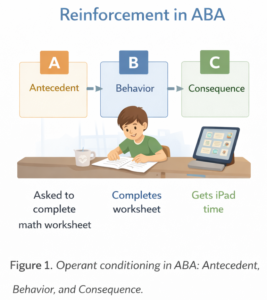
Reinforcement in ABA comes from operant conditioning and the ABC model:
- Antecedent – what happens right before the behavior.
- Behavior – what the individual does.
- Consequence – what happens right after the behavior.
When the consequence strengthens the behavior (increases its future likelihood), we call that consequence a reinforcer.
Types of Reinforcement in ABA
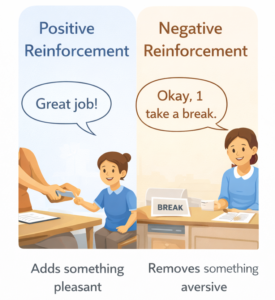
Reinforcement in ABA includes two main types: positive reinforcement and negative reinforcement. Both increase behavior; they differ in what happens in the environment.
Positive Reinforcement in ABA
Positive reinforcement means adding a stimulus after a behavior that makes the behavior more likely in the future. “Positive” means something is added.
Examples:
- A learner finishes a math worksheet and receives 5 minutes of iPad time → worksheet completion increases.
- A child greets a peer and receives enthusiastic praise → greetings increase over time.
Negative Reinforcement in ABA
Negative reinforcement means removing, reducing, or postponing an aversive stimulus after a behavior, which makes that behavior more likely in the future. “Negative” means something is taken away.
Examples:
- A student appropriately asks for a break; the teacher temporarily removes the task → use of the break request increases.
- A teen puts on headphones when the environment is loud; the noise level decreases → the teen is more likely to use headphones next time.
Negative reinforcement is not punishment. It still increases behavior, but it does so by providing relief instead of adding something pleasant.
Reinforcement vs Punishment
Reinforcement and punishment are both consequences in operant conditioning, but they have opposite effects:
- Reinforcement: behavior increases or is maintained.
- Punishment: behavior decreases over time.
Both reinforcement and punishment can be positive (adding a stimulus) or negative (removing a stimulus). On exam questions, always ask: “What happens to the behavior over time?” If it goes up, you are dealing with reinforcement.
Functions of Reinforcement in ABA Programs
Reinforcement in ABA is not just a definition to memorize; it serves several important functions in treatment.
Increasing Socially Significant Behavior
ABA is focused on socially significant behavior: communication, daily living skills, social skills, academic performance, and more. Reinforcement is how we make these behaviors happen more often.
Examples:
- Reinforcing functional communication instead of problem behavior.
- Reinforcing independent dressing, tooth-brushing, or toileting.
- Reinforcing appropriate play and peer interactions.
Shaping New Skills
Reinforcement is also used for shaping – reinforcing successive approximations toward a final target behavior.
Example:
- At first, reinforce any vocal attempt to request.
- Later, reinforce clearer words or full sentences.
- Over time, gradually require more accurate responses.
Shaping depends on carefully arranged reinforcement in ABA to move from “not yet” to “mastered.”
Maintaining Behavior and Promoting Generalization
Once a skill is learned, reinforcement helps maintain it and promote generalization across people, settings, and materials.
- Move from continuous reinforcement (every correct response is reinforced) to intermittent schedules.
- Pair more natural reinforcers (social attention, access to activities) with less natural ones (edibles, tokens).
- Reinforce use of the skill in new contexts: home, school, community.
Everyday Examples of Reinforcement in ABA
Here are some simple, exam-friendly examples that show reinforcement in ABA at work.
Example 1: Morning Routine Cooperation
Behavior: A child gets dressed independently within 10 minutes of being asked.
Consequence: The caregiver offers a choice of breakfast cereal and extra time to play before school.
Future effect: The child is more likely to get dressed quickly in the morning.
This is positive reinforcement (access to preferred items and activities) supporting a daily living skill.
Example 2: Using a Break Card Instead of Tantrums
Behavior: During a difficult worksheet, a learner hands over a break card.
Consequence: The teacher provides a 2-minute break from the task, then returns to work with support.
Future effect: The learner uses the break card more often, and tantrums decrease.
Here, negative reinforcement (removal of task demands) is arranged for an appropriate communication response instead of for problem behavior.
Example 3: Study Habits for BCBA® Candidates
Behavior: A BCBA® candidate studies for 30 focused minutes without checking their phone.
Consequence: They allow themselves a short break to scroll social media or have a snack.
Future effect: Focused study intervals become more frequent.
Reinforcement in ABA is not just for children; it also explains why adults maintain study habits, exercise, or work performance.
Using Reinforcement in ABA Treatment Plans
Effective reinforcement in ABA is planned and data-based, not random.
Step 1: Define the Target Behavior
Be specific and observable. Instead of “behaves better,” define targets like:
- “Raises hand before speaking in class.”
- “Uses a sentence to request help.”
- “Stays within 2 feet of the caregiver in the parking lot.”
Clear definitions make it easier to know when to deliver reinforcement.
Step 2: Identify Effective Reinforcers
Not every consequence works for every learner. Use simple preference assessments or observation to find what functions as reinforcement:
- Brief multiple-stimulus-without-replacement (MSWO) assessments.
- Asking caregivers what the learner enjoys.
- Watching what the learner chooses during free time.
Remember: a stimulus is only a reinforcer if it actually increases behavior.
Step 3: Decide on Reinforcement Schedules
At the start of teaching, you may use:
- Continuous reinforcement (CRF): reinforce each correct response.
Later, move to intermittent schedules:
- Fixed ratio (FR), variable ratio (VR), fixed interval (FI), or variable interval (VI) schedules.
Thinning reinforcement schedules helps behavior maintain over time and look more like everyday life.
Step 4: Combine Reinforcement with Differential Reinforcement
Differential reinforcement means:
- Reinforce desired behavior (or a replacement behavior).
- Withhold reinforcement for problem behavior.
Examples:
- DRA (Differential reinforcement of alternative behavior): reinforce asking for help instead of yelling.
- DRO (Differential reinforcement of other behavior): reinforce absence of a specific problem behavior for a period of time.
- DRL/DRH: reinforce lower or higher rates of a response.
Reinforcement in ABA is the engine that makes differential reinforcement procedures work.
Common BCBA® Exam Traps About Reinforcement in ABA
Many exam questions try to test your conceptual understanding of reinforcement in ABA. Here are common traps to watch for.
Trap 1: Reinforcement vs Bribery
Bribery usually refers to offering something to stop already-occurring misbehavior in the moment, often without a plan.
Reinforcement in ABA is planned, tied to specific behaviors, and focused on long-term behavior change. On exam questions, focus on whether the procedure is systematic and whether the target behavior increases over time.
Trap 2: Negative Reinforcement vs Punishment
Because “negative” sounds bad, many people mix up negative reinforcement and punishment.
- Negative reinforcement: behavior increases because something aversive is removed.
- Punishment (positive or negative): behavior decreases because of a consequence.
If the behavior goes up, you are looking at reinforcement, not punishment – even if the consequence involves escaping work or reducing nagging.
Trap 3: Assuming Something Is Reinforcing Without Data
A common error is to assume “stickers” or “praise” are reinforcers for every learner. For the exam and in practice, remember:
- Reinforcers are individualized.
- Reinforcement is defined by its effect on behavior.
If the behavior is not changing, you may need to adjust the reinforcer, schedule, or procedure.
Key Takeaways
- Reinforcement in ABA means a consequence follows a behavior and makes that behavior more likely to occur again in the future.
- Both positive reinforcement (adding something) and negative reinforcement (removing something aversive) can strengthen behavior.
- Reinforcement is central to building socially significant skills, shaping new behavior, maintaining progress, and designing effective ABA treatment plans.
- On the BCBA® exam, always focus on what happens to the behavior over time, not whether the consequence looks “nice” or “negative.”
- When in doubt, ask: “Did this consequence increase or maintain the behavior?” If yes, you are looking at reinforcement in ABA.