
RBT and ABAT Ethics Code: Core Principles and Real-World Application
As an entry-level behavior technician preparing for the RBT or ABAT credential, one of the most important topics you must master is ethics. The Ethics Code is not just a checklist — it defines how behavior technicians work with clients, families, and supervisors, and how they uphold the values of Applied Behavior Analysis (ABA) in everyday practice. This article breaks down the most current Ethics Code for RBTs and ABATs, explains the core principles, and gives practical examples to help you apply them on the job and on the exam.
What Is the Ethics Code for RBTs and ABATs?
If you are pursuing the Registered Behavior Technician® (RBT®) credential from the Behavior Analyst Certification Board (BACB), your work must follow the RBT Ethics Code (2.0), which became effective on January 1, 2022. It applies to all RBTs, including those pursuing certification and those already credentialed.
Download the full BACB RBT Ethics Code 2.0 here:
https://www.bacb.com/wp-content/uploads/2020/11/RBT-Ethics-Code-2.0-201218.pdf
(bacb.com)
If you are becoming certified through the Qualified Applied Behavior Analysis Credentialing Board (QABA) as an ABAT® (Applied Behavior Analysis Technician), you follow the ABAT Ethics Code, which is modeled closely after BACB standards but maintained by QABA.
Download the full QABA Ethics Code here:
https://qababoard.com/ethics/
(qababoard.com)
Why Does the Ethics Code Matter?
The Ethics Code defines how behavior technicians should behave in the workplace, with clients, and within the ABA field. It ensures:
-
Client dignity and safety
-
Professional boundaries
-
Accurate data and documentation
-
Ethical communication and conduct
-
Appropriate use of behavior-analytic procedures
-
Collaboration with supervisors and team members
Whether you’re an RBT or ABAT, violating the code can result in disciplinary action, loss of certification, and harm to your clients.
Key Sections of the RBT Ethics Code (2.0)
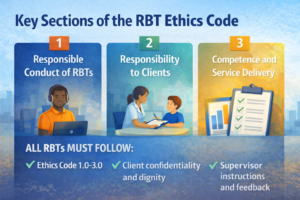
The BACB organizes the RBT Ethics Code into three sections:
Section 1: Responsible Conduct of RBTs
This section outlines personal and professional conduct. You must:
-
Practice only within your training and competence
-
Follow all laws, regulations, and policies
-
Maintain client dignity and respect
-
Avoid dual relationships and conflicts of interest
-
Accurately represent your RBT credential
Example for exam or training:
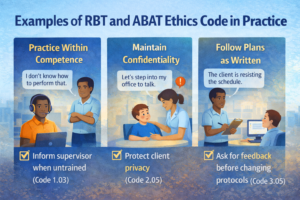
An RBT is asked to perform a behavior plan task they haven’t been trained on. Ethically, they must immediately inform the supervisor and not perform tasks outside their competence (Code 1.03).
Section 2: Responsibility to Clients
This section is about the relationship between the RBT and the client. RBTs must:
-
Prioritize the client’s welfare
-
Respect client rights and preferences
-
Maintain confidentiality
-
Avoid making treatment decisions independently
-
Report concerns about client safety
Example:
An RBT discusses a client’s behavior loudly in a hallway. This violates Code 2.05: Protect Confidential Information, which requires discretion when discussing cases.
Section 3: Competence and Service Delivery
This section applies to service quality. RBTs must:
-
Follow behavior plans as written
-
Collect and record accurate data
-
Promptly report changes in client behavior
-
Only implement procedures they were trained in
-
Ask for feedback and maintain supervision
Example:
An RBT notices a client is reacting negatively to a reinforcement schedule. They should document the behavior, inform the supervisor, and not change the protocol without approval (Code 3.05).
ABAT Ethics Code: Similar Foundations, Different Organization
If you are training for ABAT under QABA, the ethics code has four domains:
-
Professional Behavior
-
Responsibility to Clients
-
Conduct with Colleagues
-
Documentation and Accountability
While structured slightly differently from the BACB code, the ethical expectations are highly aligned — both emphasize:
-
Acting within training limits
-
Following plans as written
-
Protecting confidentiality
-
Upholding respect and professionalism
ABAT Ethics FAQs and resources:
https://qababoard.com/faqs/
Ethics and the RBT/ABAT Exams: What to Expect
You will see multiple ethics-based questions on the RBT or ABAT exam. They often involve:
-
Recognizing a violation of the Ethics Code
-
Choosing the most ethical response
-
Identifying appropriate reporting steps
-
Understanding professional boundaries
-
Distinguishing between ethical and unethical interactions
Study tips:
-
Memorize key codes and know what they mean in practice
-
Focus on gray area situations like social media, client gifts, or texting
-
Know the supervision chain of command — you never act independently
Mock exam question samples:
https://appliedbehavioranalysisedu.org/rbt-practice-exam/
(appliedbehavioranalysisedu.org)
Helpful Study Resources
Use these official and free tools to prepare:
-
RBT Ethics Code 2.0 PDF: https://www.bacb.com/wp-content/uploads/2020/11/RBT-Ethics-Code-2.0-201218.pdf
-
BACB RBT Handbook: https://www.bacb.com/wp-content/uploads/RBTHandbook_2401.pdf
-
QABA Ethics Code: https://qababoard.com/ethics/
-
Free RBT Flashcards on Quizlet: https://quizlet.com/619429190/rbt-ethics-code-20-flash-cards/
-
RBT and ABAT training providers (course + supervision): https://autismpartnershipfoundation.org/free-rbt-training/
Final Thoughts
Whether you’re pursuing RBT or ABAT certification, understanding and applying the Ethics Code is a core part of your role. It helps protect clients, guide your decisions, and shape your identity as a professional in the field of ABA.
Start by reviewing your code line by line, discuss examples with your supervisor, and test your knowledge with scenario-based mock questions. Ethics is more than a set of rules — it’s the foundation of effective, responsible, and human-centered ABA.


