Radical Behaviorism vs Methodological Behaviorism: What’s the Difference and Why It Matters for the Exam
By BCBA Mock Exam
Introduction
If you’re preparing for the BCBA® exam, you’ll see references to radical behaviorism and methodological behaviorism—especially in questions about philosophy, private events, and how ABA views “thoughts” and “feelings.”
Good news: you don’t need to be a philosopher to get these questions right. You just need to clearly understand:
-
What methodological behaviorism focuses on
-
What radical behaviorism adds
-
Why radical behaviorism is the philosophical foundation of ABA
-
How the exam uses this distinction in scenario questions
In this article, we’ll:
-
Define methodological vs radical behaviorism in plain language
-
Highlight their key differences with simple examples
-
Connect radical behaviorism to private events, verbal behavior, and ABA practice
-
Walk through common BCBA® exam traps and sample questions.
1. Big Picture: What Are We Comparing?
Both methodological and radical behaviorism are behaviorist positions, meaning they emphasize behavior and environmental variables rather than hypothetical inner causes.
However, they differ in how they treat private events (like thoughts, feelings, sensations) and what counts as “acceptable” subject matter for science.
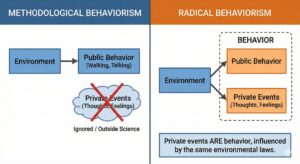
Very short version:
-
Methodological behaviorism: Only publicly observable behavior is included in the science of behavior.
-
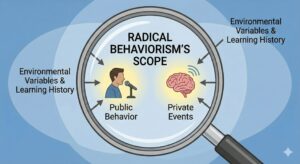
Radical behaviorism (Skinner’s position): Private events (thinking, feeling, sensory experiences) are behavior too, and can be included as long as we analyze them in the same functional way—without treating them as mystical causes.
The BCBA® exam is built on radical behaviorism, so that’s the viewpoint you’re expected to use.
2. Methodological Behaviorism: Only What We Can See
Methodological behaviorism is an earlier form of behaviorism that restricted psychology to publicly observable events.
Core ideas:
-
Psychology should be objective, so it should only study behavior that can be observed and measured by an external observer.
-
Private events (thoughts, feelings) are either:
-
Ignored, or
-
Inferred from what we can see, but not directly analyzed as behavior.
-
Example of a methodological behaviorist stance:
-
“We see that the person is pacing and shouting. We record and analyze those observable behaviors. What they say they’re thinking or feeling is outside the scope of behavioral science.”
Why this matters for the exam:
-
Methodological behaviorism may appear in questions as a contrast to radical behaviorism.
-
If an answer choice says that thoughts and feelings “cannot be part of a behavioral analysis at all” or must be completely ignored, that’s more consistent with methodological behaviorism than with modern ABA.
3. Radical Behaviorism: Private Events Are Behavior Too
Radical behaviorism, associated with B. F. Skinner, is the philosophical foundation of ABA.
Core ideas:
-
Behavior includes everything an organism does, including private events:
-
Thinking
-
Feeling
-
Seeing, hearing, bodily sensations
-
-
Private events are real, but they are not special causes that sit outside the environment–behavior relationship.
-
We analyze private events using the same basic principles:
-
Reinforcement and punishment
-
Stimulus control
-
Motivating operations
-
History of interaction with the environment
-
Example of a radical behaviorist stance:
-
“When a client says they feel anxious, that verbal report and the private sensations are both behavior. We still focus on observable relations (e.g., what triggers avoidance, what reinforces it), but we don’t pretend private events don’t exist.”
Key point:
-
Radical behaviorism includes private events as behavior, but still treats them as part of the overall functional relation between environment and behavior—not as inner, independent causes.
4. Radical Behaviorism vs Mentalism
On the exam, radical behaviorism is often contrasted not only with methodological behaviorism, but also with mentalism.
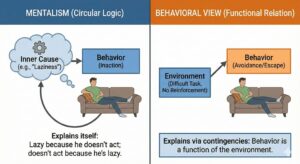
Mentalism:
-
Explains behavior by appealing to inner causes like “traits,” “attitudes,” or “unseen mental structures.”
-
Example: “He hit his sibling because he has an anger problem” or “She avoids work because she’s lazy.”
-
These explanations often relabel behavior rather than explaining it functionally.
Radical behaviorism:
-
Focuses on functional relations between behavior (public and private) and environment.
-
Example: “He hits his sibling when toys are removed; hitting has historically produced attention and toy return.” This explains the behavior in terms of antecedents and consequences.
Exam tip:
-
If an answer attributes behavior to vague traits (lazy, oppositional, unmotivated) with no environmental analysis, that’s mentalistic—not radical behaviorism.
5. Why Radical Behaviorism Is the Foundation of ABA
Applied behavior analysis is built on radical behaviorism because:
-
It allows a comprehensive view of behavior
-
We can analyze verbal reports (“I’m scared,” “I hate school”) as behavior.
-
We can consider how private events might be shaped by reinforcement and punishment.
-
-
It keeps the focus on functional relations
-
Even when private events are involved, we still look for environmental variables that influence behavior.
-
This keeps interventions grounded in observable changes we can actually measure and modify.
-
-
It lines up with ABA’s emphasis on measurable change
-
We may not directly measure private events, but we can measure:
-
Verbal behavior about private events
-
Observable behavior patterns that correlate with them
-
The impact of our interventions on those observable patterns.
-
-
For the exam, the take-home message is:
-
ABA = radical behaviorism, not methodological behaviorism, and definitely not mentalism.
6. How the BCBA® Exam Tests This Topic
Radical vs methodological behaviorism typically appears in:
-
Conceptual questions about philosophical assumptions
-
Items asking which statement is most consistent with radical behaviorism
-
Vignettes where a BCBA explains behavior using traits vs functional relations
-
Questions about whether private events are considered behavior in ABA
Common exam tasks:
-
Choose the statement that best reflects radical behaviorism
-
Identify the problem with a methodological or mentalistic explanation
-
Decide how a BCBA should respond when others describe behavior solely in terms of feelings or traits
Strategy:
-
Look for answer choices that:
-
Treat private events as behavior but not as independent causes
-
Emphasize observable, measurable behavior and environmental variables
-
Avoid vague mentalistic labels and trait-based explanations.
-
7. Common BCBA® Exam Traps
Trap 1 – “Radical” = “extreme” or “harsh”
-
On the exam, “radical” does not mean severe or punitive.
-
It refers to including all behavior (including private events) within a behavioral science.
Trap 2 – Saying private events “don’t exist”
-
Methodological behaviorism might ignore private events, but radical behaviorism does not deny them.
-
If an answer says “thoughts and feelings are not behavior and cannot be analyzed behaviorally,” it is not radical behaviorism.
Trap 3 – Treating thoughts and feelings as causes instead of behavior
-
Radical behaviorism treats private events as behavior that is influenced by the environment.
-
Statements like “He hits because he’s angry and that’s the cause” are mentalistic.
Trap 4 – Focusing only on public observables and omitting private events entirely
-
That leans toward methodological behaviorism.
Trap 5 – Overcomplicating the question
-
Many items are really asking a simple thing: Are private events included as behavior? Radical: yes; Methodological: no (or only indirectly).
8. Mini BCBA® Exam–Style Questions (With Explanations)
Question 1 – Private Events A BCBA explains to a teacher that when a student says they feel nervous before presentations, that verbal report and the private sensations described can be considered behavior, influenced by the student’s learning history and current context.
This explanation is MOST consistent with: A. Methodological behaviorism B. Radical behaviorism C. Structuralism D. Mentalism
Correct Answer: B – Radical behaviorism Explanation: The BCBA is treating private events as behavior that can be analyzed functionally, which reflects radical behaviorism.
Question 2 – Ignoring Private Events A psychologist states that only behaviors that can be directly observed by an outsider should be included in scientific analysis, and that talking about thoughts or feelings has no place in a behavioral science.
This position is MOST consistent with: A. Radical behaviorism B. Methodological behaviorism C. Applied behavior analysis D. Mentalism
Correct Answer: B – Methodological behaviorism Explanation: Restricting science to public observables and excluding private events from analysis describes methodological behaviorism.
Question 3 – Mentalistic vs Behavioral Explanations In a team meeting, a teacher says, “He refuses to do work because he’s lazy.” The BCBA responds by conducting a functional assessment and discovers that refusal behavior consistently results in escape from difficult tasks.
The BCBA’s approach BEST illustrates: A. A mentalistic explanation of behavior B. A radical behaviorist focus on environmental contingencies C. A methodological behaviorist focus on private events D. A rejection of behaviorism
Correct Answer: B – Radical behaviorist focus on environmental contingencies Explanation: The BCBA moves away from trait labels (lazy) and toward a functional analysis of behavior–environment relations.
Question 4 – Exam Philosophy A BCBA candidate is studying for the exam and asks, “Which philosophical stance underlies modern applied behavior analysis?”
What is the BEST answer? A. Methodological behaviorism B. Radical behaviorism C. Psychoanalytic theory D. Structuralism
Correct Answer: B – Radical behaviorism Explanation: Radical behaviorism is the philosophical foundation for ABA and the BCBA® exam content.
9. Key Takeaways
-
Methodological behaviorism: Limits scientific analysis to publicly observable behavior; tends to ignore or exclude private events.
-
Radical behaviorism: Includes private events (thoughts, feelings, sensations) as behavior, analyzed with the same basic principles as public behavior.
-
Radical behaviorism rejects mentalistic explanations and focuses on functional relations between behavior and environment.
-
ABA and the BCBA® exam are grounded in radical behaviorism, not methodological behaviorism.
-
On the exam, look for answers that:
-
Treat private events as behavior (not mystical causes)
-
Emphasize observable data and environmental variables
-
Avoid vague trait labels and inner “causes” that don’t specify contingencies.
-
Once you see that radical behaviorism simply widens the lens to include private events as behavior, the contrast with methodological behaviorism—and the correct answers on exam questions—becomes much clearer.