

Punishment in ABA: Ethical Use, Side Effects, and How It’s Tested on the BCBA® Exam
By BCBA Mock Exam
Introduction
Punishment in ABA is one of the most sensitive and heavily tested topics on the BCBA® exam.
In everyday language, “punishment” usually means something harsh or morally wrong. In ABA, punishment has a very specific, technical meaning: a consequence that decreases the future frequency of a behavior. The exam expects you to know that definition, but it also goes further.
BCBA® exam questions often ask whether:
-
A procedure is truly functioning as punishment
-
Side effects and risks are being monitored
-
Ethical standards are being followed (e.g., reinforcement first, consent, oversight)
-
A better, reinforcement-based alternative should be selected
This article will help you:
-
Review what punishment is—and what it isn’t—in ABA
-
Understand common side effects and risks
-
Connect punishment to BACB® ethics themes
-
See how punishment shows up in BCBA® exam scenarios
-
Practice reading “tricky” stems without getting lost in emotional details
By the end of this guide, you should be able to recognize punishment in ABA in real-life programs and BCBA® exam questions without getting tripped up by emotional language.
1. Quick Review: What Counts as Punishment in ABA?
In ABA, punishment in ABA is not about whether something seems harsh or unpleasant. It is defined by its effect on behavior over time.
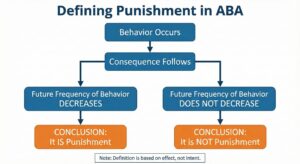
Technical definition: A consequence is punishment if it decreases the future frequency of a behavior.
Key points:
-
If the behavior does not decrease, the consequence is not functioning as punishment, regardless of intent.
-
Punishment can involve adding a stimulus (positive punishment) or removing a stimulus (negative punishment).
-
Whether a consequence feels “good” or “bad” is not part of the technical definition.
Contrast with reinforcement:
-
Reinforcement → behavior increases in the future
-
Punishment → behavior decreases in the future
Exam tip: When you see a scenario, always ask: What happened to the behavior over time? If it went down, the consequence may be punishment; if it went up, think reinforcement instead.
2. Positive vs Negative Punishment (Brief Review)
Punishment procedures are classified as positive or negative based on what happens to the stimulus, not on whether the procedure seems “nice” or “mean.”
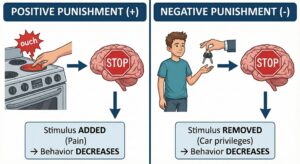
Positive punishment
-
A stimulus is added after a behavior
-
Behavior decreases in the future
Examples:
-
A child touches a hot stove → feels pain → touching the stove decreases
-
A student talks out; the teacher gives a firm reprimand → talking out decreases across the week
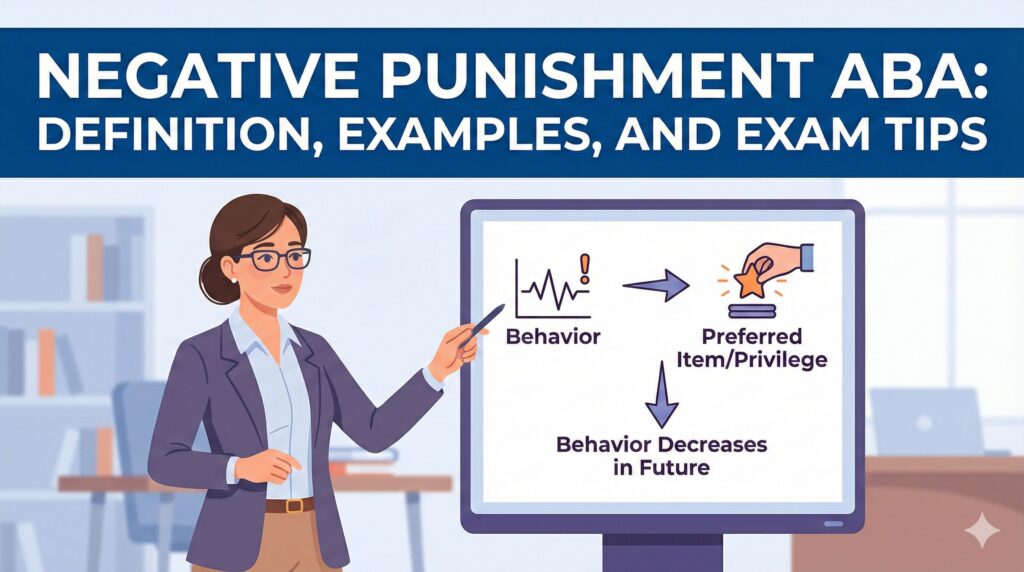
Negative punishment
-
A stimulus is removed after a behavior
-
Behavior decreases in the future
Examples:
-
A teenager breaks curfew; car privileges are removed for a week → curfew violations decrease
-
A child hits a sibling; access to a preferred toy is removed → hitting decreases
Exam tip: On the BCBA® exam, positive vs negative punishment often appears in contrast to negative reinforcement. Remember:
-
Negative punishment: remove a reinforcer → target behavior decreases
-
Negative reinforcement: remove an aversive → target behavior increases
3. Ethical Foundations: Why Punishment Is a Last Resort
The BACB® Ethics Code emphasizes that BCBAs should prioritize reinforcement-based procedures and use punishment only when necessary and with appropriate safeguards.
Common ethical themes related to punishment:
-
Least restrictive, most effective procedures: Use differential reinforcement, skill building, and environmental changes first.
-
Clear justification: Punishment should be considered only when:
-
Less intrusive procedures have been attempted and documented, and
-
The behavior is severe or dangerous, or significantly impairs quality of life.
-
-
Informed consent: Caregivers (and the client when appropriate) should understand:
-
What the procedure involves
-
Potential risks and side effects
-
Alternative options
-
-
Oversight and review: Many agencies require:
-
Clinical review by a behavior committee
-
Supervisory approval
-
Ongoing data review
-
-
Human dignity and respect: Procedures must avoid humiliation, abuse, or unnecessary restriction.
Exam tip: When answer choices include a punishment-heavy approach versus a reinforcement-based alternative that still addresses safety, the reinforcement-first option is usually better aligned with ethics.
Punishment in ABA must always be considered within an ethical framework, not just as a technical behavior-reduction tool.
4. Known Side Effects and Risks of Punishment
Punishment procedures can produce undesirable side effects, especially when they are intense, poorly planned, or used without reinforcement of alternative behaviors.
Common side effects to watch for (and that show up on the exam):
-
Emotional responding: Crying, aggression, fear, or other strong emotional reactions
-
Escape and avoidance: The learner may avoid the person, setting, or materials associated with punishment
-
Modeling of aggression: Individuals may imitate punitive behavior in other contexts
-
Behavioral contrast: Behavior decreases in the context where punishment is applied but increases in settings where it is not
-
Suppression without skill building: The target behavior decreases, but no appropriate replacement skill has been taught
Exam tip: If a stem describes increased fear, avoidance of the therapist, or new aggressive behavior after punishment is introduced, the best answer often involves:
-
Reducing or discontinuing the punishment procedure
-
Strengthening reinforcement for alternative behaviors
-
Re-evaluating the overall treatment plan and ethical implications.
5. Designing Punishment Procedures Responsibly
When punishment is used, it should be part of a comprehensive, ethically sound plan—not a stand-alone reaction.
Key components of responsible punishment use:
-
Functional assessment first
-
Identify the function of the target behavior
-
Rule out medical issues or skill deficits
-
-
Reinforcement for alternative behaviors
-
Use DRA, DRI, DRO, or DRL to build appropriate responses
-
Ensure the learner has an effective way to access reinforcement
-
-
Clear operational definitions
-
Define exactly which behavior will contact punishment
-
Ensure all staff can identify behaviors consistently
-
-
Consistency and training
-
Train caregivers and staff thoroughly on when and how to implement the procedure
-
Use treatment integrity checks
-
-
Data-based decision making
-
Collect data on both target behavior and side effects
-
Adjust the plan if behavior is not improving or side effects are significant
-
-
Fade and replace
-
Plan to fade punishment as quickly as possible
-
Shift the primary focus to reinforcement and skill acquisition
-
Exam tip: Options that add functional assessment, reinforcement for alternative behavior, and monitoring for side effects are almost always safer and more behavior-analytic than options that simply intensify punishment.
6. Punishment vs Extinction vs Negative Reinforcement on the Exam
The BCBA® exam loves to test your ability to distinguish punishment from extinction and negative reinforcement.
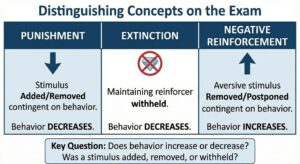
Punishment
-
Add or remove a stimulus after behavior
-
Behavior decreases in the future
Extinction
-
The maintaining reinforcer is withheld (no longer delivered) for a previously reinforced behavior
-
Behavior decreases over time
-
No new aversive is added; no new preferred stimulus is removed—reinforcement is simply no longer available
Negative reinforcement
-
A stimulus is removed or postponed after behavior
-
Behavior increases in the future because it escapes or avoids something aversive
Exam tip: Ask yourself:
-
Which behavior am I analyzing?
-
Did that behavior increase or decrease?
-
Was something added, removed, or withheld?
Many exam traps hinge on candidates labeling a procedure as “punishment” simply because it looks unpleasant. Always return to the effect on behavior and whether reinforcement is being withheld (extinction) or an aversive is being removed (negative reinforcement).
7. How Punishment Shows Up in BCBA® Exam Scenarios
Punishment rarely appears on the exam as a simple definition question. More often, you will see:
-
Case vignettes involving self-injury, aggression, property destruction, or disruptive behavior
-
Descriptions of response cost, time-out, or reprimands
-
Questions about ethical decision-making (e.g., “What should the BCBA do next?”)
-
Items asking you to interpret side effects (emotional responding, avoidance, contrast)
Common exam themes:
-
A team wants to introduce a punishment procedure quickly
-
A BCBA has not yet conducted a functional assessment
-
There is little or no mention of reinforcement for alternative behavior
-
Caregivers or staff are inconsistent or untrained
In these questions, the best answers usually involve:
-
Slowing down to conduct assessment
-
Prioritizing reinforcement-based strategies
-
Obtaining consent and oversight
-
Monitoring and adjusting based on data
-
Explicitly considering side effects and client dignity
8. Common BCBA® Exam Traps Around Punishment
Trap 1 – Equating “unpleasant” with punishment
-
Just because a consequence seems aversive does not mean it is punishment.
-
If behavior does not decrease, it is not technically punishment.
Trap 2 – Ignoring ethical requirements
-
Answers that jump straight to stronger punishment without assessment, consent, or reinforcement-based alternatives are rarely correct.
Trap 3 – Confusing negative punishment with negative reinforcement
-
Both involve removal of a stimulus.
-
Behavior decreases → negative punishment
-
Behavior increases → negative reinforcement
Trap 4 – Confusing punishment with extinction
-
Extinction: stop delivering the reinforcer that maintained the behavior.
-
Punishment: add/remove a stimulus contingent on behavior to decrease it.
Trap 5 – Focusing only on short-term suppression
-
A stem may show immediate behavior reduction, but also serious side effects.
-
The exam often expects you to select options that balance effectiveness with ethics, safety, and long-term outcomes.
9. Mini BCBA® Exam–Style Questions (With Explanations)
Question 1 – Is It Punishment? A BCBA implements a response-cost procedure: each time a client swears loudly during group, one token is removed from their token board. Over three weeks, data show that swearing has not decreased.
Which conclusion is MOST accurate? A. The procedure is negative punishment because tokens are removed B. The procedure is not functioning as punishment because the target behavior has not decreased C. The procedure is positive reinforcement for swearing D. The procedure is extinction for swearing
Correct Answer: B Explanation: Even though the intent was negative punishment, the behavior did not decrease. By definition, the consequence is not functioning as punishment.
Question 2 – Ethical Decision-Making A school team requests that a BCBA design a time-out procedure for a student’s mild off-task behavior (e.g., doodling, looking out the window). No functional assessment has been conducted, and there is no existing reinforcement program for on-task behavior.
What is the BEST action for the BCBA to take next? A. Implement time-out immediately, then add reinforcement later if needed B. Refuse any intervention until the team stops requesting punishment C. Conduct a functional assessment and develop a reinforcement-based intervention for on-task behavior before considering time-out D. Design a more intense punishment procedure to ensure rapid suppression
Correct Answer: C Explanation: Ethics and best practice require assessment and reinforcement-based procedures first, especially for mild behaviors.
Question 3 – Side Effects of Punishment A child engages in property destruction at home. The BCBA designs a brief, clearly defined time-out procedure combined with DRA for appropriate requests. After implementation, property destruction decreases, but the child begins to refuse to enter the therapy room and cries when the BCBA arrives.
Which is the BEST next step? A. Increase the duration of time-out to speed up progress B. Ignore the new behaviors, since the target behavior decreased C. Re-evaluate the plan to reduce reliance on time-out, increase reinforcement for alternative behavior, and address the avoidance of the BCBA D. Conclude the procedure is fully successful and terminate services
Correct Answer: C Explanation: Avoidance of the BCBA and setting suggests problematic side effects. The plan should be adjusted to minimize aversiveness and focus more on reinforcement.
10. Key Takeaways
Punishment in ABA is defined by its effect on future behavior, and ethical practice requires pairing it with reinforcement and careful monitoring.
-
In ABA, punishment is defined by its effect on behavior, not by how it looks or feels.
-
Positive punishment adds a stimulus; negative punishment removes one—but both must lead to behavior decrease to qualify.
-
Ethical practice requires: assessment, reinforcement-based strategies first, informed consent, oversight, and ongoing monitoring of side effects.
-
Punishment is best used as part of a broader plan that includes teaching appropriate alternative behaviors and planning to fade punishment.
-
On the BCBA® exam, look for answers that:
-
Use clear behavioral definitions and data
-
Avoid unnecessary or poorly justified punishment
-
Address side effects and client dignity
-
Emphasize reinforcement, skill building, and ethical safeguards.
-
Understanding punishment from both a technical and ethical perspective will help you choose better answers on the exam—and design safer, more effective interventions in real practice.


Pingback: Positive Punishment ABA Explained (Examples + Exam Tips)