
Understanding the distinction between positive and negative reinforcement is fundamental to applied behavior analysis and essential for BCBA exam success. These concepts form the bedrock of behavior change strategies, yet they remain common sources of confusion for many candidates. This guide provides clear definitions, practical examples, and exam-focused strategies to help you master this critical topic.
Table of Contents
- positive and negative reinforcement: Defining the Core Concepts
- Applied Examples: From Theory to Practice
- Exam Relevance and Common Traps
- Quick Reinforcement Identification Checklist
- Summary and Key Takeaways
- References
positive and negative reinforcement: Defining the Core Concepts
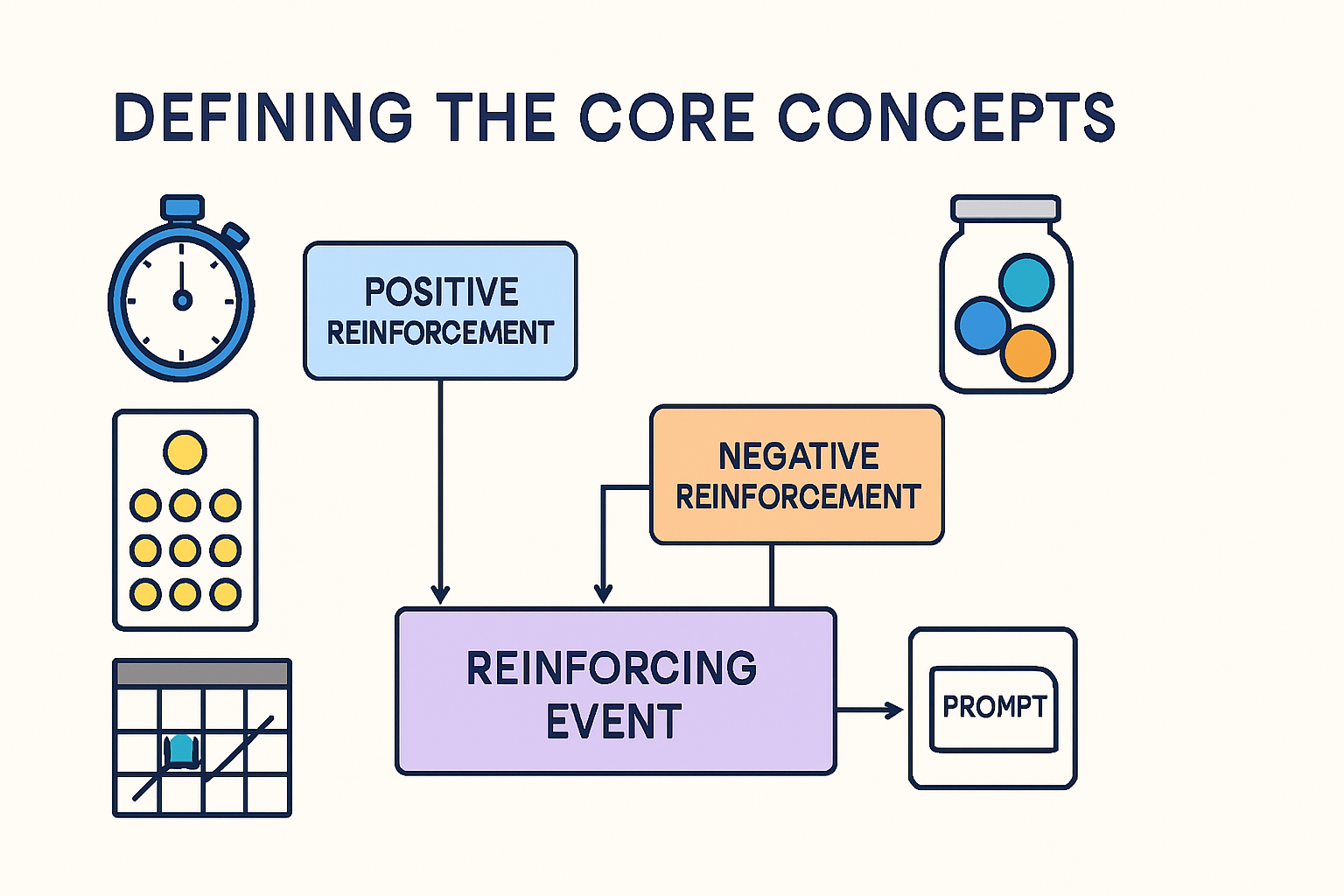
Before analyzing examples, establish precise operational definitions. Both reinforcement procedures increase behavior, but they differ in how consequences are delivered.
What is Positive Reinforcement?
Positive reinforcement occurs when a stimulus is added following a behavior, which increases the future likelihood of that behavior. The added stimulus is called a reinforcer. Remember that reinforcement is defined by its effect on behavior, not by whether the stimulus seems pleasant or desirable.
For example, when a child completes homework and receives praise from a parent, the praise (added stimulus) makes homework completion more likely in the future. The praise functions as a positive reinforcer.
What is Negative Reinforcement?
Negative reinforcement occurs when a stimulus is removed or avoided following a behavior, which increases the future likelihood of that behavior. The term ‘negative’ refers to subtraction, not to something bad or punitive. This concept includes two subtypes: escape (removing an ongoing aversive) and avoidance (preventing an aversive from occurring).
For instance, when someone takes aspirin to relieve a headache, the removal of pain (aversive stimulus) makes aspirin-taking more likely when headaches occur. This is escape behavior maintained by negative reinforcement.
Applied Examples: From Theory to Practice
Translating definitions into practice requires analyzing complete ABC contingencies. Let’s examine three detailed scenarios.
Example 1: Positive Reinforcement in an Academic Setting
Consider a student struggling with math problems during independent work time.
- Antecedent: Difficult math worksheet presented
- Behavior: Student raises hand and asks for help
- Consequence: Teacher provides step-by-step assistance (stimulus added)
- Future effect: Help-seeking increases during math work
- Hypothesized function: Access to adult attention/tangible assistance
The teacher’s assistance serves as a positive reinforcer because it’s added after the behavior and increases its future occurrence.
Example 2: Negative Reinforcement (Escape) in a Home Setting
Imagine a child with sensory sensitivities in a noisy environment.
- Antecedent: Loud television and multiple conversations in living room
- Behavior: Child puts on noise-canceling headphones
- Consequence: Aversive auditory stimulation is removed
- Future effect: Headphone-wearing increases in loud environments
- Hypothesized function: Escape from aversive sensory input
This demonstrates escape behavior maintained by negative reinforcement. The removal of the aversive stimulus strengthens the behavior.
Example 3: Negative Reinforcement (Avoidance) in a Clinical Session
Consider a client during therapy who engages in specific verbal behavior.
- Antecedent: Therapist presents non-preferred handwriting task
- Behavior: Client says ‘My hand hurts, I can’t write today’
- Consequence: Task demand is postponed (aversive avoided)
- Future effect: Complaints about physical discomfort increase before demands
- Hypothesized function: Avoidance of non-preferred academic task
This illustrates avoidance behavior, where the behavior prevents the aversive stimulus from occurring at all. Both escape and avoidance are types of negative reinforcement.
Exam Relevance and Common Traps
BCBA exam questions frequently test your ability to distinguish reinforcement types and avoid common misconceptions. Understanding these traps can prevent costly errors.
Trap 1: Confusing Negative Reinforcement with Punishment
The most frequent error involves mixing up these fundamentally different processes. Negative reinforcement increases behavior by removing something, while punishment decreases behavior (either by adding something or removing something). The shared word ‘negative’ creates confusion, but remember: reinforcement always increases behavior.
For example, taking a time-out to escape social demands involves negative reinforcement (behavior increases), while receiving a time-out for aggression involves punishment (behavior decreases). Our guide on positive vs. negative punishment explores the punishment side in detail.
Trap 2: Misidentifying the ‘Negative’ Stimulus
Candidates often struggle to identify what’s being removed in negative reinforcement scenarios. The aversive stimulus must be present or impending before the behavior occurs. Ask yourself: ‘What unpleasant thing goes away because of this behavior?’
Common aversive stimuli include demands, social situations, sensory input, or academic tasks. Correct identification requires analyzing the three-term contingency carefully.
Trap 3: Over-relying on Colloquial Meanings
In everyday language, ‘positive’ means good and ‘negative’ means bad. In behavior analysis, these terms describe mathematical operations: addition (+) and subtraction (-). A positive reinforcer could theoretically be something unpleasant if its addition increases behavior (though this is rare in practice).
Focus on the operational definitions: addition versus removal, not good versus bad. This conceptual understanding aligns with the philosophical assumptions of behavior analysis.
Quick Reinforcement Identification Checklist
Use this systematic approach when analyzing exam questions or real-world scenarios:
- Step 1: Identify the target behavior that changed in frequency
- Step 2: Determine if the behavior increased (reinforcement) or decreased (punishment)
- Step 3: If reinforcement, ask: Was something added (positive) or removed (negative)?
- Step 4: For negative reinforcement, identify the aversive stimulus that was removed or avoided
- Step 5: Verify the consequence immediately followed the behavior
- Step 6: Consider alternative explanations and rule out other behavioral functions
Summary and Key Takeaways
Mastering reinforcement concepts requires moving beyond memorization to applied understanding. Remember these essential points:
- Both positive and negative reinforcement increase behavior frequency
- Positive means addition; negative means removal or avoidance
- Negative reinforcement is NOT punishment – reinforcement always increases behavior
- Identify the specific stimulus being added or removed in each scenario
- Practice analyzing complete ABC contingencies with varied examples
- Apply the systematic checklist approach to exam questions
For further study, explore related concepts like motivating operations and reinforcement schedules. Consistent practice with varied examples will solidify your understanding of these fundamental behavior analytic principles.


