

Operational definition setting event: Defining the Core Concepts
Understanding the relationship between operational definitions and setting events is essential for accurate behavior assessment. These concepts work together to provide a complete picture of why behaviors occur in specific contexts.
Table of Contents
- Operational definition setting event: Defining the Core Concepts
- Applied Examples: From ABC to Function
- Exam Relevance and Common Traps
- Quick Checklist for Practitioners and Exam-Takers
- Summary and Key Takeaways
What is an Operational Definition?
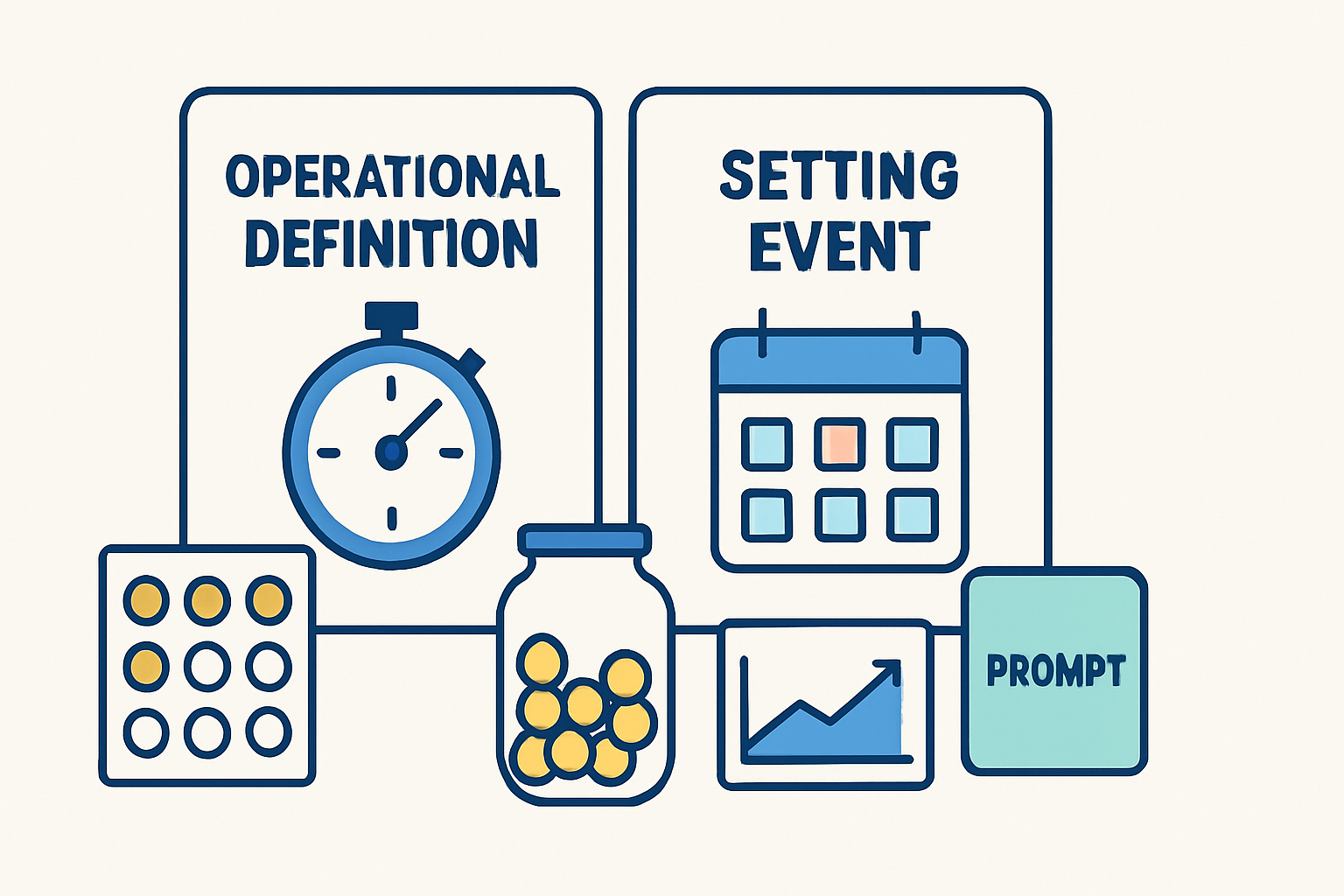
An operational definition is an objective, clear, and complete description of a behavior that allows for reliable measurement and observation. It must be measurable and repeatable by different observers, avoiding subjective interpretations or inferences about internal states.
Effective operational definitions focus on observable actions rather than intentions or emotions. For example, ‘crying’ might be defined as ‘vocalizations above 60 decibels with tears visible on cheeks’ rather than ‘feeling sad.’
What is a Setting Event?
A setting event is an environmental or biological condition that temporarily alters the value of a reinforcer or punisher, influencing the likelihood of behavior. Unlike immediate antecedents like discriminative stimuli, setting events occur earlier and create a context that affects behavior throughout a session or day.
Common examples include sleep deprivation, missed medication, hunger, or social conflicts that occurred hours before the target behavior. These events change how an individual responds to typical environmental contingencies.
How Setting Events Influence Behavioral Definitions
While the topography of a behavior (the physical action) may stay constant across situations, the context provided by setting events often determines whether a behavior is problematic or requires intervention. A behavior might only meet criteria for intervention when specific setting events are present.
For instance, task refusal might be defined differently when it occurs after adequate sleep versus following a night of poor rest. The setting event provides crucial information about behavioral function and appropriate intervention strategies.
Applied Examples: From ABC to Function
Real-world scenarios demonstrate how setting events interact with operational definitions to inform assessment and intervention planning. These examples show the practical application of both concepts in ABC data collection.
Example 1: Elopement After Missed Medication
Operational Definition: ‘Client moving more than 10 feet away from the assigned adult or designated activity area without permission during a group lesson.’
Setting Event: Client did not take morning ADHD medication.
ABC Data: Antecedent – Teacher gives math worksheet; Behavior – Elopement as defined; Consequence – Teacher follows and redirects to seat.
Hypothesized Function: Escape from academic demands, with the missed medication increasing the aversiveness of task demands.
Example 2: Aggression Following Sleep Deprivation
Operational Definition: ‘Making forceful contact with an open or closed hand against another person’s body or clothing.’
Setting Event: Client had less than 5 hours of sleep the previous night.
ABC Data: Antecedent – Peer takes preferred toy; Behavior – Hitting peer’s arm; Consequence – Adult removes toy from peer and gives to client.
Hypothesized Function: Access to tangible items, with sleep deprivation increasing the reinforcing value of preferred items.
Example 3: Task Refusal During Peer Conflict
Operational Definition: ‘Verbally stating “no,” “I won’t,” or pushing academic materials off the desk when given a directive.’
Setting Event: Client had an argument with a peer on the bus before school.
ABC Data: Antecedent – Teacher asks to begin writing assignment; Behavior – Pushes papers off desk; Consequence – Teacher provides one-on-one attention and simplified task.
Hypothesized Function: Escape from demands with possible access to adult attention, amplified by the earlier social conflict.
Exam Relevance and Common Traps
The BCBA exam frequently tests your ability to distinguish between these concepts and apply them correctly in assessment scenarios. Understanding common exam traps can help you avoid costly mistakes.
How the BCBA Exam Tests These Concepts
Exam questions may present scenarios where you must identify the best operational definition from multiple choices, often including options that are too vague or infer mental states. Other questions ask you to distinguish between setting events and immediate antecedents, or select interventions that appropriately address setting event influences.
You might encounter questions about data patterns that only make sense when setting events are considered, or be asked to identify which component of an ABC recording form would include setting event information.
Frequent Mistakes and Misconceptions
- Confusing setting events with discriminative stimuli: Remember that SDs signal availability of reinforcement, while setting events alter the value of consequences.
- Writing subjective operational definitions: Avoid terms like ‘angry,’ ‘frustrated,’ or ‘bored’ that require inference about internal states.
- Overlooking setting events in data analysis: Failing to consider setting events when analyzing behavior patterns across days or weeks.
- Treating setting events as excuses rather than variables: Setting events are environmental factors to address, not justifications for behavior.
Quick Checklist for Practitioners and Exam-Takers
Use this practical checklist to ensure you’re correctly applying both concepts in assessment and exam preparation:
- Verify operational definition objectivity: Can two independent observers reliably identify occurrences?
- Check for measurable criteria: Does the definition include observable, countable elements?
- Identify potential setting events: What environmental or biological factors preceded the session?
- Document setting events consistently: Include them in ABC data collection forms.
- Analyze patterns with setting events: Look for correlations between specific events and behavior frequency.
- Consider setting events in intervention planning: Address modifiable setting events as part of comprehensive treatment.
- Review common exam distractors: Practice distinguishing between well-written and poorly-written operational definitions.
Summary and Key Takeaways
Operational definitions and setting events work together to provide a complete understanding of behavior. While operational definitions describe what the behavior looks like, setting events explain why it might be more likely to occur in certain contexts.
For the BCBA exam, remember that the best operational definitions are objective, measurable, and repeatable. Setting events are distinct from immediate antecedents and should be documented separately in assessment data. When analyzing behavior patterns, always consider whether setting event influences might explain variability across sessions.
In practice, addressing modifiable setting events can be as important as intervening on immediate antecedents and consequences. A comprehensive functional behavior assessment should include investigation of both immediate and distant variables affecting behavior.
For more information on related concepts, see our guides on antecedent interventions and motivating operations. The BACB Ethics Code also emphasizes the importance of thorough assessment and appropriate intervention selection based on comprehensive data.


