
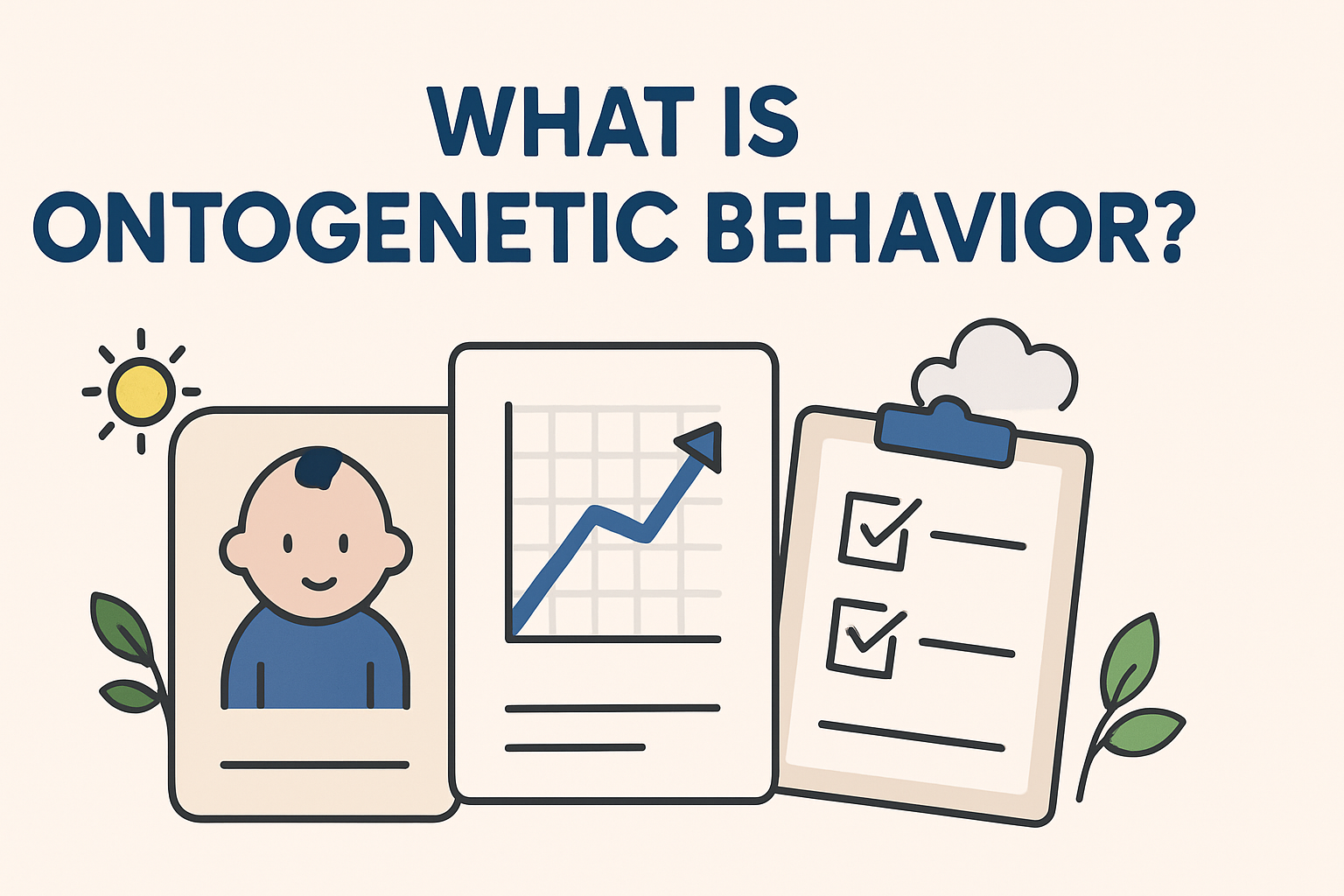
What is Ontogenetic Behavior?
In applied behavior analysis, ontogenetic behavior refers to skills and responses that develop through an individual’s unique learning history. These are behaviors acquired during one’s lifetime through interaction with the environment.
Table of Contents
- What is Ontogenetic Behavior?
- Ontogenetic Behavior in Practice: ABA Examples
- Ontogenetic Concepts on the BCBA Exam
- Quick Checklist for Clinical and Exam Analysis
- Summary and Key Takeaways
This concept is fundamental because it distinguishes between behaviors we’re born with and those we learn. Understanding this difference helps BCBA candidates target changeable behaviors effectively.
A Formal Definition for the BCBA Exam
Ontogenetic behavior encompasses both operant and respondent behaviors shaped by personal experience. Operant behaviors are strengthened or weakened by their consequences, while respondent behaviors involve conditioned responses to previously neutral stimuli.
The key distinction lies in the origin: ontogenetic behaviors develop through the individual’s lifetime, not through genetic inheritance. This makes them the primary focus of ABA interventions since they can be modified through systematic programming.
Ontogenetic vs. Phylogenetic: The Critical Distinction
Understanding this contrast is essential for exam success. Phylogenetic behavior refers to species-specific, inherited responses that appear without learning. These are reflexive and consistent across members of a species.
- Phylogenetic examples: Startle reflex, pupil constriction to light, salivation to food presentation
- Ontogenetic examples: Language acquisition, social skills, phobias, academic behaviors
- Key difference: Phylogenetic is unlearned and universal; ontogenetic is learned and individual
Ontogenetic Behavior in Practice: ABA Examples
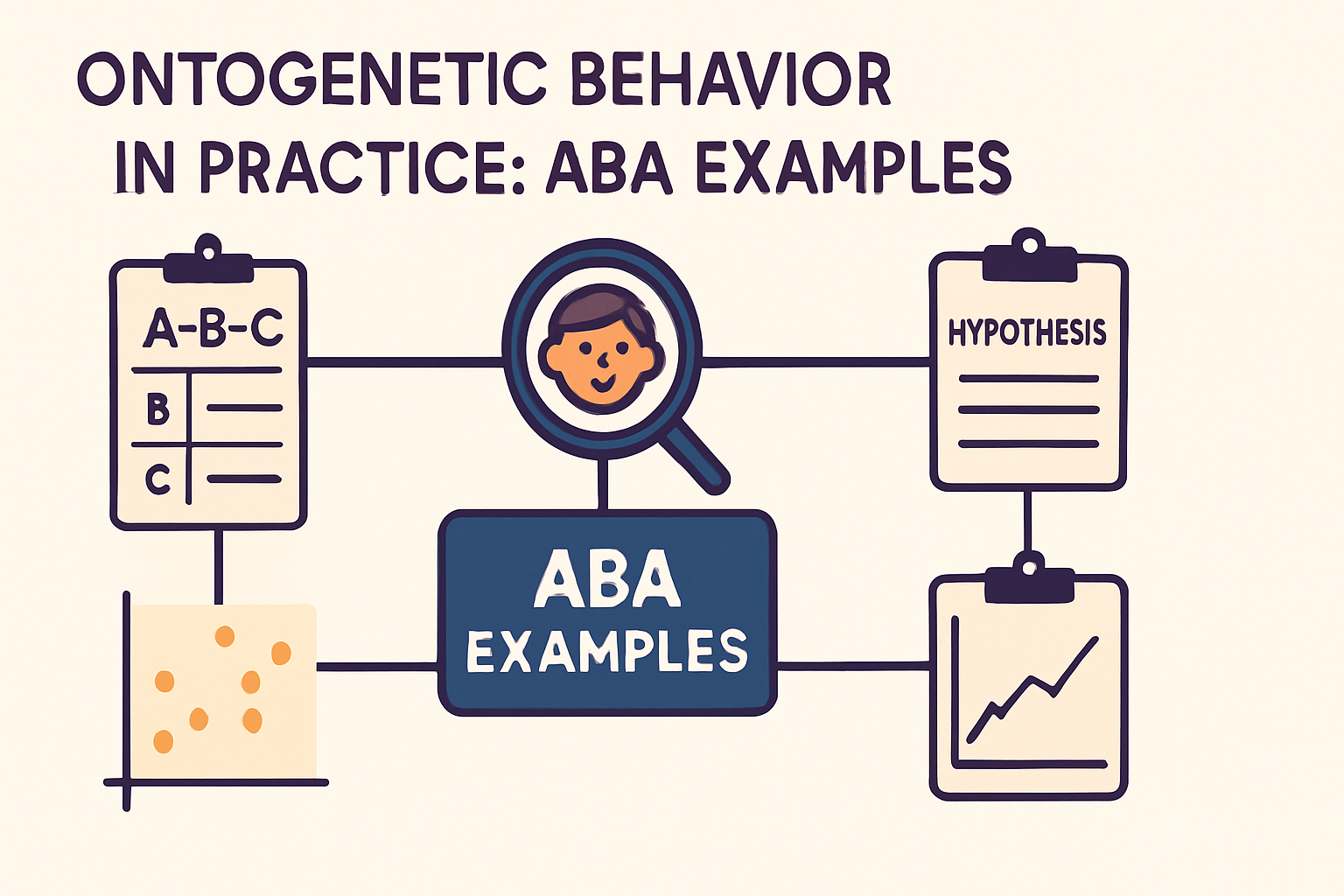
Let’s examine how ontogenetic behavior appears in real ABA scenarios. Each example includes ABC analysis to demonstrate how learning histories shape current behavior patterns.
Example 1: Social Communication (Skill Acquisition)
A child learns to say ‘please’ to access preferred items. This skill develops through specific environmental interactions.
- Antecedent: Preferred toy present, verbal prompt ‘say please’
- Behavior: Child says ‘please’ clearly
- Consequence: Immediate access to the toy
- Function: Tangible access maintained by positive reinforcement
This verbal operant is ontogenetic because it was shaped through reinforcement history. The child didn’t inherit this specific verbal behavior but learned it through environmental contingencies.
Example 2: Escape-Maintained Behavior (Reduction)
A student engages in task refusal during difficult academic work. This behavior pattern develops through learning history.
- Antecedent: Presentation of challenging math worksheet
- Behavior: Pushes paper away, says ‘I can’t do this’
- Consequence: Task removal for 5 minutes
- Function: Escape from aversive academic demands
This escape behavior is ontogenetically selected by a history of negative reinforcement. Each successful escape strengthens the refusal repertoire, making it more likely in future similar situations.
Example 3: Conditioned Emotional Response (Respondent)
Respondent behaviors can also be ontogenetic through classical conditioning processes.
- Unconditioned Stimulus (US): Loud, aversive noise
- Unconditioned Response (UR): Startle, anxiety
- Conditioned Stimulus (CS): Specific tone that precedes the noise
- Conditioned Response (CR): Anxiety when hearing the tone alone
This conditioned emotional response develops through stimulus pairing, not genetic inheritance. The anxiety response to the neutral tone is ontogenetic because it was acquired through the individual’s specific learning history.
Ontogenetic Concepts on the BCBA Exam
Exam questions often test your ability to distinguish ontogenetic from phylogenetic behaviors and apply this understanding to clinical scenarios.
Common Exam Traps and How to Avoid Them
Several patterns consistently trip up candidates. Being aware of these helps you navigate tricky questions.
- Confusing learned vs. reflexive: Remember that phylogenetic behaviors are reflexive and appear without learning history
- Overlooking respondent conditioning: Both operant and respondent behaviors can be ontogenetic through different learning mechanisms
- Assuming all behavior is learned: Some behaviors are purely phylogenetic and not amenable to the same intervention approaches
- Missing the individual aspect: Ontogenetic behaviors vary between individuals based on unique reinforcement histories
Sample Exam-Style Practice Prompts
Test your understanding with these representative questions.
Question 1: Which of the following best exemplifies an ontogenetic behavior?
- a) Pupil constriction to bright light
- b) A child tying their shoes independently
- c) Salivation when food is placed in the mouth
- d) Gasping when startled by a sudden loud noise
Answer: b) A child tying their shoes independently. This behavior requires specific learning and practice, making it ontogenetic. The other options are phylogenetic reflexes.
Question 2: A client shows fear when entering a specific room where they previously experienced a traumatic event. This fear response is:
- a) Phylogenetic and unlearned
- b) Ontogenetic through respondent conditioning
- c) Phylogenetic through natural selection
- d) Ontogenetic through operant conditioning
Answer: b) Ontogenetic through respondent conditioning. The fear developed through pairing the room (CS) with the traumatic event (US).
Quick Checklist for Clinical and Exam Analysis
Use this practical tool to quickly assess whether a behavior is ontogenetic during case analysis or exam preparation.
- Check for learning history: Does the behavior require specific environmental experience to develop?
- Assess variability: Does the behavior differ significantly between individuals with different experiences?
- Identify conditioning type: Is the behavior maintained through operant or respondent conditioning processes?
- Consider change potential: Can the behavior be modified through systematic intervention?
- Rule out reflexes: Is the behavior a species-typical reflex that appears without learning?
- Examine environmental control: Do specific antecedents reliably evoke the behavior?
This checklist helps you systematically analyze behaviors during functional behavior assessments and exam scenarios.
Summary and Key Takeaways
Ontogenetic behavior represents the core of what applied behavior analysts address in practice. These learned behaviors are shaped by individual reinforcement histories and environmental interactions.
Key points to remember:
- Ontogenetic behaviors develop through the individual’s lifetime, not genetic inheritance
- Both operant and respondent behaviors can be ontogenetic through different learning mechanisms
- This distinction is crucial for effective assessment and intervention planning
- Exam questions frequently test your ability to identify ontogenetic vs. phylogenetic behaviors
- Understanding ontogenetic behavior helps you select appropriate behavior change procedures
The concept connects directly to radical behaviorism principles, emphasizing the role of environmental variables in shaping behavior. By mastering this distinction, you’ll be better prepared for both exam success and effective clinical practice.
For further study on related concepts, explore respondent vs. operant behavior differences and the BACB’s official resources on behavior analytic principles.



