

In applied behavior analysis, observational learning represents a crucial process where individuals acquire new behaviors by watching others. This concept goes beyond simple imitation to encompass a complex interaction of environmental variables and behavioral processes. Understanding observational learning is essential for BCBA candidates, as it appears across multiple exam domains and has significant clinical applications.
Table of Contents
- observational learning ABA: What is Observational Learning? A Behavioral Definition
- Observational Learning in Action: ABA Examples
- Observational Learning on the BCBA Exam
- Quick-Study Checklist for Observational Learning
Observational learning ABA: What is Observational Learning? A Behavioral Definition
Observational learning refers to the acquisition of new behaviors through observation of others’ actions and their consequences. Unlike direct reinforcement, this process involves learning without performing the behavior during acquisition. The behavioral definition emphasizes that observational learning occurs when an observer’s behavior changes after viewing a model’s behavior and its outcomes.
This learning mechanism bridges the gap between respondent conditioning and operant conditioning, incorporating elements of both while maintaining distinct characteristics. For BCBA exam preparation, it’s crucial to distinguish observational learning from related concepts like imitation and modeling.
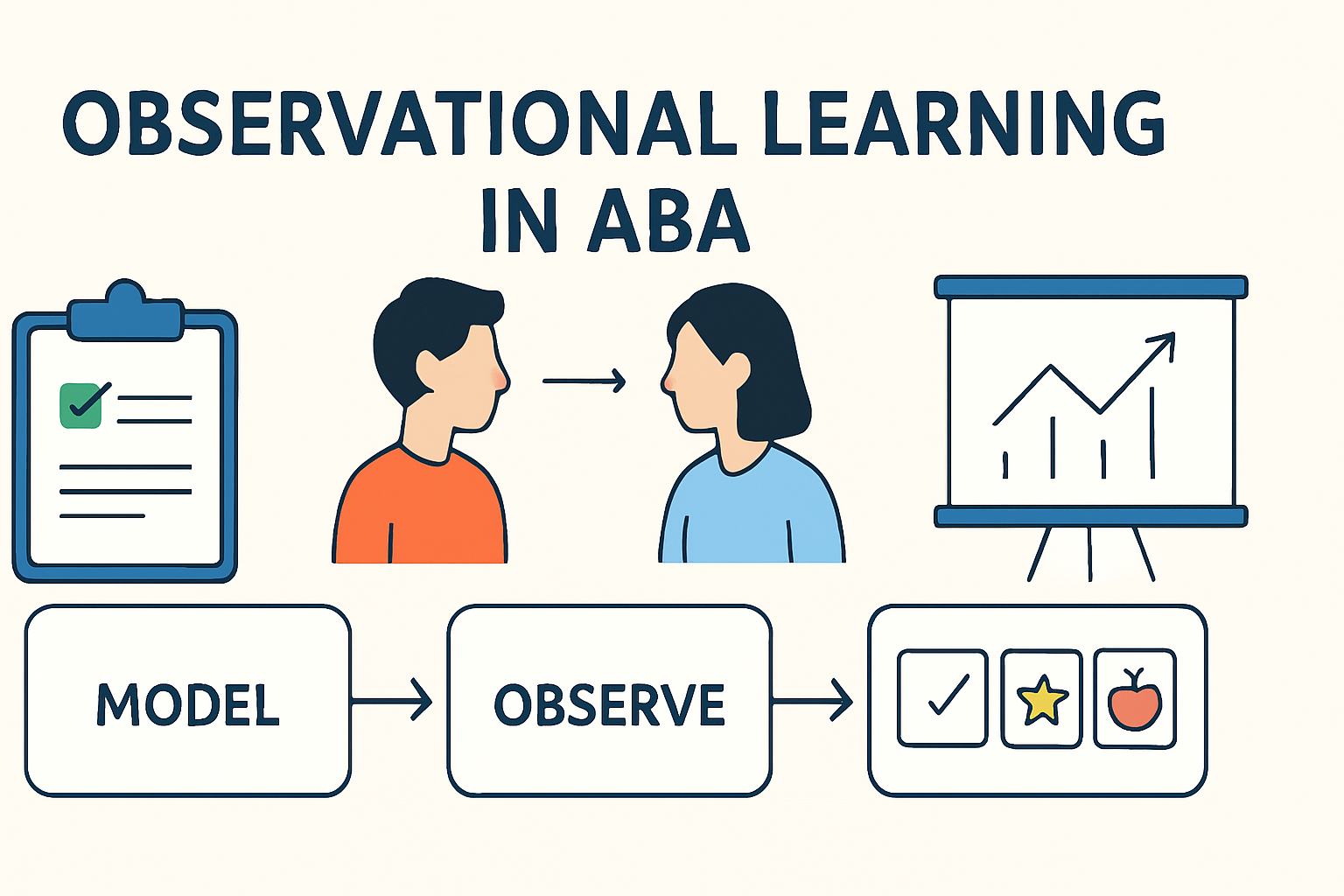
Beyond Imitation: The Four Key Processes
Albert Bandura’s social learning theory identifies four essential processes that must occur for observational learning to take place:
- Attention: The observer must attend to the model’s behavior and relevant environmental stimuli. This involves discriminative stimuli that signal when observation is important.
- Retention: The observer must encode and remember the observed behavior. This involves verbal mediation or imaginal coding to maintain the behavior in memory.
- Motor Reproduction: The observer must have the physical capability and component skills to perform the behavior. This requires response capability and appropriate response topography.
- Motivation: The observer must have sufficient motivation to perform the behavior, often influenced by observed consequences to the model. This involves vicarious reinforcement or vicarious punishment.
Observational Learning vs. Imitation and Modeling
These three terms are often confused but represent distinct concepts in behavior analysis:
- Observational learning is the overarching process and outcome – the acquisition of new behavior through observation.
- Imitation is a specific behavior – the duplication of a model’s actions. Imitation can be immediate or delayed, exact or generalized.
- Modeling is a procedure – the demonstration of behavior for others to observe. Modeling serves as an antecedent intervention to facilitate learning.
For exam questions, remember that imitation is a behavior, modeling is a procedure, and observational learning is the process. This distinction is critical when analyzing scenarios on the BCBA exam.
Observational Learning in Action: ABA Examples
Understanding theoretical concepts is important, but seeing how observational learning works in real ABA settings provides practical insight. These examples demonstrate how the four processes interact in clinical scenarios.
Example 1: Peer Modeling in a Social Skills Group
In a social skills group, a child with limited initiation skills observes a peer successfully asking to join a game. The ABC data reveals:
- Antecedent: Peer approaches group, says “Can I play?”
- Behavior: Group members welcome peer, make space
- Consequence: Peer joins game, receives social reinforcement
The observing child later approaches another group and uses the same phrase. The vicarious reinforcement observed (peer gaining access to play) serves as motivation. This example demonstrates all four processes: attention to the model, retention of the phrase, motor capability to speak, and motivation from observed positive outcomes.
Example 2: Staff Training via Behavioral Skills Training (BST)
Behavioral Skills Training incorporates observational learning as a core component. During BST, a trainee observes a skilled model performing a procedure correctly:
- Instruction: Verbal description of the skill
- Modeling: Demonstration of the skill (observational learning component)
- Rehearsal: Trainee practices the skill
- Feedback: Reinforcement or corrective feedback
The modeling phase specifically targets the attention and retention processes. When the trainee later performs the skill correctly, they receive direct reinforcement, strengthening the observed behavior. This approach is particularly effective for teaching complex procedures like behavioral skills training implementation.
Example 3: Learning from Video Models
Video modeling presents standardized demonstrations that learners can watch repeatedly. Consider a child learning to tie shoes:
- The video shows each step clearly (attention)
- The child watches multiple times (retention)
- The child has basic fine motor skills (motor reproduction)
- The child wants to wear shoes independently (motivation)
Video models offer advantages including standardization, repetition without model fatigue, and pause/rewind capabilities. This method aligns with errorless learning principles by providing clear, consistent models before attempting the behavior.
Observational Learning on the BCBA Exam
The BCBA exam tests observational learning through various question types, from straightforward identification to complex application scenarios. Understanding common testing patterns can improve your performance.
Common Exam Traps and How to Avoid Them
Several patterns consistently appear in observational learning questions:
- Confusing observational learning with operant conditioning: Remember that observational learning involves learning without direct reinforcement during acquisition. If a question describes someone watching then immediately performing with reinforcement, it’s likely testing operant concepts.
- Misidentifying the four processes: Exam questions often ask which process is deficient when observational learning fails. For example, if a child watches but can’t remember the steps, that’s a retention issue, not attention.
- Selecting ‘imitation’ when describing the broader process: When a question asks about the overall learning mechanism, choose observational learning. Save ‘imitation’ for specific behavior duplication questions.
- Overlooking vicarious reinforcement/punishment: These are key motivators in observational learning. If a model receives reinforcement, observers are more likely to perform the behavior.
Practice Application Questions
Test your understanding with these sample scenarios:
1. A teacher demonstrates how to solve a math problem on the board. Students watch carefully, then successfully solve similar problems on their own. Which process best describes how the students learned?
- A) Direct reinforcement
- B) Observational learning
- C) Respondent conditioning
- D) Error correction
2. A child watches a peer ask for help and receive praise. Later, the child asks for help in a similar situation but struggles to remember the exact words. Which observational learning process appears deficient?
- A) Attention
- B) Retention
- C) Motor reproduction
- D) Motivation
These questions test both identification and analysis skills. The first requires recognizing the observational learning scenario, while the second demands understanding which specific process is impaired.
Quick-Study Checklist for Observational Learning
Use this checklist for efficient review before your exam:
- ✓ Define observational learning as behavior acquisition through observation without performing during learning
- ✓ Memorize Bandura’s four processes: Attention, Retention, Motor Reproduction, Motivation
- ✓ Distinguish observational learning (process) from imitation (behavior) and modeling (procedure)
- ✓ Identify vicarious reinforcement as motivation when models receive positive consequences
- ✓ Recognize video modeling as an effective antecedent intervention using observational learning
- ✓ Connect observational learning to Behavioral Skills Training (BST) as a key component
- ✓ Practice identifying deficient processes when observational learning fails
- ✓ Review how observational learning relates to stimulus and response generalization
Observational learning represents a powerful mechanism for behavior change that extends beyond direct reinforcement contingencies. By understanding the four key processes and their clinical applications, BCBA candidates can better analyze learning scenarios and implement effective interventions. Remember that successful application requires considering all components – from ensuring the observer’s attention to providing motivation through observed or direct consequences.
For further study on related behavioral principles, explore our guide on radical behaviorism and its philosophical foundations. The BACB’s 6th Edition Task List also provides comprehensive coverage of observational learning concepts across multiple domains.


