

A model prompt represents a fundamental teaching strategy in Applied Behavior Analysis that demonstrates the target behavior for a learner. This approach falls within the broader category of response prompts and serves as a critical tool for skill acquisition across various domains. Understanding the model prompt ABA concept is essential for both clinical practice and BCBA exam preparation, as it frequently appears in scenarios testing prompting hierarchies and instructional strategies.
Table of Contents
- Model Prompt ABA: What is a Model Prompt in Applied Behavior Analysis?
- Applying Model Prompts: Worked Examples and Analysis
- Model Prompts on the BCBA® Exam: What to Know
- Quick-Study Checklist and Summary
Model Prompt ABA: What is a Model Prompt in Applied Behavior Analysis?
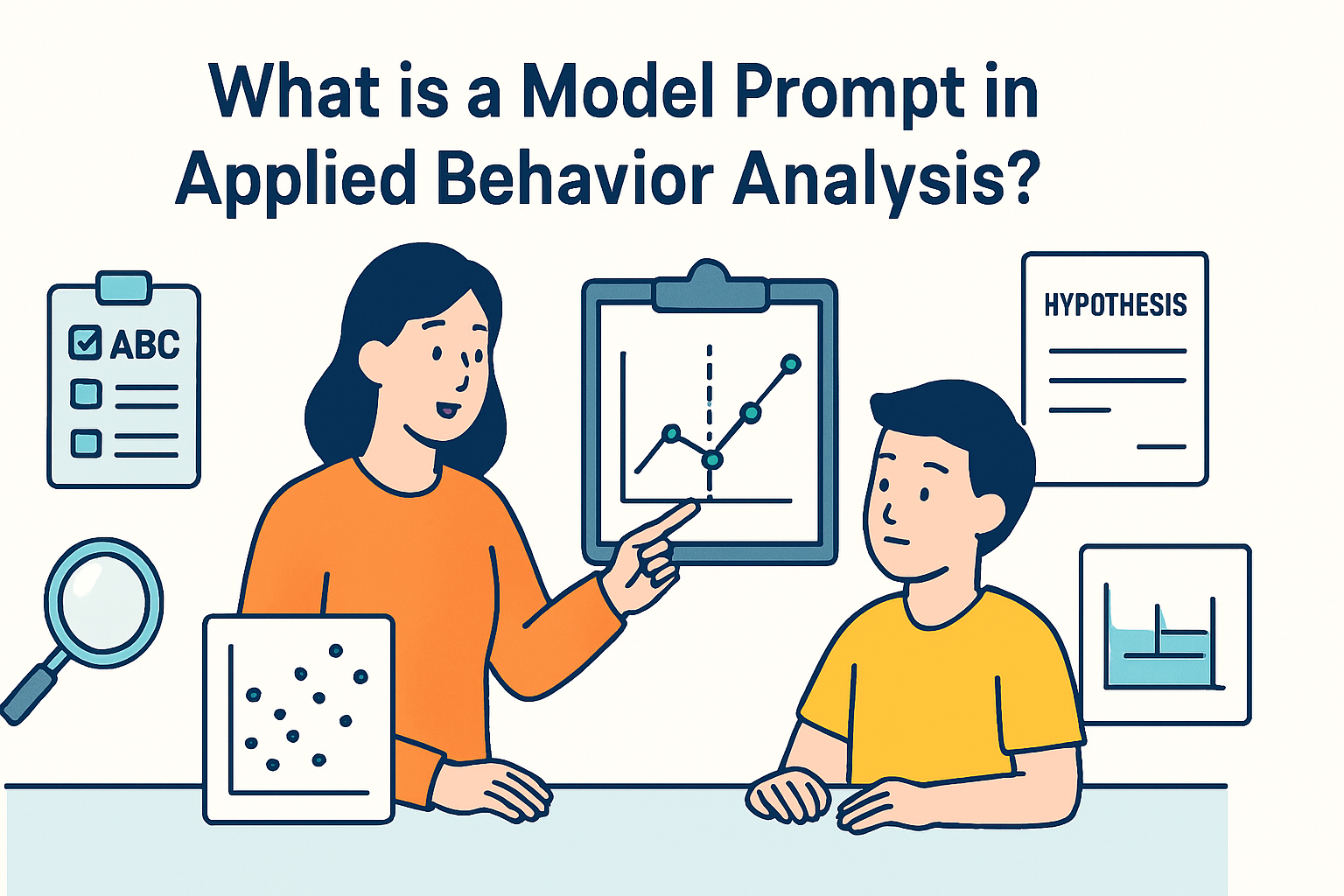
A model prompt involves demonstrating the target behavior for the learner to imitate. Unlike verbal instructions that tell the learner what to do, a model prompt shows them the exact topography of the desired response.
Definition and Key Characteristics
The model prompt is defined as a demonstration of the target behavior that the learner is expected to perform. This prompt type can be delivered live by the therapist or through recorded media. Key characteristics include:
- It demonstrates the entire behavior or specific components
- It requires the learner to have an imitative repertoire
- It can be used within chaining procedures for complex skills
- It contrasts with stimulus prompts that alter the antecedent stimulus
Video modeling represents a specialized application where recorded demonstrations provide consistent models across multiple sessions.
Placement in the Prompting Hierarchy
Within the prompting hierarchy, model prompts occupy a specific position relative to other prompt types. The typical hierarchy from most to least intrusive includes:
- Physical prompts (most intrusive)
- Model prompts (moderately intrusive)
- Gestural prompts (less intrusive)
- Verbal prompts (least intrusive)
The goal of any prompting strategy should include a systematic plan for prompt fading to promote independence. For more on related instructional strategies, see our guide on errorless learning in ABA.
Applying Model Prompts: Worked Examples and Analysis
Practical application of model prompts requires careful analysis of the learner’s needs and the target skill’s complexity. These examples illustrate how model prompts function within three-point contingency arrangements.
Example 1: Teaching a Motor Skill (Hand Washing)
This example demonstrates a model prompt for a motor sequence where the learner lacks the skill chain.
- Antecedent: Therapist presents materials and gives SD “Wash your hands”
- Behavior: Client does not initiate the first step
- Consequence: Therapist models turning on the water faucet
- Hypothesized function: Skill deficit in the behavioral chain
The model prompt provides the specific topography needed to begin the sequence. Over successive trials, the prompt should be faded using a most-to-least approach.
Example 2: Teaching a Social-Communication Skill (Greeting)
Social skills often require model prompts when the learner lacks specific response forms.
- Antecedent: Peer approaches and says “Hi”
- Behavior: Client looks away without responding
- Consequence: Therapist models waving and saying “Hi back!”
- Hypothesized function: Skill deficit in social reciprocity
This model prompt demonstrates both the motor component (waving) and verbal component (greeting response). For related social skill strategies, explore behavior skills training approaches.
Example 3: Using Video Modeling (A Specialized Application)
Video modeling extends the basic model prompt concept through technology.
- Antecedent: Learner watches video of peer ordering lunch
- Behavior: Learner imitates the sequence at lunch counter
- Consequence: Natural reinforcement (receives ordered food)
- Key advantage: Consistent demonstration across trials
This approach supports generalization by showing the skill in natural contexts and can be particularly effective for learners who attend well to screen-based media.
Model Prompts on the BCBA® Exam: What to Know
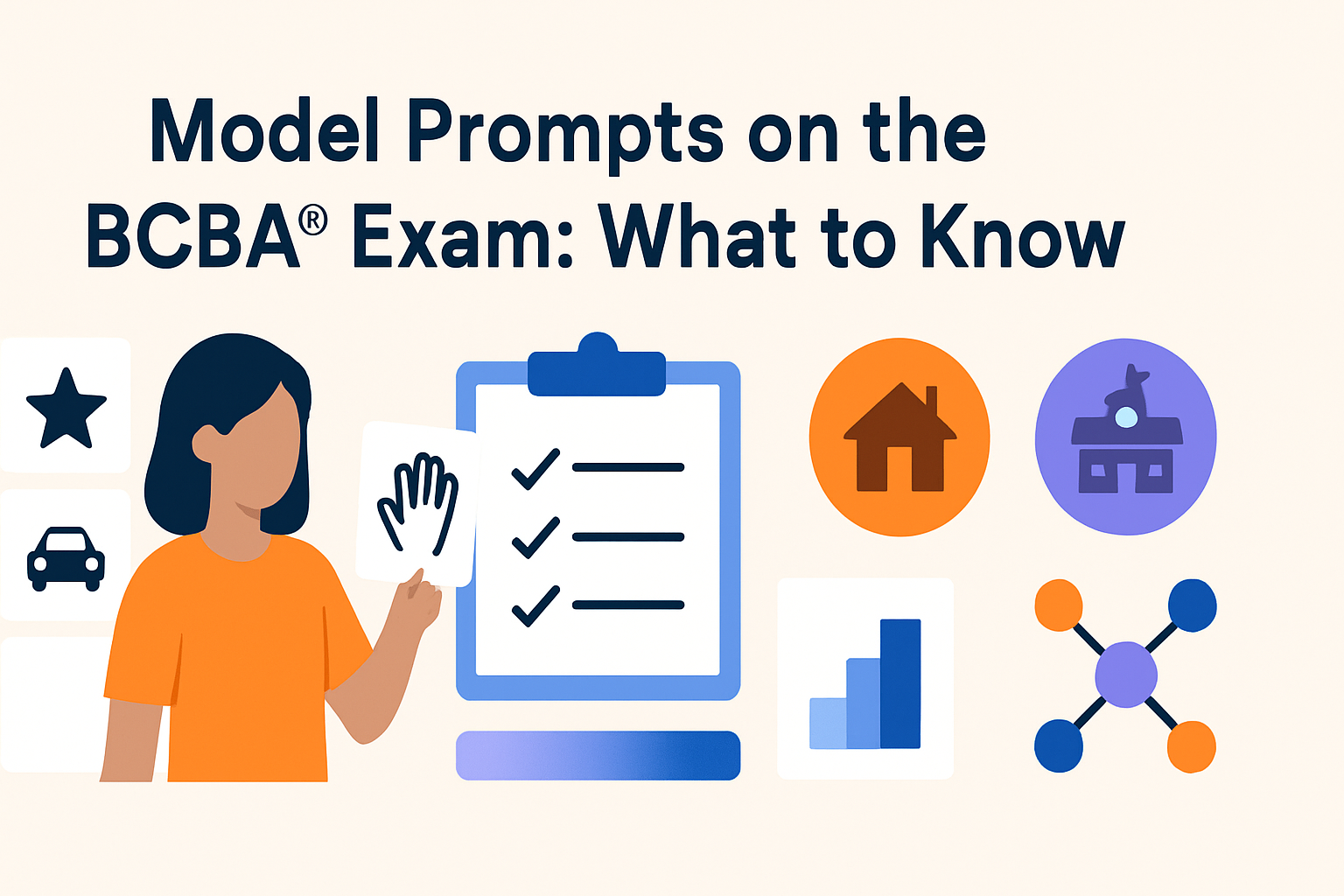
The BCBA exam frequently tests understanding of prompt types and their appropriate applications. Model prompts appear in several question formats that require careful discrimination.
Common Exam Question Formats
Exam questions typically assess model prompt knowledge through these formats:
- Definition identification: Selecting the correct definition from multiple choices
- Scenario analysis: Identifying which prompt type was used in a described situation
- Hierarchy sequencing: Arranging prompts from most to least intrusive
- Fading procedures: Determining the next step in a prompt fading plan
Understanding these formats helps with efficient question analysis during the exam.
Frequent Candidate Errors and How to Avoid Them
Common mistakes include confusing model prompts with other prompt types. Key distinctions to remember:
- Model prompts demonstrate the behavior versus verbal prompts that describe it
- Gestural prompts (pointing) differ from model prompts (showing)
- Video modeling is still a model prompt, not a separate category
- Always consider the learner’s imitative repertoire before using model prompts
For comprehensive exam preparation, review our BCBA exam prep guide covering all domains.
Quick-Study Checklist and Summary
This checklist provides a concise review tool for last-minute study sessions before your exam.
Model Prompt Mastery Checklist
- [ ] It demonstrates the target behavior for imitation
- [ ] It is classified as a response prompt
- [ ] It falls between physical and gestural prompts in intrusiveness
- [ ] Effective implementation requires a fading plan
- [ ] Video modeling represents a technological variation
- [ ] Requires the learner to have basic imitation skills
- [ ] Can be used within chaining procedures for complex skills
Key Takeaways for Your Exam Prep
Three critical points to remember for exam success:
- A model prompt shows the learner what to do through demonstration
- On the exam, carefully analyze scenarios to distinguish model prompts from verbal or gestural prompts
- Always consider both prompt fading and the learner’s prerequisite skills when selecting this strategy
For authoritative information on behavior analytic procedures, consult the Behavior Analyst Certification Board resources and Cooper, Heron, and Heward’s Applied Behavior Analysis textbook.
Complete BCBA Exam Prep
Turn this topic into exam-day practice
Practice concepts in context with five full-length 6th Edition mock exams, two bonus practice exams, a 6th Edition study guide, and key-term flashcards—all in one $120 USD package.
Get the $120 All-in-One Prep Pack
Review everything included on the product page before ordering. No pass guarantee is implied.



