
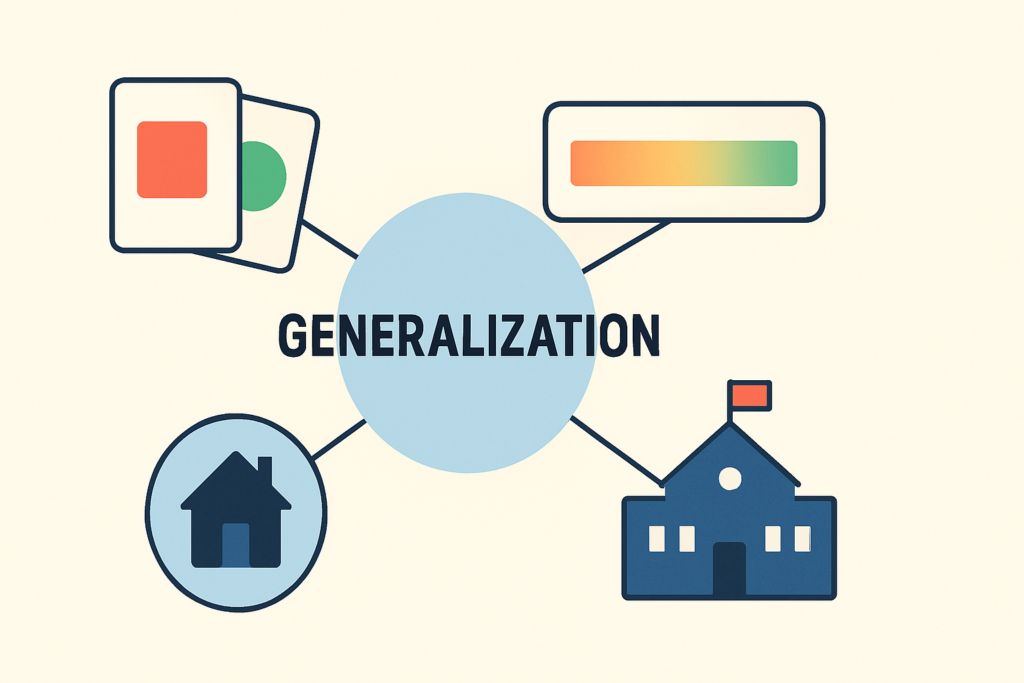
Mastering mediated generalization is essential for BCBA candidates and practicing behavior analysts. This concept explains how learned behaviors transfer to new situations through verbal rules or symbolic mediators, rather than through physical stimulus similarity alone. Understanding this mechanism helps create more efficient intervention programs and prepares you for exam questions that test your conceptual knowledge.
Table of Contents
- What is Mediated Generalization?
- Mediated Generalization in Practice: ABA Examples
- Mediated Generalization and the BCBA Exam
- Quick-Study Checklist and Summary
- References
What is Mediated Generalization?
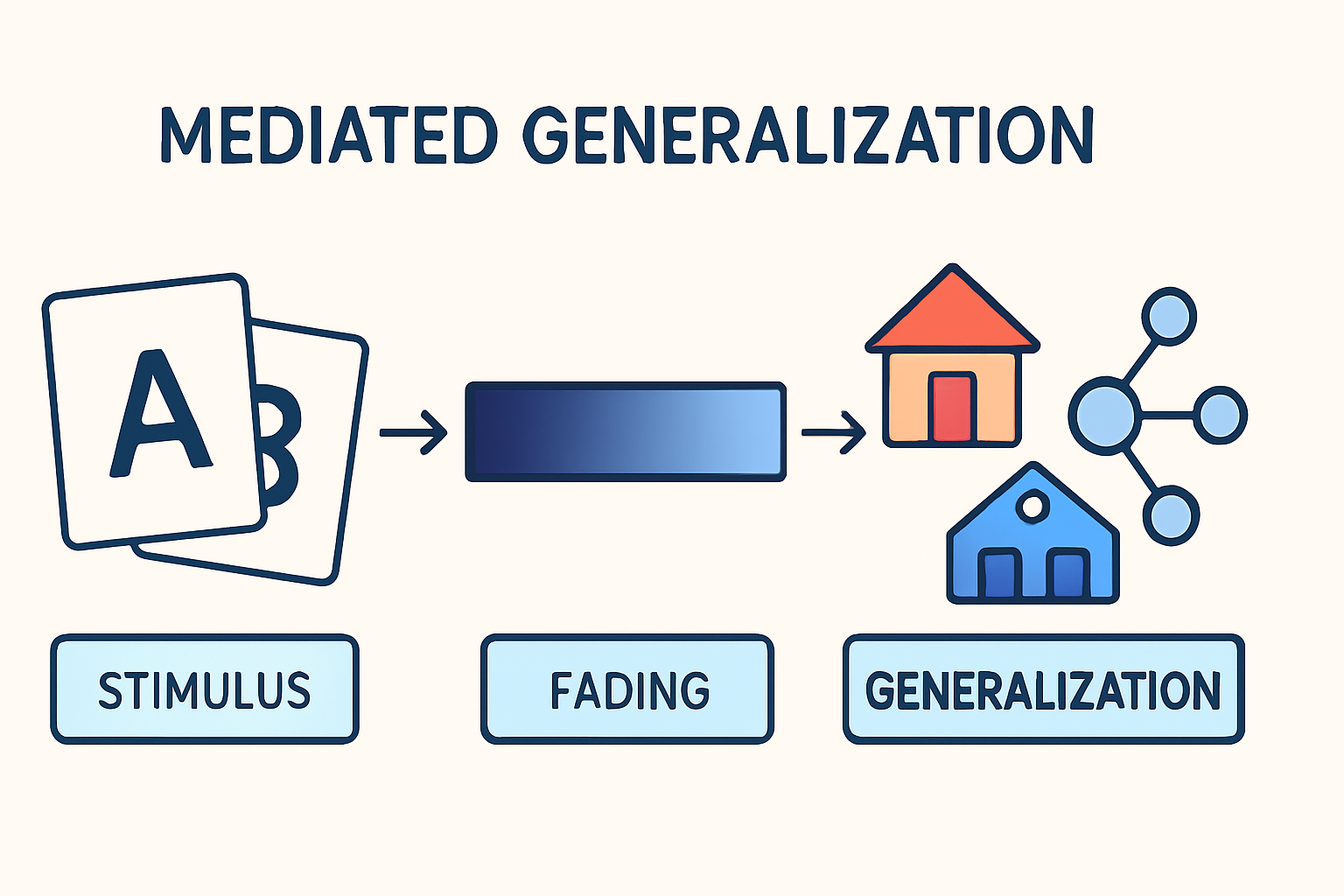
Mediated generalization occurs when a behavior transfers to new situations because of a mediating stimulus, typically a verbal rule or symbolic representation. Unlike stimulus generalization, which happens due to physical similarity between stimuli, mediated generalization involves cognitive or verbal bridges that connect different contexts.
The Core Definition and Mechanism
The key mechanism involves a common-element stimulus class created by the mediator. When a learner follows a rule like “be quiet in libraries,” they may generalize this to museums, not because libraries and museums look similar, but because the verbal rule “be quiet in quiet places” mediates the response. This process is closely related to rule-governed behavior and represents efficient learning transfer.
Contrast this with response generalization, where different but functionally similar behaviors emerge without a specific mediating rule. Mediated generalization specifically requires that verbal or symbolic mediation guides the transfer.
Mediated Generalization vs. Stimulus Equivalence
A common point of confusion involves distinguishing mediated generalization from stimulus equivalence. While both involve derived relations, they are not identical concepts. Mediated generalization often involves trained relations leading to derived responding, but stimulus equivalence represents a specific type of derived relational responding with formal properties.
Stimulus equivalence requires reflexivity, symmetry, and transitivity, while mediated generalization may occur without meeting all these criteria. For deeper understanding of equivalence relations, see our guide on stimulus equivalence concepts.

Mediated Generalization in Practice: ABA Examples
Real-world examples make abstract concepts concrete. These scenarios illustrate how mediated generalization operates in therapeutic settings, complete with ABC data and functional analysis.
Example 1: The ‘Quiet Hands’ Rule
A child learns “quiet hands” means hands in lap during structured work time. The initial training involves:
- Antecedent: Therapist says “quiet hands” during table work
- Behavior: Child places hands in lap
- Consequence: Praise and token reinforcement
Later, during free play, the child refrains from grabbing toys when a peer says “quiet hands.” The verbal rule mediates generalization to this new context, even though the physical setting and materials differ. The function remains access to reinforcement through social approval.
Example 2: Generalizing ‘Ask’ Across Functions
A learner is taught to say “Ask” to request preferred items. The initial mand training establishes the response form. Later generalization occurs across different functions:
- Saying “Ask” to get help with a difficult puzzle (mand for assistance)
- Saying “Ask” to gain a peer’s attention (mand for social interaction)
- Saying “Ask” to request a break (mand for escape)
The mediating element is the general rule “say Ask to get something.” All instances share the access function, though what is accessed varies. This demonstrates efficient skill acquisition through verbal mediation.
Example 3: Safety Skills and Conceptual Mediation
A teen learns traffic safety: “If you see a red sign with white letters saying STOP, stop walking.” Training occurs at familiar intersections. Later, while traveling, the teen stops at a novel red octagonal sign with “ARRÊT” (French).
The mediating conceptual class includes: red color, octagonal shape, intersection location. The specific verbal label “STOP” is not required for generalization. This example shows conceptual mediation rather than simple verbal rule-following.
Mediated Generalization and the BCBA Exam
Exam questions often test your ability to distinguish mediated generalization from similar concepts. Understanding these distinctions is crucial for selecting correct answers under time pressure.
Common Exam Traps and How to Avoid Them
Several patterns appear repeatedly in exam questions. Watch for these traps:
- Confusing with stimulus generalization: Look for a verbal or rule mediator rather than physical similarity
- Selecting response generalization: Choose mediated generalization when a rule guides the new response form
- Over-applying the concept: Sometimes simple discrimination training is the correct answer
- Missing the mediator: The mediating element may be subtle (conceptual class, symbolic representation)
Sample question stem: “A child who learns ‘share toys’ during playtime later shares art materials during craft time. This demonstrates…” The correct answer involves mediated generalization if a verbal rule mediates the transfer.
Linking to the Task List and Key Terms
Mediated generalization connects to multiple Task List sections. Key references include:
- B-10: Define and provide examples of stimulus control
- B-15: Define and provide examples of derived stimulus relations
- G-9: Use procedures to promote stimulus and response generalization
Related concepts include rule-governed behavior, stimulus equivalence class, generic extension, and semantic generalization. Understanding these connections helps integrate knowledge across domains. For more on generalization strategies, see our generalization and maintenance guide.
Quick-Study Checklist and Summary
Use this checklist to assess your understanding and prepare for exam questions on mediated generalization.
Your Mediated Generalization Study Checklist
- Can I define mediated generalization in one clear sentence?
- Can I provide two original examples with ABC data?
- Do I understand how it differs from stimulus equivalence?
- Have I practiced identifying it in exam-style scenarios?
- Can I explain the role of verbal mediators in behavior transfer?
- Do I recognize common exam traps and how to avoid them?
Key Takeaways
Mediated generalization represents efficient learning transfer through verbal or symbolic mediation. It’s crucial for designing interventions that promote skill generalization across settings and people. The concept bridges rule-governed behavior and derived relational responding, making it essential for comprehensive ABA practice.
Mastering this concept requires distinguishing it from similar phenomena like stimulus generalization and response generalization. On the exam, look for evidence of verbal rules or conceptual mediators guiding behavior transfer. For additional study resources, explore the BACB’s official resources and our comprehensive exam preparation materials.
References
Complete BCBA Exam Prep
Turn this topic into exam-day practice
Practice concepts in context with five full-length 6th Edition mock exams, two bonus practice exams, a 6th Edition study guide, and key-term flashcards—all in one $120 USD package.
Get the $120 All-in-One Prep Pack
Review everything included on the product page before ordering. No pass guarantee is implied.



