
Interresponse Time IRT: What is Interresponse Time? A Precise Definition
Interresponse time (IRT) is a fundamental temporal measurement in applied behavior analysis that quantifies the elapsed time between two consecutive instances of the same behavior. This measurement specifically captures the interval that begins when one response ends and concludes when the next identical response begins. Understanding interresponse time IRT is essential for BCBA candidates as it provides critical data about response patterns, pacing, and behavioral fluency.
Table of Contents
- Interresponse Time IRT: What is Interresponse Time? A Precise Definition
- Measuring and Calculating Interresponse Time
- Interresponse Time in Action: Worked ABA Examples
- IRT on the BCBA Exam: Common Traps and Strategies
- Summary and Key Takeaways
The standard unit for IRT measurement is typically seconds, though minutes may be used for behaviors with longer intervals. This measurement falls under the broader category of temporal dimensions in behavior analysis, which also includes duration and latency.
IRT vs. Latency and Duration: Clearing the Confusion
Many BCBA exam questions test your ability to distinguish between these three temporal measures. Each serves a different analytical purpose in behavior assessment.
- Interresponse Time (IRT): Measures time between two instances of the SAME behavior. Starts when one response ENDS.
- Latency: Measures time from a stimulus presentation to the BEGINNING of a response. This is stimulus-focused.
- Duration: Measures the total time a single response CONTINUES from start to finish.
For example, if a student takes 5 seconds to start writing after being given a worksheet (latency), writes for 30 seconds continuously (duration), then pauses 15 seconds before writing again (IRT between writing responses).
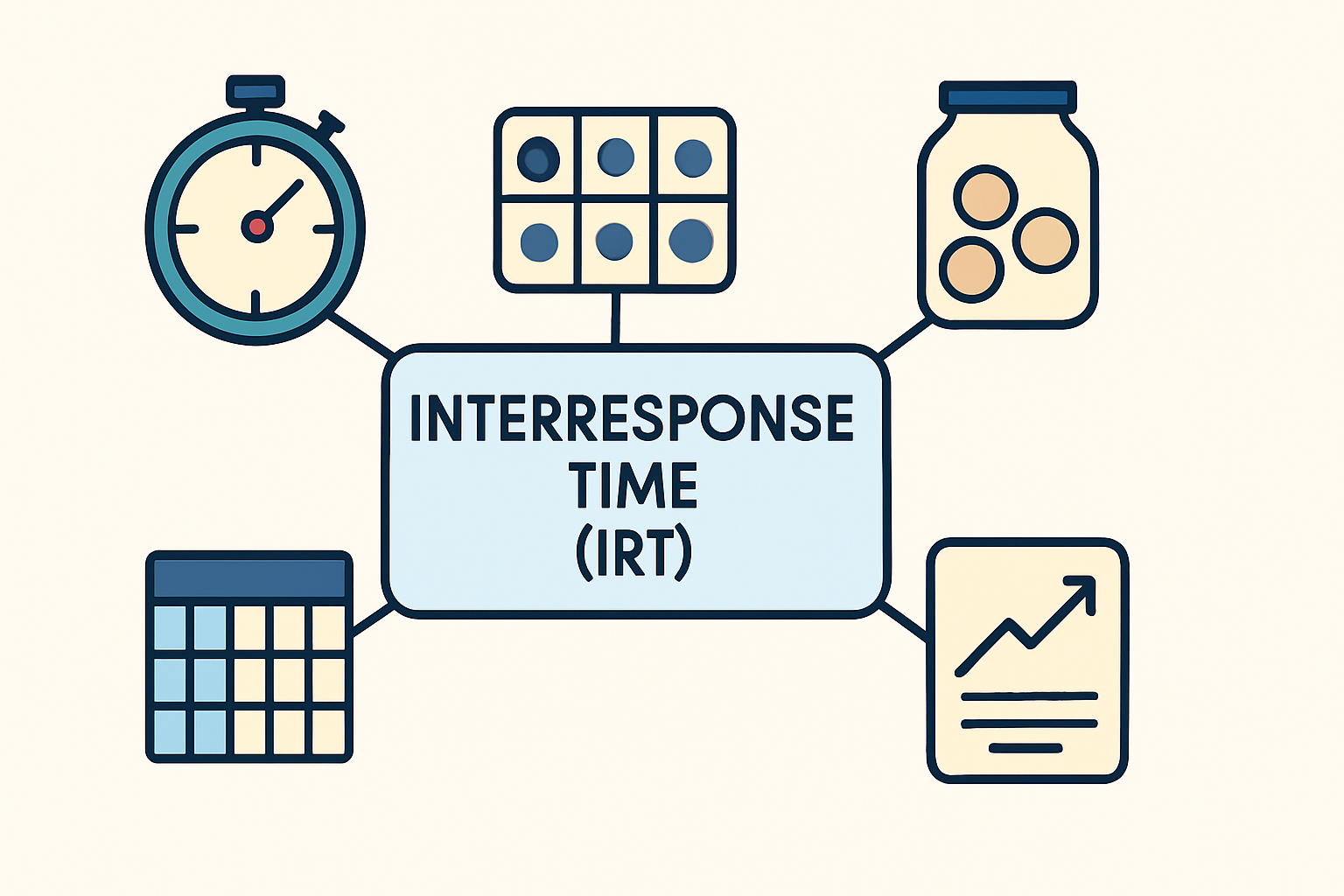
Measuring and Calculating Interresponse Time
Accurate IRT measurement requires systematic data collection and calculation methods. The process involves several key steps that BCBAs must master for both clinical practice and exam success.
When to Use IRT in Behavior Assessment
IRT measurement is particularly valuable in specific clinical scenarios where response patterns and pacing provide meaningful data for intervention planning.
- Fluency building programs where increasing response rate is a target
- Assessing pacing behaviors during academic or work tasks
- Measuring response effort changes following intervention
- Monitoring side effects of punishment procedures
- Evaluating competing behaviors in functional communication training
These applications align with the BACB Task List section C-1 on measurement procedures. For comprehensive measurement strategies, see our guide on data collection methods in ABA.

Interresponse Time in Action: Worked ABA Examples
Concrete examples demonstrate how IRT measurement applies in real clinical scenarios. These exam-style cases show the practical application of temporal measurement concepts.
Example 1: Pacing During Work Tasks
A client completes math problems but engages in frequent pacing between problems. The BCBA collects IRT data to quantify this pattern.
- Antecedent: Math worksheet presented
- Behavior: Completing math problems with pacing between
- Consequence: Brief escape from task demands
- Hypothesized function: Escape/avoidance
Raw IRT data: 45s, 32s, 28s, 51s, 37s between completed problems. Average IRT = 38.6 seconds. Reducing this average IRT becomes a fluency goal in the intervention plan.
Example 2: Vocal Stereotypy and Competing Manding
A client engages in vocal stereotypy (humming). The team implements functional communication training (FCT) to teach appropriate manding.
- Baseline IRT between stereotypy instances: 12s, 15s, 10s, 14s
- Post-FCT IRT between mands: Initially 45s, decreasing to 20s over sessions
- IRT between stereotypy increases to 60s+ as manding becomes more fluent
This dual IRT measurement tracks both the decrease in problem behavior and increase in appropriate communication, demonstrating the competing behaviors dynamic. For more on communication interventions, explore functional communication training strategies.
IRT on the BCBA Exam: Common Traps and Strategies
Exam questions often test subtle distinctions between temporal measurements. Recognizing these patterns can prevent costly mistakes.
The most frequent exam trap involves confusing IRT with latency. Questions may describe a scenario where timing begins with a stimulus presentation rather than the end of a previous response.
Quick-Reference IRT Checklist for Test-Takers
- IRT always measures between two instances of the SAME behavior
- Timing starts when one response ENDS completely
- IRT is NOT about stimulus presentation or initiation
- Average IRT provides a summary measure of response pacing
- Decreasing IRT typically indicates increasing behavioral fluency
- Increasing IRT may indicate reduced problem behavior or increased response effort
For additional exam strategies, review our comprehensive BCBA exam study framework.
Summary and Key Takeaways
Interresponse time measurement provides essential data about behavioral patterns that other temporal measures cannot capture. Mastering this concept requires understanding both the technical definition and practical applications.
- IRT measures the elapsed time between consecutive instances of the same behavior
- It differs fundamentally from latency (stimulus-focused) and duration (response-focused)
- Average IRT calculations help quantify response pacing and fluency changes
- Clinical applications include fluency building, pacing assessment, and monitoring intervention side effects
- Exam success depends on recognizing the specific conditions that define IRT measurement
For authoritative reference on measurement standards, consult the BACB Task List 6th Edition and the Journal of Applied Behavior Analysis for research applications.
Next step for BCBA exam prep
Turn this topic into exam-day practice
Use this topic as a focused review, then test it in exam-style conditions with a free mock before deciding whether five full-length mocks are the right next step.
Start the Free BCBA Mock Exam
Continue with Five Full-Length Mocks — $99
Review the included materials and access details before ordering. No pass guarantee is implied.



