
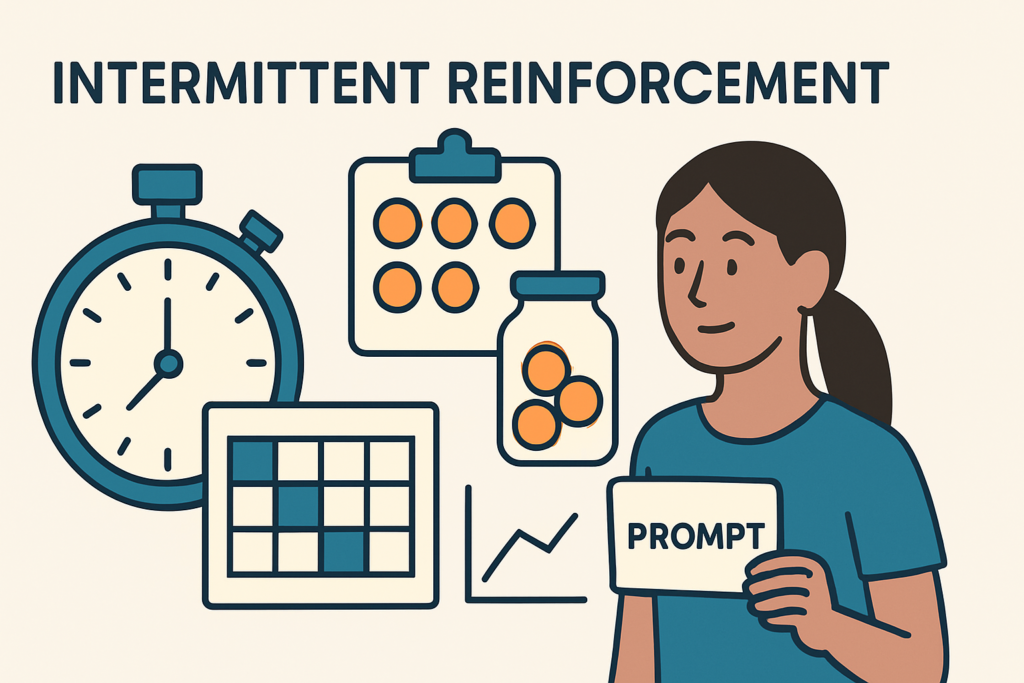
Understanding intermittent reinforcement is crucial for both effective ABA practice and BCBA exam success. Unlike continuous reinforcement where every response is reinforced, intermittent schedules deliver reinforcement according to specific patterns. This approach creates more persistent behaviors that resist extinction better than continuously reinforced behaviors.
Table of Contents
- What is Intermittent Reinforcement?
- The Four Key Intermittent Schedules
- Intermittent Reinforcement in Practice: ABA Examples
- Exam Focus: Common Traps and How to Avoid Them
- Quick-Reference Checklist and Summary
Mastering these schedules helps practitioners design effective interventions and navigate exam questions with confidence. The concept appears in the BACB Task List under Section B-5, making it essential study material.
What is Intermittent Reinforcement?
Intermittent reinforcement refers to reinforcement delivered according to a predetermined schedule rather than after every response. This fundamental principle produces behaviors that are more resistant to extinction compared to continuously reinforced behaviors.
Definition and Core Principle
The core principle involves delivering reinforcement based on either the number of responses or the passage of time. This creates schedule-controlled behavior that maintains even when reinforcement becomes less frequent. The key distinction from continuous reinforcement is the predictability pattern.
Why It Matters for BCBAs and the Exam
For practitioners, understanding these schedules is essential for thinning reinforcement during maintenance phases and promoting generalization. On the BCBA exam, questions frequently test your ability to identify schedules in applied scenarios and understand their behavioral effects.
This knowledge connects directly to BACB Task List requirements and practical intervention planning.
The Four Key Intermittent Schedules
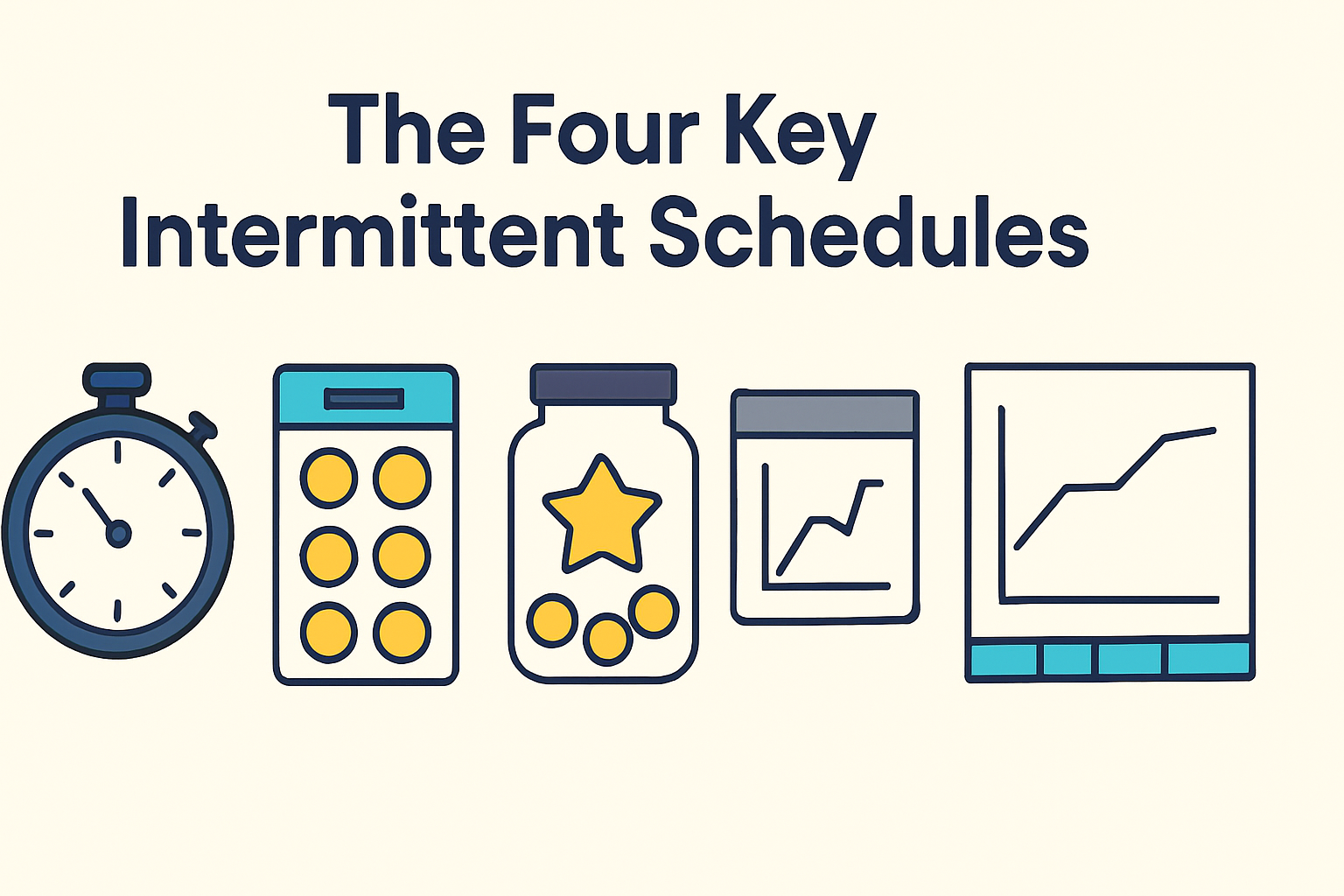
Intermittent reinforcement schedules fall into two main categories: ratio schedules and interval schedules. Each produces distinct response patterns that have important implications for behavior change programs.
Ratio Schedules: Counting Responses
Ratio schedules deliver reinforcement after a specific number of responses. Fixed Ratio (FR) schedules require a set number of responses, like piecework pay where workers earn after completing 10 items. These often produce a post-reinforcement pause followed by rapid responding.
Variable Ratio (VR) schedules reinforce after an unpredictable number of responses, similar to slot machine payouts. This produces high, steady response rates with minimal pausing, making it highly resistant to extinction.
Interval Schedules: Watching the Clock
Interval schedules deliver reinforcement after a specific time period has passed, provided at least one response occurs. Fixed Interval (FI) schedules reinforce the first response after a set time, like weekly paychecks. These create a scalloped pattern with slow responding early in the interval and acceleration near the end.
Variable Interval (VI) schedules reinforce after unpredictable time intervals, similar to checking for social media notifications. This produces low but steady response rates that are highly resistant to extinction.
Intermittent Reinforcement in Practice: ABA Examples
Real-world applications demonstrate how these schedules function in therapeutic settings. Understanding these examples helps bridge theoretical knowledge with practical implementation.
Example 1: Building Homework Compliance (VR Schedule)
Antecedent: Parent presents math worksheet. Behavior: Child completes problems independently. Consequence: Parent delivers specific praise on average every 5th completed problem (VR5).
The hypothesized function is access to social reinforcement. This VR schedule maintains compliance better than continuous praise because the unpredictable reinforcement pattern creates persistent responding. The child continues working even when praise isn’t immediate.
Example 2: Reducing Hand-Raising for Attention (VI Schedule)
Antecedent: Student in classroom setting. Behavior: Student raises hand appropriately. Consequence: Teacher provides attention or answers questions after variable time intervals (VI 2-min schedule).
This approach effectively thins reinforcement from a continuous schedule while maintaining appropriate behavior. The variable timing prevents the extinction burst that might occur with sudden removal of reinforcement, making it a valuable differential reinforcement strategy.
Exam Focus: Common Traps and How to Avoid Them

BCBA exam questions often test your ability to identify reinforcement schedules in applied scenarios. Recognizing common pitfalls can significantly improve your accuracy on these items.
Top 3 Exam Traps with Intermittent Schedules
- Confusing interval and ratio schedules: Remember that ratio schedules count responses, while interval schedules measure time. Ask yourself: “Is reinforcement based on how many responses or how much time has passed?”
- Misidentifying variable vs. fixed schedules: Fixed schedules have predictable requirements; variable schedules have unpredictable requirements. Look for patterns or lack thereof in the scenario.
- Overlooking the schedule requirement: Focus on what must occur before reinforcement is delivered, not just what the reinforcer is. The schedule defines the contingency, not the reinforcer type.
Practice Application Prompts
Test your understanding with these exam-style scenarios:
- A child receives a sticker after completing three worksheets consistently. What schedule is this?
- A therapist provides attention to a client who engages in appropriate play, but only after unpredictable time intervals averaging 3 minutes. Which schedule is in effect?
- A worker gets paid every Friday regardless of productivity, as long as some work was done. Identify this reinforcement schedule.
Quick-Reference Checklist and Summary
Use this checklist to quickly identify reinforcement schedules in exam scenarios or clinical observations.
Schedule Identification Checklist
- Step 1: Ratio or Interval? Does reinforcement depend on number of responses (Ratio) or passage of time (Interval)?
- Step 2: Fixed or Variable? Is the requirement predictable (Fixed) or unpredictable (Variable)?
- Step 3: Look for patterns: FR shows post-reinforcement pauses; VR shows steady high rates; FI shows scalloped patterns; VI shows steady low rates.
- Step 4: Consider practical effects: VR produces highest response rates; VI produces most extinction-resistant behavior.
Key Takeaways for Your Study Notes
Intermittent reinforcement creates behaviors that persist when reinforcement becomes less frequent. Variable Ratio schedules generate the highest response rates, making them effective for skill acquisition. Variable Interval schedules produce the most extinction-resistant behaviors, valuable for maintenance phases.
Understanding these schedules is essential for designing effective behavior intervention plans and answering BCBA exam questions accurately. For comprehensive exam preparation, explore our BCBA exam prep guide covering all essential topics.
Remember that these principles are supported by decades of research, including foundational work by B.F. Skinner and subsequent applied studies documented in the Journal of Applied Behavior Analysis.


