Independent and Dependent Variables in ABA: Simple Definitions, Graph Examples, and BCBA® Exam Tips
By BCBA Mock Exam
Introduction
You don’t pass the BCBA® exam just by memorizing definitions. You also need to quickly recognize what is being manipulated and what is being measured in a scenario or graph.
In experimental design language, those are your:
-
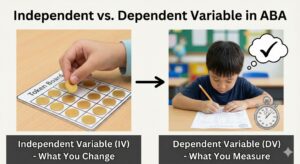
Independent variable (IV) – what you change on purpose
-
Dependent variable (DV) – what you measure to see if that change worked
In ABA, that usually means:
-
IV = the intervention, procedure, or condition you introduce, withdraw, or compare
-
DV = the behavior you’re tracking with data
In this article, we’ll walk through:
-
Simple, exam-ready definitions of IV and DV
-
Everyday ABA examples (both reduction and skill acquisition)
-
How IVs and DVs are represented on line graphs
-
Common BCBA® exam traps
-
Mini exam-style questions with explanations so you can practice.
1. Why Independent and Dependent Variables Matter on the BCBA® Exam
Independent and dependent variables show up in many exam sections:
-
Experimental design (reversal, multiple baseline, alternating treatments, changing criterion)
-
Graphing and visual analysis
-
Treatment evaluation and data-based decision making
If you can quickly spot the IV and DV, it becomes much easier to answer:
-
Whether the design demonstrates experimental control
-
Whether a graph suggests an effective intervention
-
Which variable is being changed vs which is just being observed
On test day, many questions won’t say “What is the independent variable?” directly. Instead, they’ll describe a procedure and ask what conclusion you can draw or which design is being used. The IV/DV distinction is hiding inside those questions.
2. Simple Definitions: Independent vs Dependent Variable
Let’s keep the definitions simple and behavior-analytic.
Independent Variable (IV)
-
The environmental change or intervention you deliberately introduce, remove, or manipulate.
-
The “thing you do” to see if it affects behavior.
-
Examples: token economy, extinction procedure, DRO schedule, FCT protocol, visual schedule, time-out procedure.
Dependent Variable (DV)
-
The behavior you measure to see whether it changes in response to the IV.
-
The “thing you watch” for change.
-
Examples: frequency of aggression, duration of tantrums, percentage of correct responses, latency to compliance, rate of mands.
Shortcut for the exam:
-
Ask: “What did the BCBA change on purpose?” → Likely the IV.
-
Ask: “What did they record data on?” → Likely the DV.
3. ABA Examples: Behavior Reduction and Skill Acquisition
Example 1 – Behavior Reduction (Aggression)
-
A BCBA implements extinction for attention-maintained aggression by having staff withhold attention following hitting.
-
The BCBA measures number of aggression episodes per day.
Here:
-
IV = Extinction procedure (change in how staff respond)
-
DV = Aggression per day (measured behavior)
Example 2 – Skill Acquisition (Mand Training)
-
A BCBA introduces mand training with prompts and differential reinforcement to increase a child’s requests for break.
-
They measure number of independent mands for break during sessions.
Here:
-
IV = Mand training protocol (prompts + reinforcement)
-
DV = Independent mands for break
Example 3 – Token Economy for Task Completion
-
A token economy is introduced to increase math worksheet completion.
-
The BCBA measures percentage of problems completed correctly.
Here:
-
IV = Token economy (contingent tokens + exchange)
-
DV = Percent of problems completed correctly
Exam tip:
-
Procedures, conditions, and schedules → IVs.
-
Client behaviors measured over time → DVs.
4. Where IV and DV Live on a Graph
Most ABA graphs are simple line graphs. In those graphs:
-
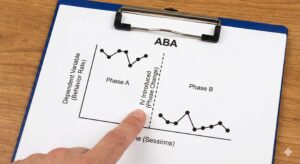
X-axis (horizontal) – usually time or sessions (e.g., days, therapy sessions, weeks).
-
Y-axis (vertical) – usually the dependent variable (rate, frequency, duration, percentage, etc.).
-
Phase change lines – vertical lines that show a change in the independent variable (e.g., baseline to treatment, treatment to withdrawal).
Think of it this way:
-
The DV is what moves up and down along the Y-axis.
-
The IV shows up in the labels above each phase (A, B, C) and at the points where conditions change.
Example described in words:
-
Baseline (A): self-injury ranges from 8–10 instances per session.
-
Treatment (B: DRA + extinction): after a phase change line, self-injury drops to 1–3 instances per session.
On this graph:
-
X-axis: sessions
-
Y-axis: self-injury per session (DV)
-
IV: introduction of DRA + extinction at the start of phase B (the change in condition).
5. How to Spot IV and DV in Exam Scenarios
When reading exam stems, the IV and DV are often buried in descriptive text.
Use this quick routine:
Step 1 – Find the target behavior (DV)
-
Look for phrases like “the BCBA measured…”, “data were collected on…”, “to reduce…”, “to increase…”.
-
That is almost always your dependent variable.
Step 2 – Find what was introduced or changed (IV)
-
Look for “implemented”, “introduced”, “began using”, “switched to”, “removed”, “added”.
-
That is usually your independent variable.
Step 3 – Check that the IV is manipulable and the DV is measurable
-
You should be able to actually apply or remove the IV.
-
You should be able to count, time, or score the DV.
Step 4 – Make sure they logically fit
-
Ask: “Does this measured behavior make sense as an effect of this intervention?” If not, you may have misidentified something.
6. What Is Not an Independent or Dependent Variable
Some details in exam scenarios are important context but are not IVs or DVs.
Common examples:
-
Client demographics (age, diagnosis, grade)
-
These are characteristics, not manipulated variables.
-
-
Setting (home, school, clinic)
-
The setting might be important, but unless you systematically vary settings as part of the design, it isn’t the IV.
-
-
Measurement system
-
Frequency vs duration vs percentage are ways of measuring the DV, not separate DVs.
-
-
Treatment integrity
-
Treatment integrity affects whether the IV is being implemented correctly, but it is not itself the IV.
-
Exam tip:
-
Ask, “Did the BCBA deliberately manipulate this, or is it just a description?” If it wasn’t manipulated, it’s probably not the IV.
7. Multiple IVs, Component Analyses, and Parametric Analyses
Some exam questions will move beyond the simple “one IV, one DV” structure.
Multiple independent variables
-
Example: A treatment package includes visual schedules, differential reinforcement, and response cost.
-
Each component can be considered an IV when you are comparing or isolating effects.
Component analysis
-
Purpose: To find out which parts of a treatment package are necessary or effective.
-
IVs: Individual components (e.g., visual schedule alone vs visual schedule + tokens).
-
DV: Target behavior (e.g., on-task behavior).
Parametric analysis
-
Purpose: To evaluate different levels of a single IV.
-
Example: Comparing 1-minute vs 3-minute vs 5-minute access to a reinforcer.
-
IV: Magnitude or intensity of the same intervention.
-
DV: Target behavior (e.g., number of tasks completed).
Exam link:
-
These designs change how the IV is delivered, while the DV stays the same behavior you’re measuring.
8. Common BCBA® Exam Traps with IVs and DVs
Watch out for these common pitfalls:
Trap 1 – Calling the behavior plan the DV
-
The plan (DRA, FCT, token system, extinction) is the IV, not the DV.
Trap 2 – Treating static client variables as IVs
-
Age, diagnosis, or grade level are not manipulated by the BCBA.
Trap 3 – Confusing measurement dimension with DV
-
“Frequency” or “duration” are how you measure the DV, not the DV itself.
-
DV wording should include the behavior (e.g., “frequency of hitting”, “duration of screaming”).
Trap 4 – Ignoring the phase labels
-
In an A-B-A-B graph, the A and B phases usually represent changes in the independent variable (baseline vs treatment).
Trap 5 – Overlooking what the BCBA actually did
-
If the question asks about whether the design demonstrates control, you need to know exactly what changed (IV) and what responded (DV).
9. Mini BCBA® Exam–Style Questions (With Explanations)
Question 1 – Identifying IV and DV
A BCBA introduces a differential reinforcement of alternative behavior (DRA) program to decrease property destruction and increase appropriate requests for help. The BCBA records the number of property destruction episodes each day.

What is the dependent variable in this scenario? A. DRA program B. Number of property destruction episodes per day C. Number of appropriate requests for help D. Reinforcement schedule
Correct Answer: B – Number of property destruction episodes per day Explanation: The DV is the specific behavior being measured to evaluate the effect of the intervention. In this question, that is property destruction.
Question 2 – Simple IV Identification
In a clinic, a BCBA adds a token system to an existing teaching program to see if correct responding increases. All other procedures remain the same. The BCBA compares correct response rates before and after the token system is added.
What is the independent variable? A. The teaching program B. The token system C. The rate of correct responding D. The clinic setting
Correct Answer: B – The token system Explanation: The new element being manipulated/added for comparison is the token system; this is the IV.
Question 3 – Graph-Based Question
A graph shows high, stable rates of out-of-seat behavior during baseline (A). When a fixed-interval DRO procedure is introduced (B), out-of-seat behavior decreases and remains low across sessions.
Which option BEST identifies the independent and dependent variables? A. IV = out-of-seat behavior; DV = DRO schedule B. IV = baseline; DV = treatment C. IV = introduction of DRO; DV = rate of out-of-seat behavior D. IV = number of sessions; DV = phase labels
Correct Answer: C – IV = introduction of DRO; DV = rate of out-of-seat behavior Explanation: The procedure introduced (DRO) is the IV; the measured behavior (out-of-seat) is the DV.
Question 4 – Component Analysis Framing
A BCBA has been using a package that includes visual schedules, noncontingent attention, and contingent tokens to increase on-task behavior. To see which parts of the package are necessary, the BCBA systematically removes one component at a time while continuing to measure on-task behavior.
In this component analysis, which is the dependent variable? A. Presence or absence of visual schedules B. Use of noncontingent attention C. Use of tokens D. On-task behavior
Correct Answer: D – On-task behavior Explanation: The BCBA is manipulating components of the treatment package (IVs) and measuring the client’s on-task behavior (DV) to see which combination is effective.
10. Key Takeaways
-
The independent variable (IV) is the intervention or environmental change you deliberately implement.
-
The dependent variable (DV) is the behavior you measure to evaluate whether the IV had an effect.
-
On graphs, the DV is typically shown on the Y-axis, and phase changes represent changes in the IV.
-
Client demographics, settings, and measurement tools are usually context, not IVs or DVs.
-
On the BCBA® exam, keep asking:
-
What did the BCBA change on purpose? (IV)
-
What behavior did they record data on? (DV)
-
Clear IV/DV discrimination will help you in design, graph, and treatment evaluation questions across the test.