
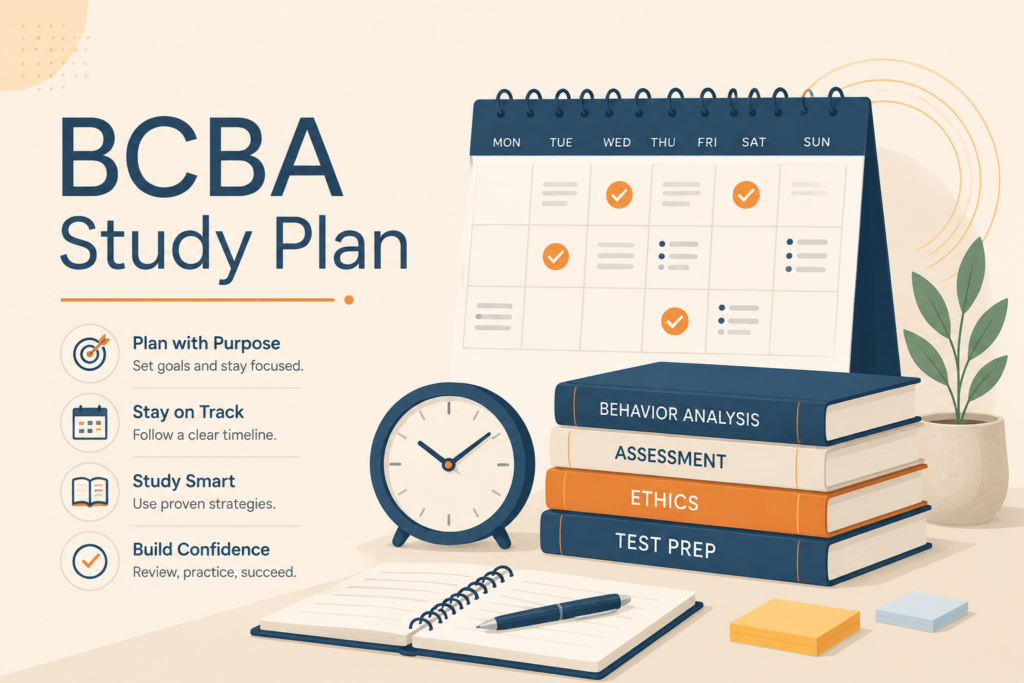
How long should you study for the BCBA exam? There is no official required number, but most candidates do well with about 8–12 weeks of consistent study — roughly 100–150 focused hours. Your exact timeline depends on your baseline knowledge, how recent your coursework is, and how many hours you can put in each week.
Short answer: plan for 8–12 weeks (about 100–150 hours): content review → targeted practice on weak domains → full-length timed mocks. Start by taking a mock to find your baseline.
Table of contents
What determines your study timeline
Two people can need very different amounts of time. The biggest factors:
- Your baseline. Take a free mock exam first — your starting score tells you how much ground you need to cover.
- Coursework recency. If you finished your sequence recently, content review goes faster.
- Weekly hours. Working full-time? Stretch the calendar rather than cramming.
- Weak domains. Heavy gaps in areas like experimental design or ethics add time.
A sample BCBA study plan
Pick the pace that matches your life — the total work is similar; only the calendar changes.
| Timeline | Weekly study | Best for |
|---|---|---|
| 8 weeks (intensive) | ~15–20 hrs/wk | Recent grads, full-time studiers |
| 12 weeks (steady) | ~10 hrs/wk | Working professionals |
| 16+ weeks (gradual) | ~6–8 hrs/wk | Rusty on coursework, limited time |
Whatever the length, the structure is the same: review content by domain, then drill your weak areas, and finish with full-length timed mock exams so test-day stamina and pacing are not a surprise.
How to know you are ready
- You consistently score comfortably above passing on full-length, timed mocks (the real exam needs a scaled 400 of 500).
- No domain is still a weak spot.
- You can hold focus and pacing across all 185 questions in 4 hours.
This matters because the BCBA first-time pass rate is just 51% and retake takers pass at only ~23% — so it pays to be genuinely ready before you schedule.
Week-by-week: a detailed 12-week plan
Here is how the three phases break down into concrete weeks. Compress this for an 8-week sprint or stretch it across 16 weeks — the sequence stays the same.
- Weeks 1–2 — Map the territory. Take a full-length mock to find your baseline, then skim the entire 6th-edition task list so you understand the scope. Build your schedule around your weakest domains rather than studying everything equally.
- Weeks 3–4 — Foundations & core principles. Work through behaviorism, measurement, reinforcement, punishment, motivating operations, and stimulus control. Re-write each concept in your own plain-language definition; if you cannot explain it simply, you do not know it yet.
- Weeks 5–6 — Assessment & experimental design. These are among the most frequently missed areas. Practice reading graphs and telling the single-subject designs apart, because the exam loves to test them with scenarios.
- Weeks 7–8 — Behavior-change procedures & ethics. Drill DRA/DRO/DRI, prompting and fading, chaining, and the ethics code with scenario questions rather than flashcards alone.
- Weeks 9–10 — Targeted practice. Hammer your weakest domains with question banks and review every miss against its explanation. Your error log is your highest-value study tool.
- Weeks 11–12 — Full-length timed mocks. Simulate test day exactly: 185 questions, 4 hours, no interruptions. Review thoroughly, then taper and rest the day before.
Study methods that actually work
How you study matters more than how many hours you log. The approaches with the strongest evidence:
- Practice questions over re-reading. Retrieval practice — actively answering questions — builds exam-ready recall far better than passively rereading notes or highlighting.
- Active recall & spaced repetition. Quiz yourself, space your reviews across days, and revisit weak items more often. SAFMEDS-style fluency drills are excellent for terminology.
- Apply, do not memorize. The exam tests application to novel scenarios, so practice classifying fresh examples instead of reciting definitions.
- Full-length mocks. They build the stamina and pacing you cannot get from short quizzes, and they surface weak domains you would otherwise miss.
Common time-wasters to avoid
- Re-reading the textbook cover to cover. High effort, low return — target your weak areas instead.
- Studying only what you already know. It feels productive and changes nothing.
- Skipping timed practice. Pacing problems sink otherwise-ready candidates on test day.
- Marathon cram sessions. Spaced, consistent study beats last-minute bingeing every time.
Studying while working full-time
Most candidates prepare while working, and it is entirely doable with structure. Protect your plan by time-blocking — schedule study like unmissable appointments, for example 1–2 hours on weekday mornings plus one longer weekend block. If your hours are tight, stretch the calendar to 12–16 weeks rather than cutting total study time, and front-load content review so the final weeks can be pure practice. Consistency beats intensity: four focused hours across the week outperform a single exhausted Saturday.
What to do in the final week
- Take one last full-length, timed mock early in the week and review every miss.
- Do light review of high-yield terms and your personal weak spots — no brand-new material.
- Confirm logistics (ID, test center or online proctoring setup) and prioritize sleep, especially the night before.
If you have to retake the exam
If a first attempt does not go your way, resist the urge to rush back in — retake candidates pass at only about 23%. Use your score report to pinpoint weak domains, give yourself a focused 4–6 week reset built around practice questions and full-length mocks, and only reschedule once you are consistently clearing the bar with room to spare.
The best BCBA study resources
The right materials make your study hours count. A well-rounded toolkit usually includes:
- Full-length mock exams. The closest thing to the real test — use them to find weak domains and build pacing. Start with a free BCBA mock exam.
- A question bank. Hundreds of scenario-style questions for daily retrieval practice, ideally with an explanation for every answer.
- A core reference. Cooper, Heron & Heward’s Applied Behavior Analysis remains the standard text for deep dives.
- Flashcards / SAFMEDS. Fluency drills for terminology and the ethics code.
- A study group. Explaining concepts to peers is one of the fastest ways to expose your own gaps.
How to use mock exams effectively
Mocks only help if you mine them. After each one, build an error log: for every miss, write the concept, why the correct answer is right, and why your choice was wrong — then re-test those items a few days later. Take at least two or three full-length, timed mocks before exam day so the format, pacing, and four-hour stamina are familiar rather than a surprise.
Find your starting point
The fastest way to plan your timeline is to take a free, full-length BCBA mock exam and see your baseline and weak domains today.
Frequently Asked Questions
How long should I study for the BCBA exam?
Most candidates do well with about 8–12 weeks of consistent study — roughly 100–150 focused hours — but the right timeline depends on your baseline knowledge, how recent your coursework is, and how many hours you can study each week.
How many hours does it take to prepare for the BCBA exam?
A common target is 100–150 focused study hours, spread across content review, targeted practice on weak domains, and full-length timed mock exams.
How do I know when I am ready to sit the BCBA exam?
A good signal is consistently scoring comfortably above passing on full-length, timed mock exams, with no remaining weak domains. Because retake candidates pass at only ~23%, it is worth waiting until you clear that bar reliably.
Can I pass the BCBA exam in a month?
It is possible for candidates with a strong, recent foundation studying intensively, but for most people a rushed timeline raises the risk of a costly retake. Use a mock exam to gauge whether one month is realistic for you.
References
- Behavior Analyst Certification Board — BACB.com (exam format: 185 questions, 4 hours, 6th-edition task list).
Complete BCBA Exam Prep
Turn this topic into exam-day practice
Practice concepts in context with five full-length 6th Edition mock exams, two bonus practice exams, a 6th Edition study guide, and key-term flashcards—all in one $120 USD package.
Get the $120 All-in-One Prep Pack
Review everything included on the product page before ordering. No pass guarantee is implied.



